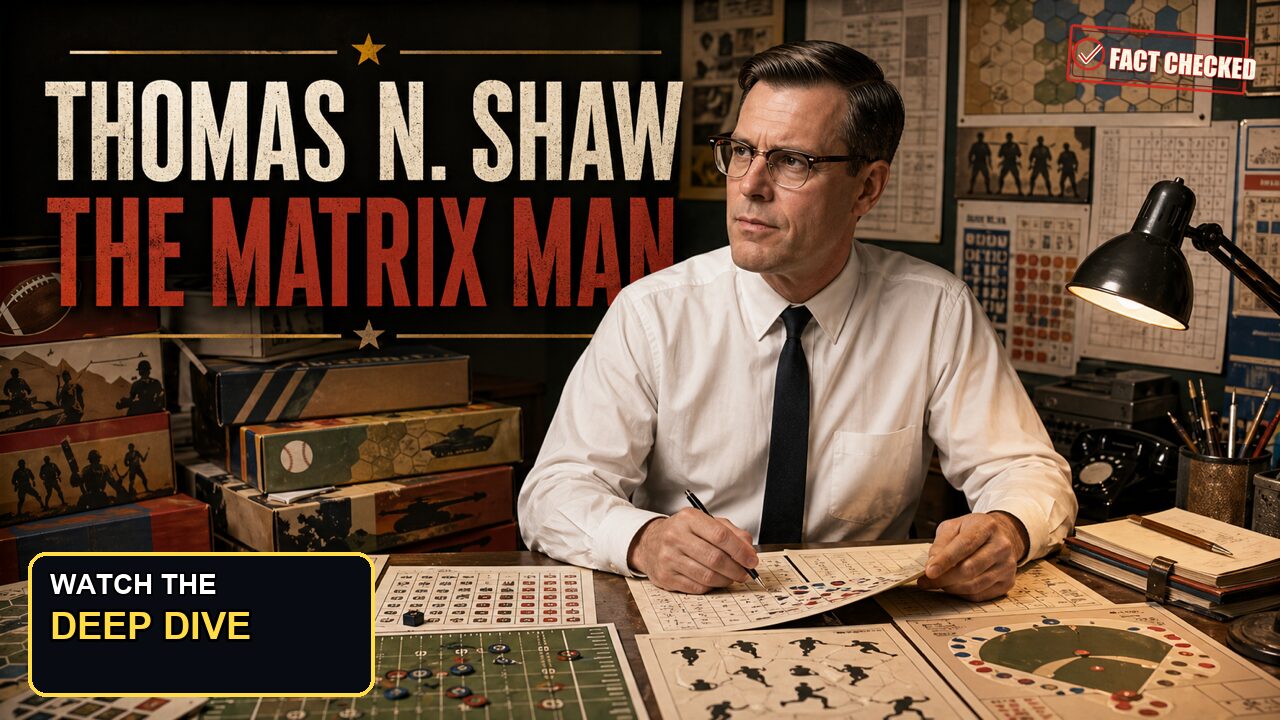
He began with football and baseball.
That matters because Avalon Hill is usually remembered through hex grids, campaign maps, odds tables, and cardboard armies pushing across Europe. But one of the company’s most important early executives came into its orbit with sports games built around a simple idea: the best strategy games are not about knowing the answer.
They are about knowing what the other player thinks the answer is.
Football Strategy and Baseball Strategy were built on that double-think. Call a play. Guess the defense. Choose a pitch. Read the batter. The players are not rolling through a fixed narrative. They are staring at each other across a table, making educated guesses inside a rules system.
That was Shaw’s gift.
He understood that simulation did not have to mean drowning the player in detail. A game could be simple enough to play in an evening and still make the player feel like a coach, manager, editor, developer, and tactician all at once.
Then he took that instinct into Avalon Hill.
The Sports Line That Came In A Tube
Before Shaw became an Avalon Hill executive, he had already tried publishing games himself.
In a later interview about Baseball Strategy, Shaw said Baseball Strategy and Football Strategy first appeared in 1958 through his own Strategy Game Company. They were sold in mailing tubes before Avalon Hill acquired the rights, boxed them, and folded them into its line.
That detail changes the story.
Shaw was not merely an employee assigned to a sports title. He was a designer-publisher whose games gave Avalon Hill an instant sports-strategy branch at a time when the company was still figuring out how broad its catalog could be.
Football Strategy asked players to think like coaches. Offense and defense secretly chose plays, then the result came from the interaction between those calls. Baseball Strategy used the same broad philosophy in another sport: the batter and pitcher each make a choice, then the matrix tells the story.
That matrix was the engine.
It made luck matter less than expectation. The game was not just “run or pass” or “swing or take.” It was the question behind the question: what does my opponent think I am going to do, and what should I do because of that?
Shaw later described wanting to capture the mental duel between pitcher and batter, catcher and hitter, coach and coach. That is a clean design instinct. Strip the sport down to the decision that feels most strategic, then build the game around that.
For all the later talk of sports simulation, Shaw’s games were not primarily about statistical completeness.
They were about confrontation.
The Avalon Hill Machine
Avalon Hill was founded by Charles S. Roberts in 1958 and became the company most associated with American hobby wargaming. Tactics II, Gettysburg, D-Day, Chancellorsville, Afrika Korps, Stalingrad, Waterloo, Bismarck, and the rest of the early line helped define what a serious boxed strategy game could look like in the United States.
Shaw entered that company at a crucial moment.
Avalon Hill had the vision, but it also had the problems every young publisher eventually meets: production, cash, audience, retail channels, editorial standards, and the endless difficulty of turning clever systems into products that people can actually buy, learn, and replay.
Shaw became part of the answer.
He served as a vice president of The Avalon Hill Game Company through much of its classic era. He was also closely tied to The General, Avalon Hill’s in-house magazine, serving as its founder and editor in 1964 and continuing as editor until Donald Greenwood took over in the 1970s.
The magazine matters almost as much as the boxes.
The General gave Avalon Hill players scenarios, strategy articles, variants, rules clarifications, designer notes, letters, tournament culture, and a sense that buying a game meant entering a continuing conversation. It was not just marketing. It was community infrastructure before the internet had any say in the matter.
That was field-building work.
The Editorial Hand
Shaw’s design record is tricky because Avalon Hill credits from that era are messy.
Some games list him directly. Some involved graphic help, development help, revisions, or executive approval. Some credits in hobby memory overstate his design role. Shaw himself later corrected parts of that record. He said he was not involved in the design of several games sometimes tied to him, though he did provide graphic input or small contributions on some.
That honesty helps.
It lets us see the real contribution without inflating it.
Shaw designed Baseball Strategy and Football Strategy before they were Avalon Hill products. He redesigned Charles Roberts’ Management into Air Empire. He developed additional cases for Verdict II. He expanded Roberts’ Afrika Korps design. He created Word Power as a board game version of the Reader’s Digest feature. He developed a simplified version of James Dunnigan’s Outdoor Survival. He designed The Stock Market Game. And he created Kriegspiel under deadline pressure for Toy Fair.
That is a strange catalog.
Sports. Business. law. wordplay. air routes. desert war. survival. abstract military chess.
It does not look like the work of one signature mechanic. It looks like the work of a company man in the best old sense: someone who could take a concept, a market need, a half-finished system, or a deadline and turn it into a playable product.
That kind of designer rarely becomes famous.
The catalog needs him anyway.
The General And The Long Game
One of Shaw’s most important decisions was not a game design.
It was hiring Donald Greenwood.
Shaw later called Greenwood’s hiring his greatest decision as an Avalon Hill executive. That is a remarkable thing to say, and it shows a kind of stewardship that the hobby often undervalues. The best publisher-developers do not only make things themselves. They find the people who can keep the line alive after them.
Greenwood would become one of Avalon Hill’s defining editorial figures. The General grew into a central organ of the hobby. The company’s player culture deepened. Rules conversations became more formal. Strategy discussion became part of the product’s life.
Shaw helped build the bridge to that.
This is where the attribution gets hard. If we only count named designs, Shaw sits modestly. If we count infrastructure, editorial continuity, sports-game expansion, magazine creation, rights acquisition, product development, and executive judgment, his shadow gets much larger.
But shadows are not signatures.
That is the limitation.
The Quiet Foundation
Shaw belongs to a generation where hobby game history was not cleanly divided into designer, developer, editor, graphic artist, marketer, executive, and publisher.
The same person might touch the rules, the box, the magazine, the ad copy, the production schedule, the rights deal, and the replacement parts problem. The industry was too small for everyone to stay in one lane.
That makes Shaw hard to measure and easy to underestimate.
He did not create the first commercial wargame. Roberts is the name on that door. He did not become Avalon Hill’s most famous developer. Greenwood’s name dominates that next phase. He did not design one landmark system that the entire industry copied. His own best-known games stayed in the sports-strategy lane and appealed to players who liked the head-to-head decision more than the statistical encyclopedia.
But Shaw helped Avalon Hill become Avalon Hill.
He brought in sports strategy. He made The General happen. He worked across design, development, editing, graphics, and executive leadership. He helped turn Avalon Hill from a few brilliant boxes into a company with a continuing culture.
That is not a small thing.
The modern hobby needed designers.
It also needed people who could make the business of serious games repeatable.
What He Actually Built
Thomas N. Shaw built educated guessing into game form.
Football Strategy and Baseball Strategy took sports and reduced them to the mental duel at the center: coach against coach, pitcher against hitter, expectation against counter-expectation. They were not perfect statistical recreations. They were clean contests of anticipation.
Then Shaw helped build the place where games like that could live.
Avalon Hill’s achievement was not just that it published wargames. It published a way of being a serious hobby gamer: buy the box, learn the system, argue the rules, read the magazine, try the variant, replay the scenario, write in, improve, come back.
Shaw was one of the people who made that loop work.
His name is not as bright as Roberts, Greenwood, Dunnigan, or Sackson. It should not be. The work is different. Shaw’s contribution is quieter, broader, and more institutional.
He was the designer who brought a sports line in a tube.
He was the editor who helped give Avalon Hill players a magazine.
He was the executive who knew when to hire the person who could carry the next era.
That is a foundation-builder.
Where To Find Him
Thomas N. Shaw is part of Avalon Hill history now: in the credits of Football Strategy, Baseball Strategy, Air Empire, Kriegspiel, and other catalog entries; in the early years of The General; and in the memory of players who learned that a board game could be a serious contest of minds.
The most revealing Shaw game is still Baseball Strategy.
Two players. A few choices. A matrix. A result.
Not realism by accumulation.
Realism by pressure.
What do you think I will do?
What do I think you think I will do?
That question is older than Avalon Hill, older than sports, older than games in boxes.
Shaw put it on a chart and made it playable.
Fact Check Notes
Publication notes
This site is AI-assisted and human-reviewed. We use artificial intelligence to help gather research, organize source material, and draft profile content. Human editors then read, revise, and check each profile before it goes live. Most profiles are built through deep AI research and two separate rounds of fact-checking.
Leave a Reply
You must be logged in to post a comment.