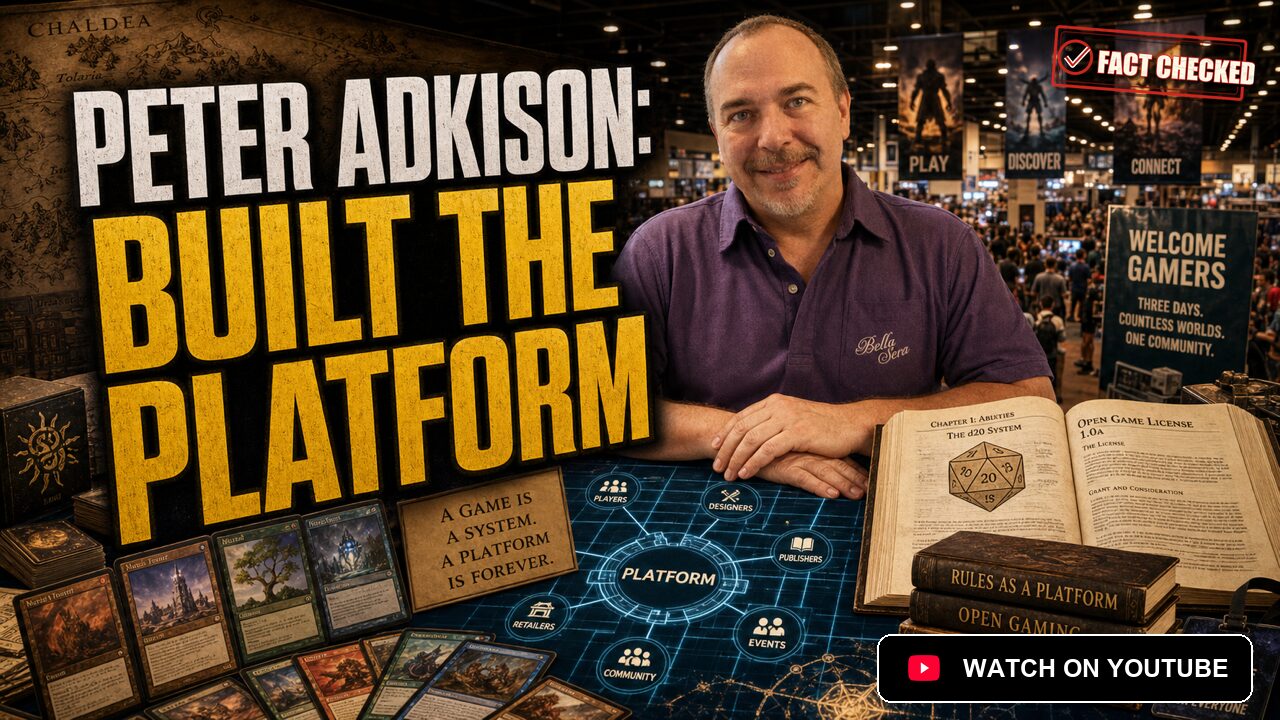
Richard Garfield designed the game. That distinction matters. But Adkison saw what Garfield had brought him, recognized that it was not just a clever card game, and built the company structure that let it become a new category of play.
That is the Peter Adkison pattern.
He is not best understood as a rules designer. He is a platform builder. He founded Wizards of the Coast, launched the company that turned collectible card games into a global business, bought TSR when Dungeons & Dragons was in danger of collapsing under its own publisher, backed the platform logic that made D&D Third Edition and the Open Gaming License possible, then bought Gen Con and turned it into a stable independent institution.
Some people invent mechanics. Adkison built the rooms where mechanics could become industries.
The Systems Analyst
Adkison came to gaming with the mind of an engineer and the appetite of a lifelong player.
He grew up in rural Idaho in a Seventh-day Adventist household, where games carried more social weight than they might have in a louder, more media-saturated home. Board games, card games, and indoor play mattered. They were entertainment, but they were also structure. People gathered around rules, learned how systems behaved, and made their own little worlds inside them.
Then Dungeons & Dragons hit him.
Adkison has described discovering D&D in the late 1970s as a life-changing experience. The game gave him not just a pastime but a creative grammar. In 1981, he began the Chaldea campaign, a fantasy world that would keep following him long after he became one of the most important executives in tabletop history.
The other half of his formation was technical. He earned a computer science degree from Walla Walla College and later an MBA from the University of Washington. At Boeing, he worked as a systems analyst on launch vehicle modeling. That work was not glamorous in the way game fans imagine a startup founder’s life. It was formal, structured, full of variables, dependencies, trade-offs, and complex systems that had to hold together.
Then he looked at his own life and felt like a small piece inside a huge machine.
Wizards of the Coast began as the attempt to build his own machine.
The Basement Company
Adkison founded Wizards of the Coast in 1990 with friends from his gaming circle. The name came out of their campaigns. The first vision was not a card-game empire. It was a small roleplaying publisher run by people who loved roleplaying games.
The early Wizards product that best shows the ambition was The Primal Order, a system-neutral supplement about gods, mythology, and divine power. It was designed to work across multiple RPGs, a "capsystem" that could sit above other rules sets.
That idea was bold. It was also dangerous.
Compatibility claims in the early 1990s were not protected by the open-gaming assumptions that would come later. A legal dispute with Palladium Books put pressure on the young company and helped teach Adkison a lesson he would never forget: good ideas are not enough. A publisher has to survive law, distribution, cash flow, manufacturing, and the limits of its own scale.
Wizards needed something that could break out of the tiny RPG-margin trap.
Richard Garfield first brought Adkison RoboRally, a clever board game with too many components for a small publisher to manufacture cheaply. Adkison asked for something more portable, quicker to play, and practical for convention downtime.
Garfield came back with the game that became Magic.
The Portable Revolution
Magic: The Gathering was not merely successful. It changed the business model of hobby gaming.
Before Magic, a tabletop publisher usually sold a book or a boxed game. A roleplaying group might buy one core book and share it around the table. A board game sale was often a one-time event. Magic worked differently. It sold decks, boosters, discovery, trade, collection, tournaments, metagame knowledge, and the feeling that the game was always moving.
Adkison saw the category shape early. Magic was portable. It was social. It fit between convention events. It gave players reasons to buy more without needing the publisher to produce an entire new boxed game every time. It was a game, but it was also a platform for organized play, collecting habits, magazines, strategy discussion, and retail traffic.
The 1993 Gen Con launch became one of tabletop’s great turning moments. Wizards printed what it thought was enough product to last for months. The market devoured it. Within a few years, Wizards had gone from basement RPG publisher to the company everyone else in hobby gaming had to react to.
Adkison’s hard choice came soon after.
He loved roleplaying games, but Wizards could not keep behaving like a tiny RPG house once Magic had turned it into a much larger company. The scale had changed. A product that might have been meaningful to a small publisher became operationally inefficient inside a fast-growing business built around a massive card-game engine.
So Wizards pulled away from many of its RPG ambitions.
That decision frustrated people who wanted Wizards to use Magic money to publish every beloved niche line. It also kept the company focused enough to survive explosive growth. Adkison could be sentimental about games at the table. As CEO, he learned to be less sentimental about product lines.
The D&D Rescue
By the mid-1990s, TSR was in serious trouble.
That sentence still sounds strange because TSR owned Dungeons & Dragons, the game that created the roleplaying category. But ownership of the original brand did not protect the company from debt, distribution problems, overextended product lines, and management decisions that had left the business fragile.
Adkison understood what was at stake. D&D was not merely a valuable acquisition target. It was the game that had shaped his life. Wizards bought TSR in 1997 and, in doing so, rescued Dungeons & Dragons from a publisher that could no longer reliably carry it.
The rescue was not just financial. Wizards had to repair relationships and clean up legacy issues around the game’s creators. Adkison pushed for Gary Gygax and Dave Arneson to be credited together as co-creators on D&D products, a simple act that corrected years of public imbalance. Wizards also had to rebuild trust with authors, fans, distributors, and players who had watched TSR stumble.
Then came Dungeons & Dragons Third Edition.
Adkison did not design Third Edition. Jonathan Tweet, Monte Cook, Skip Williams, and the larger D&D team did the mechanical work. Ryan Dancey was central to the Open Gaming License strategy. Lawyers shaped the license language.
Adkison’s role was executive permission and platform instinct.
The Open Gaming License treated D&D less like a sealed product and more like an operating system for the hobby. If other publishers built for d20, they would reinforce the standard. If the broader market used the same core grammar, D&D’s core books became more valuable, not less.
That was the platform move. It did not just sell books. It changed the way publishers thought about compatibility, third-party support, and shared mechanical language. The d20 boom had plenty of messy, forgettable products. It also trained a generation of publishers to think of RPG rules as infrastructure.
The Hasbro Line
Hasbro bought Wizards of the Coast in 1999. The sale was enormous by tabletop standards, and Adkison stayed long enough to oversee the launch of D&D Third Edition.
But the fit was not permanent.
Adkison believed digital gaming would become central to roleplaying’s future. He wanted Wizards involved in computer RPGs and online worlds in a serious way. Hasbro’s corporate priorities moved differently. When the D&D digital-rights direction diverged from what Adkison wanted, he left Wizards in 2001.
That could have been the end of his industry story.
Instead, he bought the convention where Magic had exploded.
GEN CON
Adkison purchased Gen Con from Hasbro in 2002 and moved it from Milwaukee to Indianapolis in 2003.
This was another platform decision, but this time the platform was physical. Gen Con needed room, hotels, infrastructure, walkability, and a city that could absorb the convention’s growth. Indianapolis gave it those things.
The move was not just a change of address. It professionalized the convention as an institution. Gen Con became easier to attend, easier to scale, and easier for publishers to plan around. It grew into the central public gathering of the North American tabletop industry: part trade show, part fan convention, part family reunion, part annual measurement of where the hobby’s energy was moving.
Adkison also had to defend it.
In 2008, Gen Con LLC filed for Chapter 11 bankruptcy protection during a dispute connected to Star Wars Celebration IV and Lucasfilm. The convention survived. It emerged from bankruptcy in 2009, and its later growth made the crisis look like a chapter rather than an ending.
That matters because conventions are fragile in a different way than games. They depend on hotel blocks, venue contracts, exhibitor trust, volunteer systems, city relationships, badge sales, insurance, transportation, and a thousand human logistics that players never see when they walk onto the show floor.
Adkison kept that machine running.
What He Actually Built
Peter Adkison did not invent the trading card game as a solo designer. He did not personally write D&D Third Edition. He did not create the OGL by himself. He did not design every part of the companies and conventions associated with his name.
What he built was scale.
He built Wizards of the Coast into the company that launched Magic, bought TSR, revived D&D, and made the d20/OGL era possible. He built the conditions under which Richard Garfield’s design could become a global category. He built the business case for D&D as a platform. He built Gen Con LLC into the steward of the hobby’s most important annual gathering.
His gift was recognizing when a game was more than a game.
Magic was not just cards. It was organized play, collectibility, retail gravity, and repeatable discovery. D&D was not just a rulebook. It was a shared language that could support an ecosystem. Gen Con was not just an event. It was the physical commons of the tabletop industry.
That is why Adkison belongs in the history of game design even when he was not the designer holding the pencil. He changed the structures that determined what designs could reach the public, how large they could become, and whether they could keep living after their first release.
Where To Find Him
Adkison has continued to follow the personal creative thread that began with Chaldea in 1981. World of Chaldea has become a mixed-media fantasy project through Hostile Work Environment and Gen Con-related media, with Adkison serving as creator, producer, and director.
His role at Gen Con has also changed. In January 2025, Gen Con announced that Adkison had retired as chairperson after more than two decades of leadership. He retained co-ownership and continued as a member of the board, while Adrian Swartout became chairperson.
That is a fitting current shape for his career. He is no longer the person standing at the center of every machine he built. But the machines still run.
Magic still defines the trading card game business. Dungeons & Dragons still lives in the platform logic that Third Edition and the OGL made visible. Gen Con continues to gather the tabletop world in Indianapolis. Chaldea, the home campaign from 1981, is still expanding into new media.
Some founders build a company and leave behind a logo.
Peter Adkison left behind platforms people still stand on.
Fact Check Notes
Publication notes
This site is AI-assisted and human-reviewed. We use artificial intelligence to help gather research, organize source material, and draft profile content. Human editors then read, revise, and check each profile before it goes live. Most profiles are built through deep AI research and two separate rounds of fact-checking.
Leave a Reply
You must be logged in to post a comment.