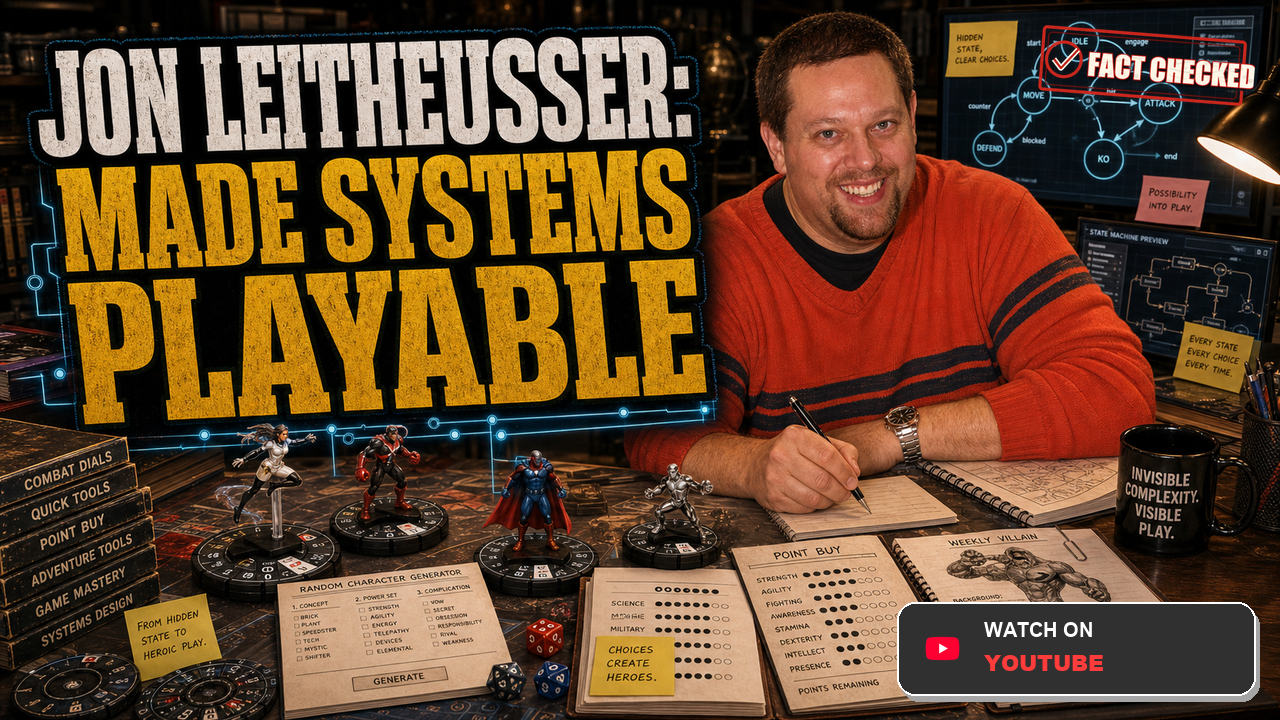
How do you make a complicated thing easy enough to use?
That question shows up in miniature form under a superhero figure, where a rotating combat dial hides math inside plastic. It shows up in Mutants & Masterminds, where a player can build almost any comic-book power without the whole table drowning in exception rules. It shows up in Emerald City, where a superhero setting was deliberately built with space for the players to matter. It even shows up later in Rive, where interactive animation tools turn state machines into something designers can see and ship.
The medium changes.
The habit stays.
Leitheusser is not the loudest name in tabletop history. He is not attached to one single invention that explains the whole career. His trace is more practical: he keeps finding systems that are too big, too loose, or too intimidating, then helping shape them into something a person can actually use.
That is design.
Not just adding rules.
Removing the friction between the player and the thing they came to do.
The Road Through The Hobby
Leitheusser came out of Wisconsin gaming culture.
Green Ronin’s author page identifies him as originally from Burlington, Wisconsin, and says he started gaming at age twelve. That matters because Burlington sits close to Lake Geneva, the symbolic birthplace of Dungeons & Dragons. But the more useful detail is not geography. It is the route he took into the industry.
He did not begin as a famous designer.
He worked in a game and comic store. He worked for distribution companies. He worked as a publisher. He freelanced. Then he moved into game design and development.
That path gives a person a strange education.
Retail teaches what players ask for when they are holding money. Distribution teaches what stores actually order. Publishing teaches what can be printed, sold, packed, shipped, and supported. Freelancing teaches deadlines and humility. Design teaches that none of the earlier lessons go away just because the idea is clever.
Leitheusser’s early publishing work shows that he understood the hobby as a culture, not only as a rules market. He was the original publisher of John Kovalic’s Dork Tower comic. He published Campaign Magazine during the d20 era. He also published a small game called SKETCH!.
Those credits are not the centerpiece of his design legacy, but they explain the shape of it.
He knew the table. He knew the store shelf. He knew the inside joke. He knew that a game product is not finished when the idea is finished.
It has to reach people.
The Dial
At WizKids, Leitheusser worked on HeroClix.
That one credit carries more mechanical importance than it may look like from the outside. HeroClix was a collectible miniatures game built around an unusually clean physical interface: the combat dial. Instead of asking players to track wounds, powers, and stat changes across a separate sheet, the miniature’s base did the memory work.
Take damage.
Click the dial.
The character changes.
That is elegant because it hides complexity without deleting it. A superhero can become weaker, angrier, faster, exposed, desperate, or newly dangerous as the dial turns. The player does not need a spreadsheet to see that change. The object on the table tells them.
Designers love to talk about depth, but depth is only useful if the player can reach it. HeroClix made a deep tactical idea feel like a toy you could understand in your hand.
That lesson follows Leitheusser through the rest of his career.
The best interface is not always digital. Sometimes it is a click.
Mutants And Masterminds
Leitheusser’s largest tabletop RPG footprint came at Green Ronin.
In his 2016 farewell post for the company, he wrote that he had worked on Mutants & Masterminds for a little over eight years, after earlier freelance writing and editing under Steve Kenson’s guidance. He worked on the tail end of M&M Second Edition, DC Adventures, and M&M Third Edition. He also named two things he was proudest of: the Quickstart Random Character Generator, created with Leon Chang, and Emerald City.
Those choices are revealing.
They are not about power inflation. They are not about making the system louder.
They are about access and room.
The Quickstart Random Character Generator took a game that was not built around random generation and gave new players a way in. Mutants & Masterminds can be intimidating because the core promise is so broad. Build any hero. That sounds freeing until a new player stares at the machinery and has no idea where to start.
Leitheusser and Chang solved that by giving players an archetype and a handful of d20 rolls.
Now the player had motion.
Emerald City solved a different problem. Superhero settings often arrive overstuffed with famous protectors. The city is already saved before the campaign begins. The players become guest stars in someone else’s comic.
Leitheusser described Emerald City differently: a city full of villains, looking for people to step up and become heroes. The Sentinels could be used as player characters, as a team, as villains, or removed entirely. The point was not to worship the setting’s canon.
The point was to make space for the table.
That idea also carried into Freedom City Third Edition, where the Freedom League moved out of the city-protector role and opened space for a new group of player heroes.
That is a strong design instinct.
The system should not impress itself.
It should make the players matter.
The Weekly Machine
Leitheusser also helped Green Ronin run a different kind of product engine.
In the same farewell post, he points to the DC Adventures line and a successful five-year run of weekly PDFs. That detail is easy to pass over. It should not be.
Weekly game content is hard.
It needs enough structure that each release feels complete, enough consistency that the audience trusts it, enough flexibility that the line does not become stale, and enough production discipline that the schedule does not collapse.
Mutants & Masterminds was well suited to that model because superhero RPGs thrive on modular pieces: villains, powers, gadgets, locations, archetypes, and story hooks. A Gamemaster does not always need another giant hardcover. Sometimes they need one sharp tool for Thursday night.
That is why the Threat Report, Power Profiles, Gadget Guides, Rogues Gallery, Atlas of Earth-Prime, and related lines matter. They turned the enormous promise of superhero gaming into smaller usable packets.
Again, the pattern holds.
Do not make the person at the table fight the whole machine.
Give them the part they can use right now.
Other Worlds
Leitheusser’s credits move beyond superheroes.
RPGGeek lists work across a wide spread of Green Ronin and adjacent projects, including Atlas of Earth-Prime, Emerald City, DC Adventures material, Dragon Age-related work, A Song of Ice and Fire material, and a contribution to Sword Coast Adventurer’s Guide for Dungeons & Dragons Fifth Edition.
The exact role changes from book to book.
That matters. Do not turn every credit into authorship. Development, editing, writing, contribution, line management, and product support are different jobs.
But the range is still useful because it shows transfer. Superheroes ask one kind of design question. Dark fantasy asks another. Licensed worlds add another constraint: the game has to feel like the property without becoming trapped by it.
Leitheusser’s useful skill was not that every genre became the same in his hands.
It was that he could look for the working interface between a world and a player.
What does the player need to do? What does the Gamemaster need to prepare? How much canon helps, and when does it get in the way? What can be randomized? What needs to be built by hand? Where does the book stop talking and let the table play?
Those are not flashy questions.
They are the questions that make a game usable.
The Digital Turn
After Green Ronin, Leitheusser’s public work moved further into digital interaction.
Rive’s blog carries his byline on posts about interactive design and game UI, including a 2023 announcement for Rive for Unity. That post describes a toolchain where designers and developers can ship interactive UI directly into Unity, with Rive’s State Machine supporting real interactions rather than only mockups or prototypes.
For someone who worked on HeroClix, that is almost too neat.
The combat dial was a physical state machine.
Rive uses digital state machines.
In both cases, the design problem is not merely what the system can do. It is whether the person using it can understand the state they are in, change it, and trust the result. A superhero dial, a character generator, a villain PDF, a city setting, and an interactive UI tool all live near the same question:
Can the user get from intention to action without getting lost?
That is the throughline.
What He Actually Built
Jon Leitheusser did not invent HeroClix alone. He did not create Mutants & Masterminds. Steve Kenson’s authorship and design foundation matter. Green Ronin’s team mattered. WizKids’ teams mattered. The writers, editors, artists, licensors, and publishers around those lines mattered.
What Leitheusser built was usability inside complexity.
He helped physical miniatures carry changing game state in a way players could read. He helped a superhero RPG line become more approachable, more modular, and more focused on the players at the table. He helped settings leave room for new heroes instead of burying them under canon. He helped turn giant comic-book possibility into weekly tools, quick generators, city books, villain drops, and source material a Gamemaster could actually run.
That is a real contribution.
The hobby often celebrates the designer who adds the biggest idea.
Leitheusser’s work argues for another kind of designer: the one who makes the big idea playable.
Where To Find Him
Leitheusser’s Green Ronin author page remains the cleanest public doorway into his tabletop record. His 2016 farewell post is still one of the best explanations of what he believed he had added to Mutants & Masterminds: quick access, player room, DC Adventures, Third Edition, Emerald City, Freedom City, and years of weekly PDFs.
His more recent public bylines appear at Rive, where the subject has shifted from tabletop mechanics to interactive digital design.
That shift does not feel like a departure.
It feels like the same problem in a new medium.
A state changes. A user responds. A system hides complexity until the person needs it. A designer tries to make the machine feel clear.
Leitheusser has spent much of his career there.
Between the rules and the person trying to use them.
Fact Check Notes
Publication notes
This site is AI-assisted and human-reviewed. We use artificial intelligence to help gather research, organize source material, and draft profile content. Human editors then read, revise, and check each profile before it goes live. Most profiles are built through deep AI research and two separate rounds of fact-checking.
Leave a Reply
You must be logged in to post a comment.