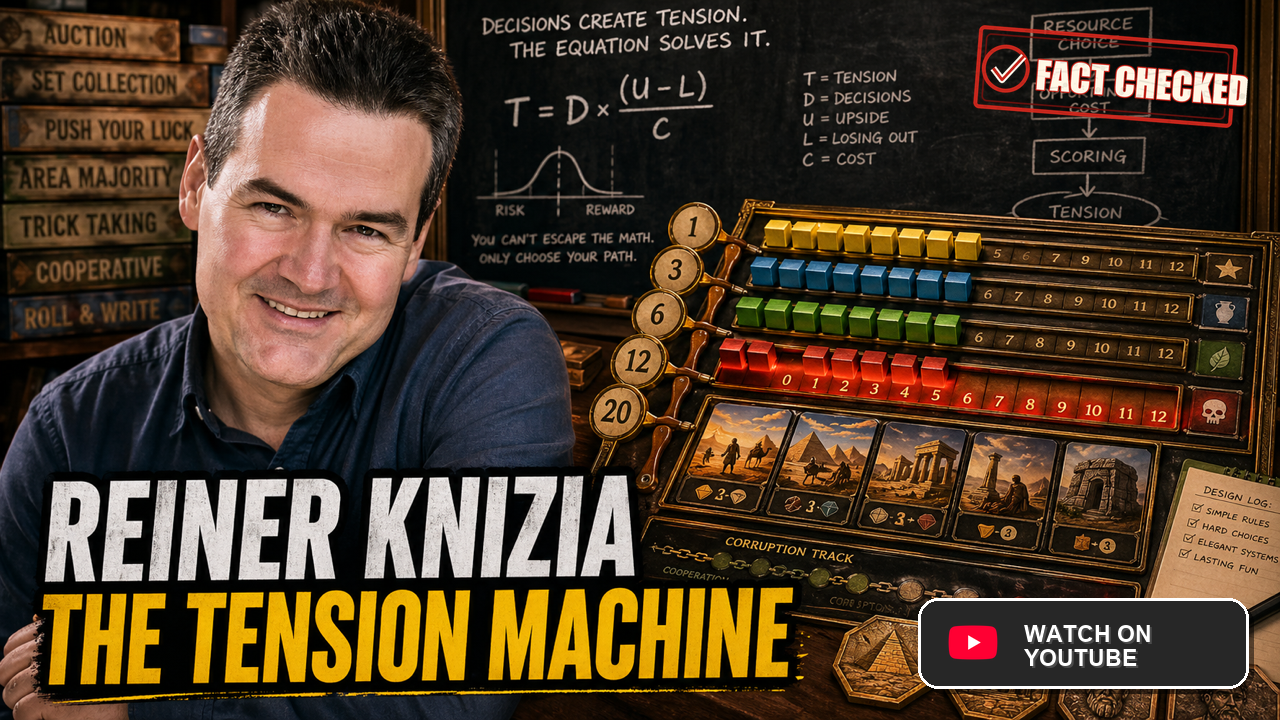
Reiner Knizia designs decisions you cannot escape.
That is the cleanest way to understand him. Not themes. Not worlds. Not campaigns. Not lore. Decisions. An auction where every bid might be too much. A card you cannot play yet because the expedition has not begun. A civilization where your final score is not your best color, but your weakest one. A cooperative journey where the whole table watches corruption creep closer and closer to failure.
The rules are usually small. The pressure is not.
That is the Knizia signature. He strips a game down until the decision has nowhere to hide, then leaves the player alone with it. The math is there, but it is not showing off. It is underneath the table, tightening the bolts. The result is one of the most prolific and recognizable design careers in tabletop history — and one of the most quietly merciless.
The Third Life
Knizia’s biography sounds like a setup for a designer of elegant pressure.
He earned a doctorate in Mathematics from the University of Ulm in 1986, then built a career in finance and banking, eventually managing a two-billion-dollar mortgage services company in the United Kingdom. He spent years in professional environments where risk, timing, incentives, and constrained choices were not abstractions. They were Tuesday.
The games were there from childhood, but they became his third life. First academia. Then business. Then games. By the late 1990s, Knizia left corporate work and became a full-time designer. What followed was not a normal career arc. It was a flood.
His official biography now describes more than eight hundred published games, more than two thousand editions, and publication in many languages around the world. The number is almost too large to process. Most designers hope to make one enduring game. A few make five. A handful make a shelf. Knizia made a library, and the remarkable part is not only the quantity. It is the consistency of voice.
You can pick up a Knizia game without knowing it is his and often feel the hand behind it. Few rules. Sharp scoring. Repeated pressure. The sense that the game is less interested in simulating a world than in creating the exact moment where a player has to choose what kind of mistake to make. A man who spent years calculating mortgage risk apparently never stopped asking the same question: what does this decision actually cost?
The Auction Box
Modern Art is one of the cleanest entrances into the Knizia mind.
The game is about buying and selling paintings, but the paintings are not really the point. The market is the point. More precisely, the point is that the players create the market and then suffer inside it. Different auction formats change the texture of the decision. Open bidding does not feel like sealed bidding. A fixed-price offer does not feel like once-around pressure. The object being sold is not valuable in isolation. It becomes valuable because the round, the artists, the timing, and the players make it so.
That is the machine.
Modern Art showed that an auction could be more than a moment inside a larger game. The auction could be the game. Medici, Ra, High Society, and other Knizia auction designs kept exploring the same family of pressure from different angles. Medici makes every bid hurt because money not spent is also victory. Ra turns a limited set of bidding tiles into a little closed economy of timing, temptation, and disaster. High Society contains one of the nastiest lessons in status gaming: score well, but do not end the game poorest.
Knizia returned to auctions because auctions are pure decision pressure. How much is this worth? How much do you think I think it is worth? How much of the game am I losing by winning this bid? That last question is very Knizia. Winning can be the wrong move. The game is always watching.
The Lowest Score
Tigris and Euphrates is often treated as his masterpiece, and the reason is a single rule.
The game looks like an ancient civilization game. It is really a conflict engine about balance, collapse, and the danger of overbuilding the wrong thing. Players collect points in multiple colors, but the final score is determined by the weakest color. That scoring rule changes everything. It punishes specialization. It makes abundance suspicious. It turns strength into a problem if another part of your position is starving. You cannot simply race ahead in the category you enjoy. The game asks what your civilization cannot do, and then makes that your score.
The elegance is brutal.
A longer rule could have done less. Knizia found a single scoring principle that reshapes every decision in the game. It creates tension without artificial catch-up rules. It makes players look at their own success with suspicion. It turns balance into survival. And somewhere underneath all of it is a quietly uncomfortable idea: that what defines you is not your strength, but what you left behind.
Ingenious later brought a related scoring idea to a broader audience, showing how the same pressure could live in a more abstract, accessible form. Different game. Same lesson. Your best part does not save you. Your weakest part defines you.
The Cooperative Door
Knizia did not invent cooperative board games.
That history reaches back well before him. Family Pastimes had been publishing cooperative games for decades. Sherlock Holmes Consulting Detective and Arkham Horror had already shown other branches of cooperation. What Knizia’s Lord of the Rings did was make cooperative play matter at a modern commercial scale.
The game gave players a shared journey, a corruption track, sacrifice, timing, and a sense that the table was trying to survive a story together. The pressure was not simply "beat the game." It was "how much can we spend of ourselves before the darkness catches up?" That is a different emotional contract than winning. It is closer to endurance.
That structure mattered downstream. Matt Leacock has directly credited Knizia’s Lord of the Rings as a major inspiration for Pandemic. That influence line is one of the clearest in modern board game history: a commercially visible cooperative design helps inspire the game that later helps define the modern cooperative boom. Knizia did not plan to reshape how a generation of designers thought about cooperation. He made a good game and left the door open. Leacock walked through it.
Knizia’s Lord of the Rings was not the first cooperative game. It was one of the games that reopened the door. That difference matters, and it is enough.
The Small Card Knife
Lost Cities shows how little Knizia needs.
Five colored expeditions. Cards played in ascending order. A twenty-point cost to begin. Investment cards that multiply gains and losses. A choice every turn: play a card or discard one. That is almost the whole game. It should not be enough. It is enough.
The tension comes from commitment. Starting an expedition is not progress by itself. It is debt. Every card after that is a promise that the expedition might become worth the risk. Investment cards make the promise larger and the failure uglier. The discard pile becomes a knife too. What you throw away may help the other player. What you keep may clog your hand. What you start may become the reason you lose.
Lost Cities is small, portable, and readable. It is also mean in the quiet way Knizia games often are. No dramatic attack is necessary. The structure is already hostile. The game does not need to threaten you. It waits for you to threaten yourself.
The Quest for El Dorado, decades later, shows the same mind adapting to deck-building. It is not deck-building as bloated engine. It is deck-building as race. The cards are not only your economy. They are how your expedition moves through terrain, stalls, cuts through jungle, and reaches the goal. Knizia can enter a later mechanism and still make it sound like Knizia. That is voice.
The Theme Question
The common criticism is that Knizia themes can feel pasted on.
Sometimes that criticism is fair at the surface level. He is not usually trying to build a fictional world the way a role-playing designer or narrative campaign designer might. The setting often arrives after the mechanism. The game may change themes between editions and still survive because the engine was always the real object.
But the criticism can miss the point.
Ra is not memorable because it teaches you about ancient Egypt in a detailed historical way. It is memorable because time runs out, lots appear, and the sun tiles force players into a rhythm of temptation and restraint. Tigris and Euphrates is not a simulation of Mesopotamia. It is a machine for balance, conflict, and collapse. Modern Art is not about art appreciation. It is about market belief becoming market reality.
The theme is often the emotional label on the pressure. That does not excuse every thin theme in the catalog. With hundreds of games, some are lighter, slighter, or more replaceable than others. No honest article should pretend every Knizia design is a masterpiece. But the great ones are great because the mechanism creates an emotion the theme can name. The pressure needed a word. The theme provided it. That is a cleaner division of labor than it looks.
The Grandmaster Problem
Mastery is where Knizia becomes almost unfair to compare.
A designer can be brilliant with one game. Knizia has been brilliant often enough that the failures, curiosities, licensed jobs, small children’s games, app adaptations, and minor releases become part of the larger picture rather than evidence against it. The career is not one lucky hit. It is an industrial-scale demonstration of craft.
Modern Art. Tigris and Euphrates. Ra. Lost Cities. Samurai. Through the Desert. Schotten Totten. Battle Line. Lord of the Rings. Ingenious. Keltis. The Quest for El Dorado. My City. That list could keep going.
The forms change: auctions, tile-laying, two-player card games, cooperative play, abstract strategy, route racing, legacy structure, children’s games, dice games, deck-building, push-your-luck. The voice remains. Constraint. Balance. Tension. Scoring that makes players care about the wrong thing at exactly the wrong time. That is why designers study him. Not because every game is perfect. Because the method is visible, and the method works.
There is something almost unsettling about a career this consistent. Most designers hit their ceiling and orbit it. Knizia keeps landing. The mathematician never stopped running the calculation.
What He Actually Built
Reiner Knizia built the strongest body of elegant mechanism design in modern tabletop history.
He did not invent the role-playing game. He did not invent the trading card game. He did not build an endlessly expandable platform like Dungeons and Dragons or Magic. His games are usually complete objects, not ecosystems. That is the limit. It is also the point.
Knizia’s best games feel finished in the way a proof feels finished. The question has been reduced to its cleanest form. The player sees the problem, makes the decision, and immediately understands that every available answer is compromised. He helped make auctions a design center. He gave board games one of their sharpest balance-scoring tools. He helped reopen commercial cooperative design. He made small card games feel enormous. He proved that mathematical elegance could be warm, cruel, funny, commercial, abstract, and endlessly replayable.
The machine did not need more parts. It needed better tension. Knizia spent forty years proving that tighter is almost always stronger.
Where To Find Him
Start with Modern Art if you want the auction mind. Play Ra if you want timing and temptation. Play Lost Cities if you want two-player pressure in its cleanest small form. Play Tigris and Euphrates if you want the grand statement. Play Ingenious if you want the scoring idea made accessible. Play The Quest for El Dorado if you want a late-career reminder that he can still take a familiar mechanism and make it his.
The lasting image is not a board or a pawn.
It is a decision.
You know what you want. You know what it will cost. You know the game is asking a question with no comfortable answer. Reiner Knizia built that moment hundreds of times. He built it in auctions and card games and tile games and cooperative journeys and races through the jungle and ancient civilizations where your weakest color decides everything.
The equation keeps solving for tension.
It always will.
Fact Check Notes
Publication notes
This site is AI-assisted and human-reviewed. We use artificial intelligence to help gather research, organize source material, and draft profile content. Human editors then read, revise, and check each profile before it goes live. Most profiles are built through deep AI research and two separate rounds of fact-checking.
Leave a Reply
You must be logged in to post a comment.