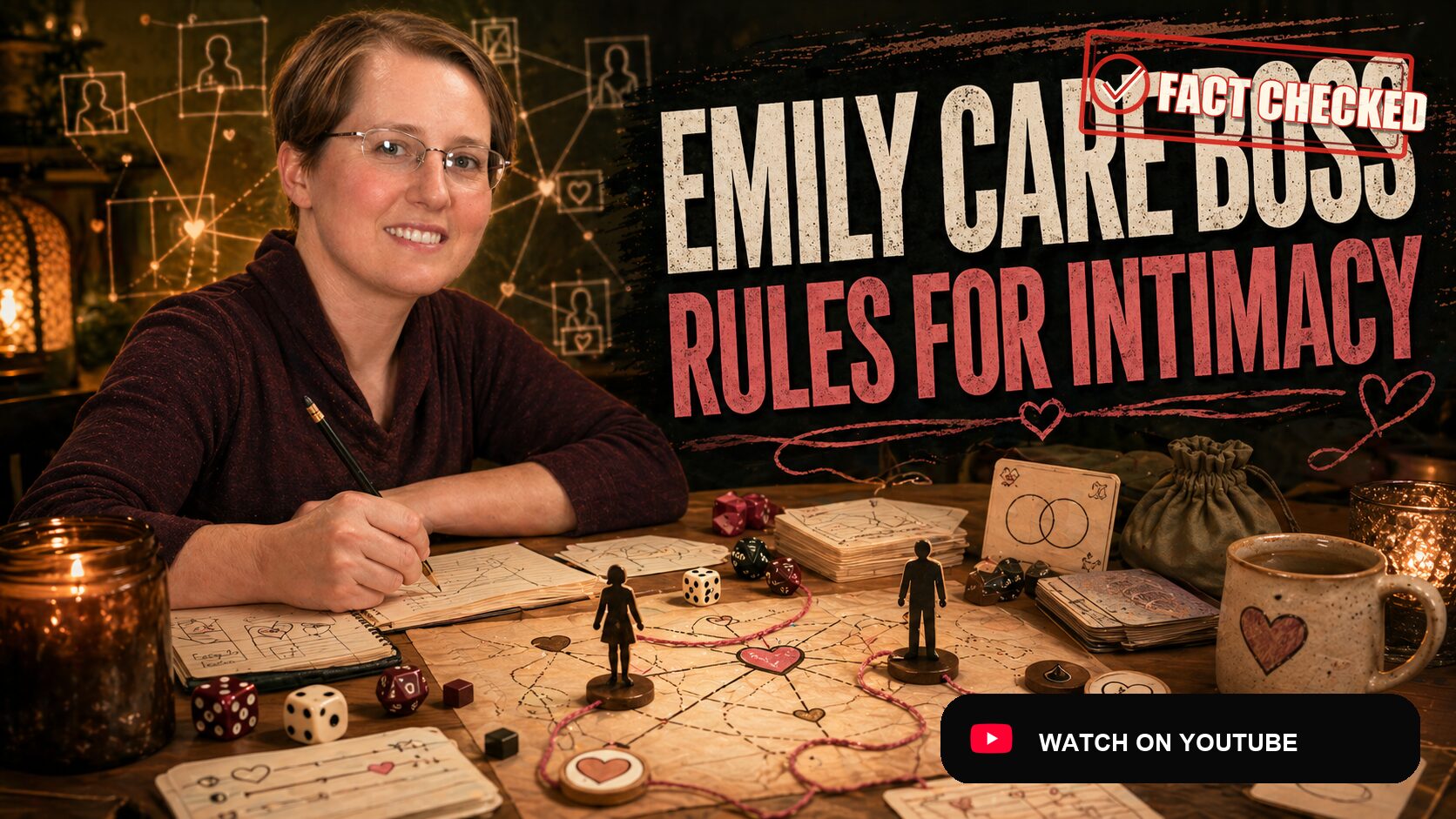
Games could model combat in detail. They could tell you how armor worked, how swords landed, how spell lists expanded, how monsters attacked, how characters advanced, and how many feet someone could move in six seconds.
But falling in love?
Building trust?
Feeling something bleed from the character into the player and back again?
Most games left that to the table.
Boss made it the design instead.
The Forge And The Gap
Boss came out of the early-2000s American indie RPG movement, especially The Forge, the online community where designers argued hard about what role-playing games were actually doing. That scene produced a lot of vocabulary, a lot of fights, and a lot of small games that treated rules as tools for shaping human attention.
Boss brought a different pressure into that space.
She was not trying to make a better combat engine. She was asking why emotional connection, attraction, and relationship pressure were so often treated as side effects. If a game could build mechanics around swordplay, why not around a first date? If a game could track wounds, why not vulnerability? If a campaign could care about treasure, why not longing?
That question became a body of work.
It also became a design argument.
Romance was not flavor.
It was structure.
Breaking The Ice
Breaking the Ice, published in 2005, is the clean starting point.
Two players. Three dates. No dungeon. No party of adventurers. No combat loop.
Just two people trying to find out whether their characters might fall for each other.
The game matters because it takes the awkwardness of a first date seriously. The uncertainty is not window dressing. It is the engine. Players create characters, discover points of attraction, risk connection, and build a relationship through play. The rules support conversation, attraction, vulnerability, and missteps.
That sounds small only if you think games need scale to matter.
Breaking the Ice argues the opposite.
Two people can be enough.
One relationship can be enough.
One conversation can carry a whole game if the rules know where to put pressure.
That was a real design move in 2005. The indie RPG scene had already opened doors for personal, focused games, but Boss made romance and intimacy the center of the machine. Not a subplot. Not something the group improvised between adventures. The machine.
The two-player scale also changes the social contract immediately. There is nowhere to hide in a crowd and no game master to absorb the awkwardness. The design has to create permission, pacing, and safety through procedure. That is part of why the game matters: it understands that intimacy needs structure, not just enthusiasm.
The Romance Trilogy
Breaking the Ice became part of a larger suite.
Shooting the Moon shifted the shape into pursuit and rivalry, with two suitors and a beloved. Under My Skin moved into freeform territory, using romantic entanglement, secrets, and emotional pressure at a larger table. Together, the Romance Trilogy explored relationship play at different scales.
That range matters.
Breaking the Ice is intimate and contained. Shooting the Moon adds competition and desire. Under My Skin spreads the emotional web across a group. The subject stays recognizable, but the form keeps changing.
Boss was not simply writing love stories.
She was testing how rules, roles, and procedures change the way players approach emotional risk.
The trilogy’s later recognition says something about the delay between innovation and understanding. The Romance Trilogy collection was nominated for the Diana Jones Award in 2017, long after Breaking the Ice first appeared. That gap is telling. Sometimes a design opens a door before the room on the other side is crowded enough for everyone to notice.
Boss opened that door early.
BLEED
Boss’s influence is not limited to her games.
At Ropecon in 2007, she helped bring the term "bleed" into wider design conversation. In role-playing and LARP, bleed describes emotional movement between player and character. Bleed-in is when the player’s real emotions shape the character. Bleed-out is when the character’s experiences follow the player after play.
The idea was not that Boss invented the experience.
The experience was already happening.
She named it.
Naming matters.
Once designers had the word, they could talk about it. Once they could talk about it, they could design for it, warn about it, invite it, limit it, process it, and study it. Bleed became a piece of shared vocabulary across Nordic LARP, American freeform, and intimate RPG design because it described something players recognized immediately.
That is one of Boss’s recurring contributions.
She finds the emotional thing people already feel, then gives design a way to hold it.
System Is Agreement
Boss also sits inside another important piece of RPG theory: the Lumpley Principle, associated with Vincent Baker and shaped in conversation with others in the Forge-era design community.
The principle is often summarized as the idea that system is the means by which a group agrees what happens in the shared imagined space. That sounds abstract, but it cuts straight to the core of role-playing.
The rulebook is not magic.
The dice are not magic.
The table decides what counts.
Rules, procedures, authority, trust, social contract, conversation, and consent all help the group agree on what is true in play. Boss’s relationship-focused work makes that principle feel concrete. A romance game cannot hide behind tactical procedure. It has to care about how players agree to emotional fiction and how they protect each other while doing it.
That is why her theory and her games fit together.
Both are about what happens between people.
Beyond Romance
Boss did not stay only inside the Romance Trilogy.
Bubblegumshoe, co-designed with Kenneth Hite and Lisa Steele for Evil Hat, adapted the Gumshoe investigative framework to teen mystery and noir. It won the 2017 Gold ENnie for Best Family Game. That credit matters because it shows Boss working inside an established engine with professional collaborators and a larger publisher.
That is a different skill from self-publishing intimate two-player games.
Playing With Intent, developed with Matthijs Holter and Alex Fradera, moved toward a toolkit for freeform, improv, and intentional play. Other work, including freeform and LARP projects, continued the same larger question: how do people create emotionally meaningful play together?
The genres shift.
The concern remains.
Relationships. Consent. Vulnerability. Agreement. The charged space between the player and the character, and between one player and another.
The Field Builder
Boss also built places for other people to play and design.
She founded JiffyCon in 2006, a regional indie RPG mini-convention in Massachusetts. That kind of infrastructure matters more than it looks from the outside. Small games need small rooms before they can find larger audiences. Designers need tables, players, feedback, peers, and a reason to finish the thing they are making.
She also worked with the Living Games Conference, including chairing the 2018 event. She co-wrote Fair Game with Meguey Baker, contributing essays and design discussion during a period when the indie RPG community was still shaping its vocabulary.
This is field work.
Not glamorous. Necessary.
The games are the visible part. The conventions, blogs, workshops, and conversations are the soil.
Boss tended the soil.
What She Actually Built
Emily Care Boss did not create the biggest RPG engine of her generation.
She did not build a mass-market brand. She did not publish a huge catalogue. Her games reached indie RPG and LARP circles more than the mainstream hobby.
What she built was a design space.
She made romance playable as structure. She helped give bleed a name. She helped connect American indie RPG thought with freeform and LARP practice. She built games where the central question was not "can you win the fight?" but "can you risk being changed by another person?"
That question matters.
Role-playing games have always been emotional machines. Boss made that visible. She treated intimacy as craft, not accident. She treated relationship mechanics as worthy of the same seriousness that other designers gave combat, magic, and survival.
That is why her work still matters.
Where To Find Her
Boss’s games are associated with Black & Green Games and indie RPG storefronts. Breaking the Ice remains the best starting point because it states the thesis so clearly: two players, three dates, and enough rules to make vulnerability playable. The full Romance Trilogy shows how the idea expands. Bubblegumshoe shows her professional collaborative work inside a published investigative engine.
Her larger influence lives in the vocabulary of modern play.
Bleed.
Consent.
Agreement.
Intentional emotional design.
Those words now sit closer to the center of RPG design than they did before her work. Not because she was the only person thinking about them, but because she was one of the people who made them playable, discussable, and legitimate.
The industry spent decades building rules for violence.
Emily Care Boss built rules for closeness.
Fact Check Notes
Publication notes
This site is AI-assisted and human-reviewed. We use artificial intelligence to help gather research, organize source material, and draft profile content. Human editors then read, revise, and check each profile before it goes live. Most profiles are built through deep AI research and two separate rounds of fact-checking.
Leave a Reply
You must be logged in to post a comment.