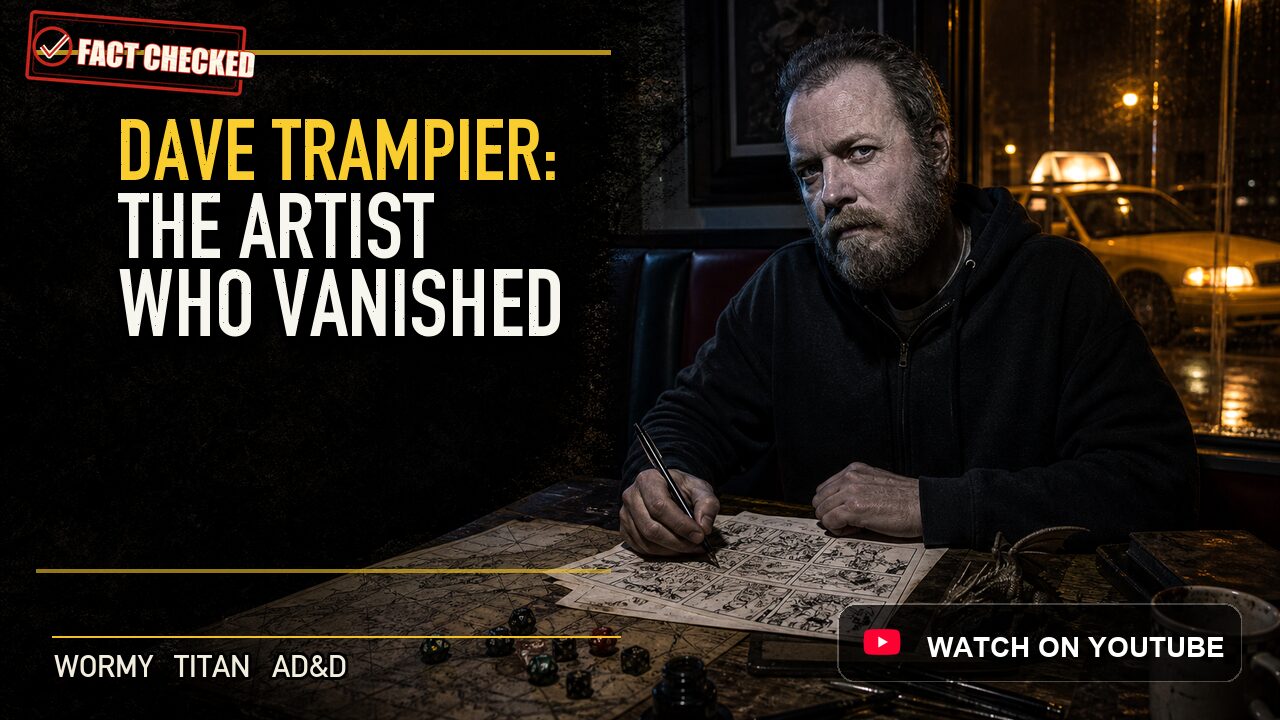
The Man Who Made Dungeons Look Dangerous
The first great Dungeons & Dragons image is not noble.
It is a party inside a dungeon, prying jewels out of the eyes of a giant idol while someone wipes blood from a sword.
That is David A. Trampier’s 1978 cover for the Advanced Dungeons & Dragons Player’s Handbook, and it still feels like a dare. This is what the game is: people go underground, take risks with bad light and worse information, and hope the dungeon lets them come back out.
Trampier didn’t polish fantasy. He gave it weight. Stone looked heavy. Fur looked greasy. A corridor looked like it had been waiting in the dark for centuries, patient as a trap.
For a generation of players, Trampier didn’t just illustrate D&D.
He taught them what it felt like to be there.
The Line That Made It Real
David A. Trampier was born on April 22, 1954. By the late 1970s, he was one of the defining artists at TSR, signing work as DAT or Tramp. The early books had rules, tables, and monster names. What they didn’t have yet was a shared inner picture.
Trampier provided one.
His style carried an older memory: woodcuts, engravings, monster books, the kind of illustration that looks like it came from a manual you weren’t supposed to open. Later fantasy art often became brighter and more heroic. Trampier’s art felt like evidence pulled out of a drawer.
That mattered because early AD&D wasn’t a power fantasy yet. It was an exploration game. Characters were fragile. Doors were suspicious. A bad choice could end the night. Trampier didn’t draw a stage. He drew a place that would hurt you if you treated it like one.
He made the dungeon feel stubborn. He made the world feel uninterested in your plans. That’s why so many players remember individual images decades later. The pictures weren’t ornaments. They were instruction manuals for imagination.
Monsters With Weight
Fantasy creatures can become silly fast. A creature that is only a gimmick collapses as soon as you see it clearly.
Trampier’s best TSR creature illustrations made the opposite move. They made the strange feel physical.
The monster doesn’t look posed. It looks interrupted. It isn’t trying to impress you. It’s busy being itself. A posed monster is decoration. An interrupted monster feels like proof.
This is one reason the old-school look never died. When later players wanted danger and texture again, they reached for the visual memory that already held it. Black ink. Heavy shadows. A dungeon that doesn’t care if you’re ready.
WORMY AND THE MONSTER’S SIDE OF THE TABLE
If Trampier’s AD&D art showed the dungeon from the outside, Wormy showed what it was like to live there.
Wormy began in Dragon Magazine in 1977 as a full-color comic about a cigar-smoking green dragon in a cap, surrounded by friends, rivals, debts, grudges, and low-level politics. It was funny, but it was also crowded with life. The jokes worked because the place worked.
The reversal was simple: the monsters were the people.
They had routines. They had appetites. They had relationships that lasted longer than an initiative roll. Adventurers weren’t the center of the world. They were the noise that kicked the door in.
That joke plants a question that doesn’t go away:
What were the monsters doing before the party arrived?
Then, in 1988, Wormy stopped. No clean ending. No farewell. Just silence where the story should have gone next.
People remember the disappearance, but they mourned Wormy because it felt alive. An unfinished strip is only a curiosity unless the world inside it had weight.
Titan, The Game Inside The Artist
Titan is the proof that Trampier wasn’t only building pictures.
First published in 1980 and credited to Jason B. McAllister and David A. Trampier, Titan is a big fantasy board game about hidden legions, recruitment, collisions, and sudden destruction. The main board is strategic movement and growth. The battle board is tactical truth. When you meet someone, you find out if your planning was real.
The design forces a specific kind of courage: the courage to reveal yourself. You can’t play forever in the dark. Eventually you have to commit to a fight, and the game doesn’t soften what happens next.
Titan has the same emotional shape as Trampier’s AD&D cover. The wrong room. The wrong fight. A consequence that doesn’t negotiate.
Cab No. 4
In 1988, Trampier stepped away from TSR and vanished from the public hobby scene. Wormy ended unfinished. The trail went cold.
For years, fans built a mythology around the blank space. They imagined reasons. They looked for clues. They wanted a return that would make the story feel complete.
On February 22, 2002, a student newspaper profile in The Daily Egyptian surfaced him again. Trampier was in Carbondale, Illinois, driving a cab. The piece reads like a portrait of a working man, not a fantasy legend. He knew the city by heart. He liked the quick conversations that happen in a car at night.
In the tabletop community, that image snapped into a nickname: Cab No. 4.
After that profile traveled through the hobby, people reached out. Publishers and collectors wanted the missing chapter. Fans wanted Wormy to end. Everyone wanted the silence to mean something they could hold.
Trampier didn’t give them that.
That can feel like theft if you believe the audience owns the ending. But there is another reading, quieter and harder: a person is allowed to leave. A person is allowed to keep the rest of his life to himself.
Trampier died on March 24, 2014, in Carbondale.
In 2024, the Academy of Adventure Gaming Arts and Design inducted him into its Hall of Fame. The recognition arrived late, but the influence had been doing its work the whole time.
What He Actually Built
David Trampier built the shadow vocabulary of early Dungeons & Dragons.
He taught the hobby a visual honesty it never fully lost. Fantasy could be funny and dirty and dangerous at the same time. A dungeon could look like a place that existed before you. A monster could feel like something you interrupted, not something that posed for you. A board game could punish you the way a dungeon punishes you, and still be worth playing.
He also built one of the hobby’s great silences. The unfinished Wormy pages. The refusal to return. The blank space where everyone wants a neat conclusion.
But the work is the real inheritance. The work is what stayed.
It stayed in the books. It stayed in the hands of players. It stayed in the old-school imagination. It stayed in every dungeon that feels dangerous before the first door is opened.
Where To Find His Work
David Trampier is gone, but his work is still easy to find if you know where to look.
Start with the 1978 Player’s Handbook cover. Find surviving issues of Dragon Magazine for Wormy. Track down Titan if you want to see the game designer beneath the illustrator.
Then notice how often modern old-school games still reach for the same visual grammar: ink, shadow, texture, and danger.
That is the line Trampier left behind.
Black ink. White paper. A torch in the dark.
Fact Check Notes
Publication notes
This site is AI-assisted and human-reviewed. We use artificial intelligence to help gather research, organize source material, and draft profile content. Human editors then read, revise, and check each profile before it goes live. Most profiles are built through deep AI research and two separate rounds of fact-checking.
Leave a Reply
You must be logged in to post a comment.