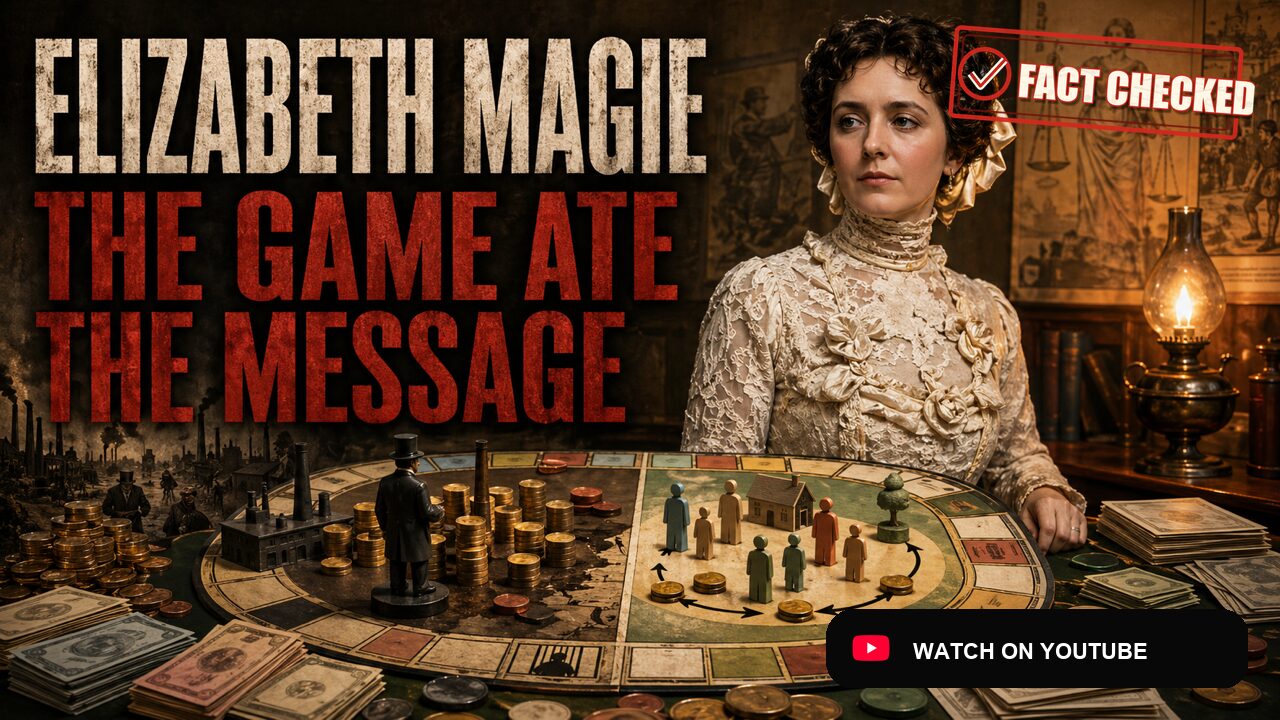
The world turned it into Monopoly.
That is the whole tragedy in one sentence.
In 1904, Magie received a United States patent for The Landlord’s Game. The board had an endless track around the edge. Players moved through properties, railroads, taxes, rent, mortgages, jail, and economic pressure. The game was not yet the polished Parker Brothers product that would later sit in millions of closets, but the bones were already there.
The loop.
The land.
The rent.
The squeeze.
Magie was not trying to make a celebration of winning through property ownership. She was trying to teach the opposite. The Landlord’s Game was built as a playable argument for Henry George’s single-tax economics, the idea that land value is created by the community and should return to the community rather than enrich private landlords.
She wanted players to feel the cruelty of rent extraction.
They did.
Then they decided it was fun.
The Georgist At The Table
Magie was born in 1866. Her father, James K. Magie, was a newspaper publisher and an abolitionist who exposed her to politics early. She grew into a writer, stenographer, actress, inventor, and activist at a time when very few women held patents and even fewer were credited as system designers.
Her economic imagination came from Henry George.
George’s Progress and Poverty argued that poverty persisted amid industrial progress because landowners captured value created by everyone else. A city becomes valuable because people build streets, schools, jobs, transport, trade, and culture. Then the owner of a parcel collects the rising value as if they personally created it.
Magie turned that argument into a board game.
That was the brilliant move.
Most political arguments ask people to agree. Games do something meaner and more useful. They make people behave inside a system until they discover what the system rewards.
The Landlord’s Game did not just say monopoly was unjust.
It made monopoly happen at the table.
The Two Lessons
The most important part of Magie’s design was not only the property loop.
It was the comparison.
She designed The Landlord’s Game to show that different rules produce different moral worlds. In one version, players competed under monopolist logic: buy property, collect rent, pressure opponents, accumulate advantage, and watch the weaker players collapse. In another, sometimes described through Prosperity-style rules, rent and land value could be handled for the common good, with the game ending when shared prosperity rose rather than when one player destroyed everyone else.
Same teaching object.
Different rules.
Different outcome.
That is one of the most radical ideas in board game design.
Magie understood something in 1904 that many later designers still struggle to say cleanly: a game’s rules are not neutral. They tell players what matters. They define success. They make some behaviors rational and others foolish. If the rules reward extraction, players extract. If the rules reward shared gain, players learn a different shape of play.
The board was not the message.
The contrast was.
The Mechanical Bones
Look at The Landlord’s Game as design and it becomes clear why it survived even after its politics were stripped away.
It had an endless path instead of a simple race to a finish line. That let the economy build over time. Players could circle the board again and again, with previous decisions changing the meaning of later movement.
It made spaces ownable. Landing on a square was no longer just an event. It could become a relationship between players: one owns, another pays.
It turned board position into economic pressure. A player did not merely move. They moved through someone else’s claims.
It made accumulation accelerate. The more property one player controlled, the more dangerous the board became for everyone else.
It used debt, taxes, jail, and rent not as decoration, but as system pressure.
Those are powerful design ideas.
Not because they are pleasant.
Because they make a board game generate a society.
That is Magie’s real invention. She did not merely put economic terms on squares. She created a machine where wealth, movement, ownership, and punishment interacted until the table started producing the lesson.
The Folk Game Takes Over
The Landlord’s Game spread through Georgist circles, progressive communities, universities, and homemade copies. It was taught, copied, modified, renamed, and passed hand to hand. By the time Charles Darrow encountered the game in the early 1930s, it had already lived a long folk life.
That folk life matters.
The game that became Monopoly was not a clean line from Magie’s patent to Parker Brothers. It passed through many hands. Players changed the names. Quaker communities in Atlantic City used local streets. Fixed prices replaced earlier pricing methods in some versions. Property groups, values, cards, and board layout evolved through use.
That is why the story is both simple and complicated.
The simple part: Charles Darrow did not invent Monopoly from nothing.
The complicated part: the game Parker Brothers sold was not only Magie’s 1904 design. It was Magie’s chassis after decades of folk mutation.
But without Magie, there is no chassis.
No endless economic loop.
No property-rent engine.
No anti-monopoly lesson for later players to misunderstand.
The Darrow Story
The official story for years was clean and marketable.
Charles Darrow, unemployed during the Depression, created Monopoly, sold it to Parker Brothers, and became a symbol of American ingenuity. It was a perfect story for the product. A man in hard times dreams up a game about wealth and wins.
The truth was messier.
Darrow learned a version of the game from others, copied it, produced his own sets, and eventually got Parker Brothers interested after local sales showed demand. Parker Brothers then bought rights connected to earlier versions, including Magie’s patent, to secure control of the property.
Magie received $500 and no royalties.
She reportedly accepted partly because Parker Brothers promised to publish The Landlord’s Game. They did publish versions of her work, but Monopoly became the commercial engine. Her message did not ride the wave. Darrow’s story did.
Magie died in 1948 without the public credit that should have followed her invention.
That credit had to be dug up later.
Ralph Anspach, creator of Anti-Monopoly, fought Parker Brothers in the 1970s and 1980s and helped expose the deeper history through litigation and research. Later historians and writers, including Mary Pilon in The Monopolists, made the story widely visible again.
The Invention And The Erasure
Magie’s story is often told as theft, and it is fair to feel the anger in it.
But for design history, theft is not enough.
The more important question is what was stolen.
It was not just a board layout. It was a working model of political economy. It was a design that let people compare rule systems and feel different outcomes. It was an early example of a game as procedural argument: the game did not merely describe an ideology, it made the ideology act.
Then the market kept the more addictive half.
The monopolist mode was sharper. Meaner. Easier to sell. It produced drama, grudges, table talk, revenge, and the pleasure of domination. The cooperative economic lesson was the point, but the competitive economic cruelty was the hook.
The hook won.
That may be the darkest design lesson of all.
A game can contain a moral argument and still be consumed for the opposite reason.
What She Actually Built
Elizabeth Magie built one of the most important mechanisms in board game history: a repeatable economic loop where property ownership changes the value of movement.
She also built something rarer.
A game that made rules visible as politics.
Most designers build a system and hope players enjoy it. Magie built two economic realities on the same foundation and asked players to compare them. She understood that a rule is not only a rule. It is a claim about the world.
Her body of work was not large. She was not a full-time game designer. Her surviving reputation rests overwhelmingly on The Landlord’s Game. That limits the craft case if we are measuring a career across many titles.
But invention is different.
One game was enough.
The Landlord’s Game became the buried ancestor of the most famous board game in the world. Its core structure has shaped property games, economic games, family games, parody games, classroom games, and every table where someone learns that the richest player can make the board feel smaller for everyone else.
Magie tried to show that monopoly was theft.
The world learned that monopoly was playable.
Where To Find Her
Elizabeth Magie died in 1948.
You can still find her in the 1904 patent for The Landlord’s Game. You can find her in the 1924 revision. You can find her in the legal history behind Anti-Monopoly, in Mary Pilon’s The Monopolists, and in every serious account of how Monopoly became Monopoly.
You can also find her in the question every good political game asks:
What do these rules reward?
That was Magie’s question before most of the industry knew how to ask it.
She built a game to expose the landlord.
Then the landlord bought the game.
The invention ate its own message.
Fact Check Notes
Publication notes
This site is AI-assisted and human-reviewed. We use artificial intelligence to help gather research, organize source material, and draft profile content. Human editors then read, revise, and check each profile before it goes live. Most profiles are built through deep AI research and two separate rounds of fact-checking.
Leave a Reply
You must be logged in to post a comment.