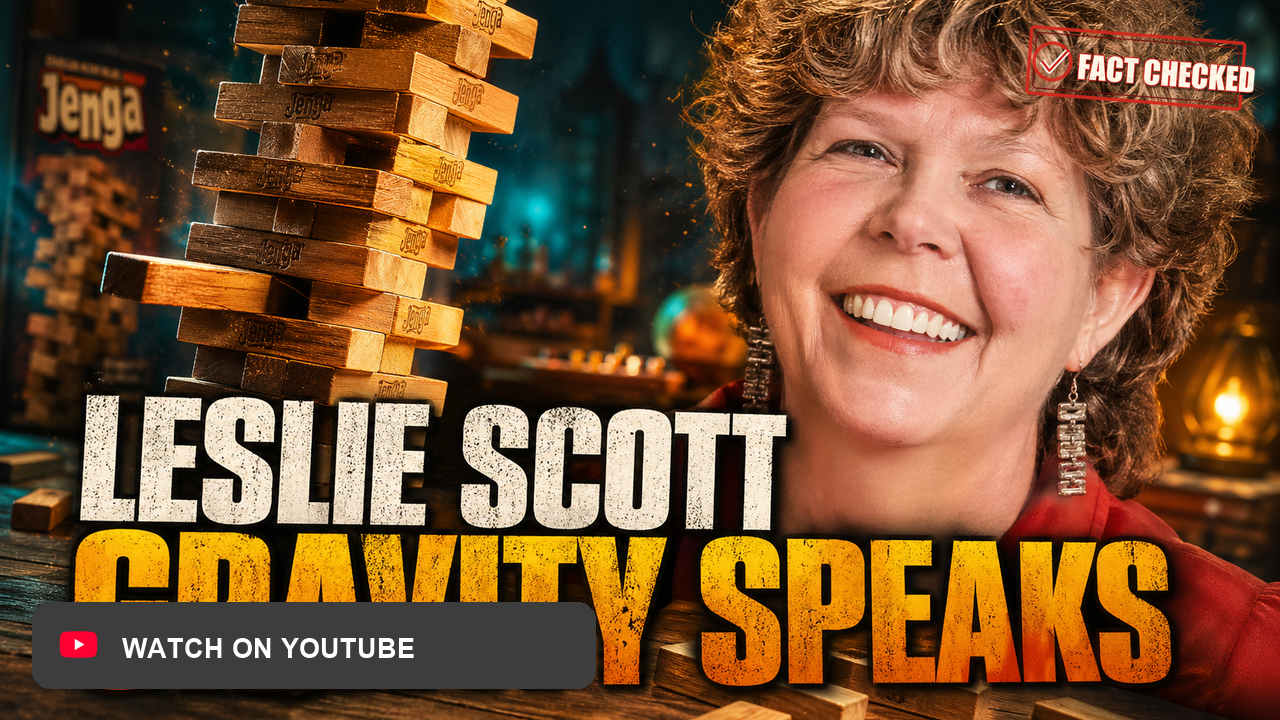
Jenga is one of the rare games whose rules can be understood before anyone says a word.
Fifty-four wooden blocks. Eighteen layers. Three blocks per layer, each layer turned across the one beneath it. Pull one block from below the top complete layer. Place it on top. Keep going until the tower falls.
That is almost the whole explanation.
The rest comes from the body. The pause before touching the tower. The careful fingertip push. The sudden grin when a loose block slides free. The room going quiet while the tower leans. The crack and clatter when gravity finally wins.
Leslie Scott did not build a game out of lore, cards, charts, or written exceptions. She built one out of wood, weight, touch, and nerve. Jenga works because the object teaches the player what the game is. The rules are not hidden in a manual. They are stacked on the table.
That is the design miracle.
The Family Game From Ghana
Jenga began as a family game, not a corporate invention.
Scott was born in what is now Tanzania and grew up in East and West Africa. In interviews, she has described a household where games mattered and making things was ordinary. Her father made toys. Her family played together. Her younger brother had wooden building blocks, off-cuts from a sawmill in Ghana, and the family began stacking them, removing them, laughing, trying again.
Some games arrive as a fully formed idea. This one arrived as behavior.
The family found a repeated pleasure in the same little danger: how much can you disturb the tower before it stops forgiving you? There was no need to invent a villain, a board, a counting track, or a deck. The opponent was the structure itself. The excitement came from the fact that every successful move made the next move worse.
Scott later brought a set of those blocks with her to Oxford. She worked at Intel UK, where she handled marketing communications and designed competitive games for company events. That mattered. Jenga was simple, but bringing it to market was not. A physical game has to survive factories, retailers, packaging, naming, demos, and buyers who may not understand why a pile of wooden blocks is supposed to be a product.
The childhood game had to become an object people could buy.
The Great Game With The Strange Name
Scott trademarked the name Jenga from kujenga, the Swahili word meaning to build. She has said that holding onto that name mattered, even when others doubted it. The name did not explain the product in English. It did something better. It gave the game a sound of its own.
In 1982, Scott worked out how to manufacture the blocks while keeping the handmade feel that made the game function. That detail is not cosmetic. Jenga needs imperfection. If every block were exactly identical, the tower would behave too cleanly. The game lives in the tiny variations: one block tighter than another, one surface smoother, one layer slightly more forgiving.
She packed the sets, 54 blocks each, and launched Jenga at the London Toy Fair in January 1983. It was not an instant triumph. Retail buyers were not lining up to bet on a one-person, one-product company selling a stack of wood in an era when electronic entertainment was beginning to pull attention away from traditional toys.
Then the game found the right hands.
Irwin Toy saw the potential in Canada. The name was questioned. Scott held her ground. The slogan that followed, "the great game with the strange name," turned the risk into a selling point. Through Irwin, Hasbro acquired worldwide rights in 1986, and Jenga moved from clever invention to household object.
Once people saw it played, the explanation problem disappeared.
The Game That Gets Harder By Surviving
Most games need a system to make pressure rise. Timers. Escalating costs. Stronger enemies. Shrinking options. Hidden information. Random events.
Jenga needs gravity.
Every successful move damages the position for everyone. The tower grows taller. Its center of mass changes. Empty spaces appear below. The structure becomes more dramatic because the players are succeeding, not because the rules introduce a new phase.
That is why Jenga feels so clean. The game does not ask players to remember that the danger has increased. They can see it. They can feel it under their fingers. A move that seemed easy five minutes ago now feels reckless because the object has changed.
The decision space is small, but it is real.
Which block moves? Which one is trapped? Is it better to push from one side or pull from the other? Can the tower absorb a wobble? Should the block go on top in a way that stabilizes the structure, or is that just a gift to the next player? Skilled players learn to read the tower like a body under stress.
The game also changes the room. People lean in. Spectators become invested. Nobody needs to understand a point economy to know what danger looks like. A leaning tower is public information.
That is why Jenga works across age, language, and setting. It is not that the game has no rules. It is that the rules are embodied so clearly that the object carries them.
The Business After The Tower
Jenga became the work that made Scott famous, but it was not the only thing she made.
In 1991, she co-founded Oxford Games Ltd with Sara Finch. Together they devised, manufactured, and marketed a collection of games, many of them built around language, literature, history, memory, and bluffing. Ex Libris asked players to write convincing first or last lines for real books. Anagram played with words. Bookworm dealt with reading and remembering. The Hieroglyphs Game connected play to the Ashmolean Museum.
Those games did not become Jenga. Almost nothing does.
But they show that Scott’s design instinct was not limited to dexterity. She kept returning to games that turn an object, a text, or a shared cultural artifact into social play. Jenga uses blocks. Ex Libris uses books. Anagram uses letters. The material changes, but the question stays close: what simple human action can become a table full of tension?
Oxford Games also matters because it kept Scott from being only the person who had one lucky hit. Jenga gave her freedom. The later games gave shape to the rest of the work.
What She Actually Built
Leslie Scott did not invent stacking. She did not invent dexterity play. She did not create a sprawling design school that thousands of designers follow in a formal way.
What she built was more exact than that.
She turned a family block activity into one of the clearest physical game objects ever published. She found the commercial form of it. She kept the name. She protected the tactile imperfection that made the game work. She trusted that people would understand a game whose whole drama could be held in two fingers.
Jenga is often described as simple. That is true, but it can make the achievement sound smaller than it is. Simple is easy to say after the fact. Before the fact, simple is terrifying. Simple gives the designer nowhere to hide.
If Jenga had one unnecessary rule, players would feel it. If the blocks were too uniform, the tower would lose personality. If the name had been made generic, the game might have felt like a novelty instead of a thing. If the tension did not rise naturally, the whole experience would collapse before the tower did.
Scott’s achievement was not adding more.
It was stopping at enough.
The Sound Everyone Knows
The cultural reach of Jenga is hard to measure because it has escaped the normal edges of a tabletop game.
It lives in family rooms and classrooms. It turns up in bars, offices, therapy exercises, retreats, weddings, youth groups, and giant backyard versions. People write questions on the blocks. Teachers adapt it. Facilitators use it as a metaphor for risk, trust, stress, collapse, and rebuilding. Some of those uses have almost nothing to do with Scott’s original rules, but they happen because the object is so readable.
A tower made of removable blocks is a metaphor waiting on a table.
That is not always under a designer’s control. Once a game becomes this visible, people start using it for their own purposes. Jenga has been copied, resized, branded, themed, digitized, and turned into a social shorthand. The core design still survives because the original action remains stronger than the variations.
Pull a block.
Place it on top.
Hope the tower forgives you.
Where To Find Her
Leslie Scott remains publicly active through Oxford Games and through her writing about play. Oxford Games still sells her book About Jenga: The Remarkable Business of Creating a Game that Became a Household Name, and in late 2025 she announced BOUNDLESS PLAY, a Substack project devoted to play in its many forms.
Jenga itself was inducted into the National Toy Hall of Fame in 2020. Recent coverage places its sales at more than 100 million sets worldwide. Scott has also said she designed and published dozens of other games, many through Oxford Games, even though Jenga remains the tower everyone can see from the road.
Some games need a lifetime of explanation.
Jenga needs a table.
The blocks fall. People laugh. The tower is built again.
That is the whole game.
That was enough.
Fact Check Notes
Publication notes
This site is AI-assisted and human-reviewed. We use artificial intelligence to help gather research, organize source material, and draft profile content. Human editors then read, revise, and check each profile before it goes live. Most profiles are built through deep AI research and two separate rounds of fact-checking.
Leave a Reply
You must be logged in to post a comment.