Tabletop games are physical first. They are weight, texture, and scale. A pawn that tips too easily changes a whole turn. A token that reads wrong from three feet away turns a clean plan into a misplay. A prototype is where the idea stops being a pitch and starts being a thing that can betray you.
Coffey’s design story begins with that pressure. Not a signature mechanic. Not a manifesto. The job of making an imagined world survive contact with plastic, cardboard, ink, shipping tolerances, and a player’s hands.
The Pawns
Coffey came into games through sculpture and illustration. He and Jesse Labbé met while attending art school in Dallas, drifted apart for years, and then reconnected through art. Their styles fit together in a way people noticed. In 2010, they collaborated on Berona’s War, a graphic-novel project published by Archaia Studios Press.
It was not game design, but it trained the same partnership muscle. Labbé worked from notebooks and characters. Coffey worked from form and movement. Both were artists first, which is why the studio that came later felt less like a publisher and more like a workshop.
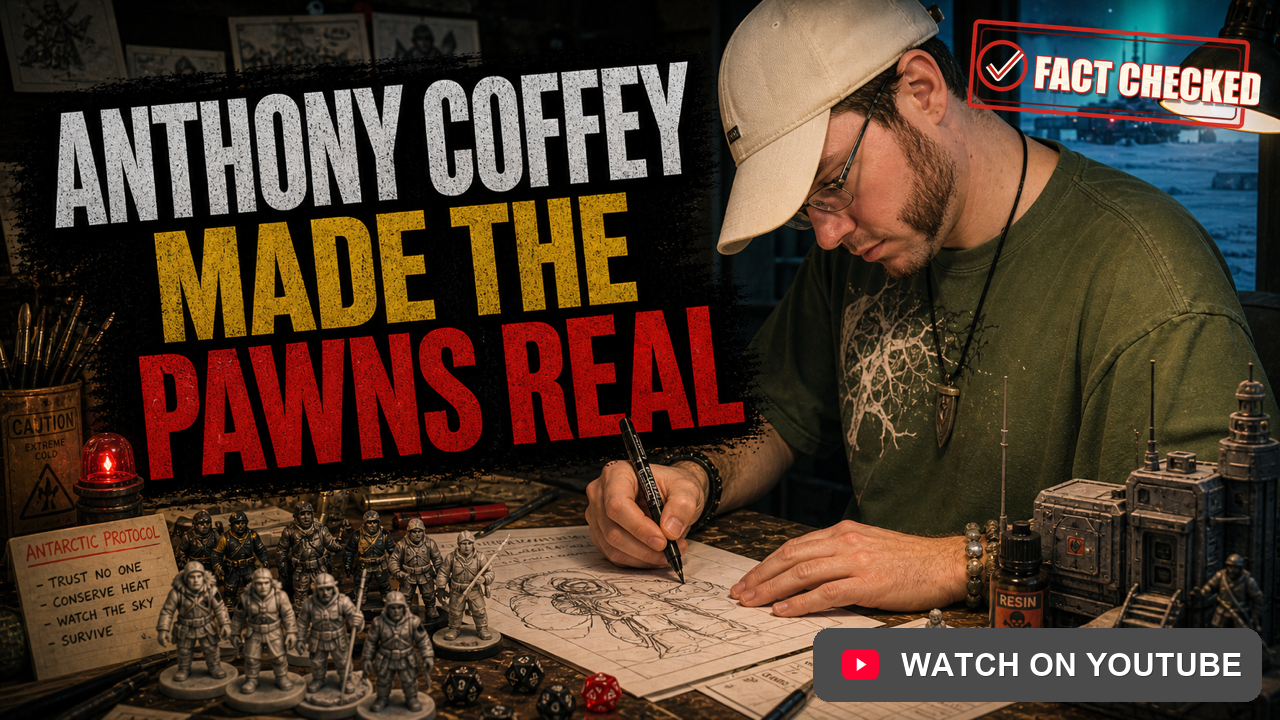
During the 2016 Kickstarter campaign for Endangered Orphans of Condyle Cove, Labbé asked Coffey to sculpt the game’s miniature pawns. Coffey was still in Dallas, working in animation and illustration, so the work happened at a distance. He was not credited as a designer on that game. He was there to make the pieces real.
That role sounds secondary until you picture the table. A game like that lives on tone. The pawns have to look like they belong to the same strange world as the cards and the jokes and the cruelty of the premise. If the figures come out wrong, the spell breaks.
It became a side door into Certifiable. Early in 2017, Coffey moved to the Jackson, Mississippi area and joined the studio full time. Public profiles describe him as an illustrator, designer, sculptor, and general jack of all trades. In a small tabletop studio, that is not a résumé flourish. It is the real operating system. Art, prototype, rules, factory notes, and marketing assets all land in the same few hands.
The Partnership
A 2020 Jackson Free Press profile (later reprinted by Mississippi Free Press) laid out the simple split that shaped the studio’s work. Labbé would bring the initial idea, recorded in a notebook and turned into concept paper. Then he and Coffey would worldbuild, develop mechanics, and make the thing bigger.
That distinction protects the story from mythology.
Coffey was not the lone originator of Certifiable’s games. He does not have a public catalog of solo designs. His tabletop design credits are tied to Certifiable and to collaboration with Labbé. But that same public record also makes clear why his role cannot be reduced to “artist.” He was involved in idea development, illustration, design, sculpting, prototype work, and the quiet problem solving that keeps a project from collapsing at the factory stage.
One line from Coffey’s own description captures the real appeal. When you help create the idea, draw the idea, and design the idea, you do not have to beg another department to tell you how big the miniatures should be. The person making the object is in the design conversation from the start.
That is Coffey’s lane. He is not the notebook. He is the hand that makes the notebook answer to the table.
The Antarctic Table
Who Goes There? was Coffey’s first formal co-designer credit, released by Certifiable Studios after a large Kickstarter campaign. It adapts John W. Campbell Jr.’s novella, the story that also fed the bloodstream of The Thing: an Antarctic outpost, an alien infection, and a group of people who cannot safely trust each other.
The tabletop problem is obvious. If the traitor is assigned at setup, the story becomes a puzzle. If infection can happen through play, the story becomes a pressure cooker.
Who Goes There? chose pressure. Everyone begins human. Players eat, sleep, build, trade, and try to prepare for escape while the system creates chances for infection to enter the group. Trust erodes slowly, not because someone reveals a role card, but because the mechanics keep asking people to gamble with one another while the temperature drops.
The physicality mattered. Certifiable’s games were built like props. Chunky pieces. Illustrated components. A table that looks crowded in the way a real crisis looks crowded. You are not only thinking about who might be infected. You are staring at a cold room full of objects that make the danger feel built.
Coffey’s contribution sits inside that total effect. He co-designed the game with Labbé. He helped give it its body.
The Second Edition
The first edition of Who Goes There? had a strong emotional engine and a rough structural one.
Players often praised its tension, theme, art, and production value, and then followed that praise with caveats. A long game with player elimination is a risky promise. Pacing can stretch. Rules overhead can show up as friction instead of depth. When the math feels heavier than the story, paranoia turns into exhaustion.
That does not erase what the game did well. It clarifies what kind of achievement it was. Who Goes There? was immersive before it was elegant. It could make the room feel cold even when it struggled to keep the machine clean.
The 2nd Edition in 2020 was an attempt to keep the mood and repair the structure. Player elimination gave way to frostbite. Base camp systems and host tests offered different ways to manage the threat. The revision matters because it shows a studio responding to table experience instead of treating the first box as sacred.
For Coffey, that revision is part of the record. He was there for the big thematic swing, and he was there for the repair work.
D6 And The Joke Of Play
Coffey’s other main design credit is D6: Dungeons, Dudes, Dames, Danger, Dice and Dragons!, built around a small joke with a lot of room inside it. The players are not simply adventurers. They are playing people who are playing an RPG.
The premise turns the usual fantasy frame sideways. The boat you need is already at the harbor. The hole has already been dug. The adventure exists because a table of imaginary players is pushing it forward. Certifiable’s own copy presents it as a game where you play the role of a player playing a role-playing game, a recursive wink that fits a studio built by illustrators, video makers, game night hosts, and prop-minded artists.
D6 did not change tabletop design. It did show the same Certifiable personality: bright art, physical abundance, humor, and an eagerness to make the box feel like a world instead of just a mechanism.
The Small Studio Machine
Certifiable Studios was not a normal board game publisher. It was a Mississippi art studio, a game company, a video production shop, a community space, and, for a while, a local gathering point. The 2020 profile described monthly First Friday game nights at the Ridgeland headquarters, with dozens of people gathering before the pandemic put those events on hold.
Coffey’s workspace in that profile included digital sculpting and 3D printing. He used the printer to refine prototypes based on overseas production samples before final factory work. That is not glamorous design work, but it is the work that decides whether a game feels right in the hand.
The studio’s published list in that profile included Endangered Orphans, Who Goes There?, Stuffed, D6, and Who Goes There? 2nd Edition. The shop still lists Who Goes There? 2nd Edition and D6 products for sale, but the broader public signal from Certifiable is quieter than it was during the main crowdfunding years.
Coffey’s own current trail points more clearly to Dimensional Pixel, his art and sculpture brand. It presents him as a 2D and 3D artist with a career spanning product design, animation, illustration, sculpting, and related creative work. It sells resin figures, pins, stickers, prints, and an Anthony Coffey art book. It looks like the same skill set that got him into tabletop, just pointed back toward the object itself.
What He Actually Built
Anthony Coffey did not build a famous game system by himself. He did not create the first idea behind Certifiable’s catalog. He does not have the kind of solo design bibliography that lets you trace a private mechanical philosophy from one game to the next.
What he built was more material than that.
He helped make Certifiable’s games into objects with presence. He sculpted pawns, shaped prototypes, illustrated characters, designed components, and co-developed the games where those objects lived. In Who Goes There?, he helped translate paranoia into something you can feel on a table. In D6, he helped turn a meta-RPG joke into a bright, physical product. In the 2nd Edition of Who Goes There?, he was part of the repair crew trying to make the first game’s strongest ideas play more cleanly.
That contribution lives in the borderland between design and fabrication. Tabletop history often treats those as separate jobs. Small studios do not always have that luxury. Sometimes the designer is also the sculptor, the illustrator, the prototype fixer, and the person looking at a factory sample and deciding whether it will hold up when someone slaps it down on a Saturday night.
Coffey’s story lives there.
Where To Find Him
As of this current check, Coffey’s clearest active public home is Dimensional Pixel, where he continues to present himself as a 2D and 3D artist and sells figures, prints, stickers, pins, and an art book. Certifiable Studios’ store remains online with Who Goes There? 2nd Edition and D6 products listed, though the studio’s public moment is quieter than it was around its 2018 to 2020 releases.
That ending fits the arc. Coffey entered games by sculpting the pawns. He became a co-designer inside a studio where art, product, and rules were tangled together. Then the visible trail bends back toward the hand: resin figures, physical objects, characters you can hold.
The record remembers the games. The pawns made them real.
Fact Check Notes
Publication notes
This site is AI-assisted and human-reviewed. We use artificial intelligence to help gather research, organize source material, and draft profile content. Human editors then read, revise, and check each profile before it goes live. Most profiles are built through deep AI research and two separate rounds of fact-checking.
Leave a Reply
You must be logged in to post a comment.