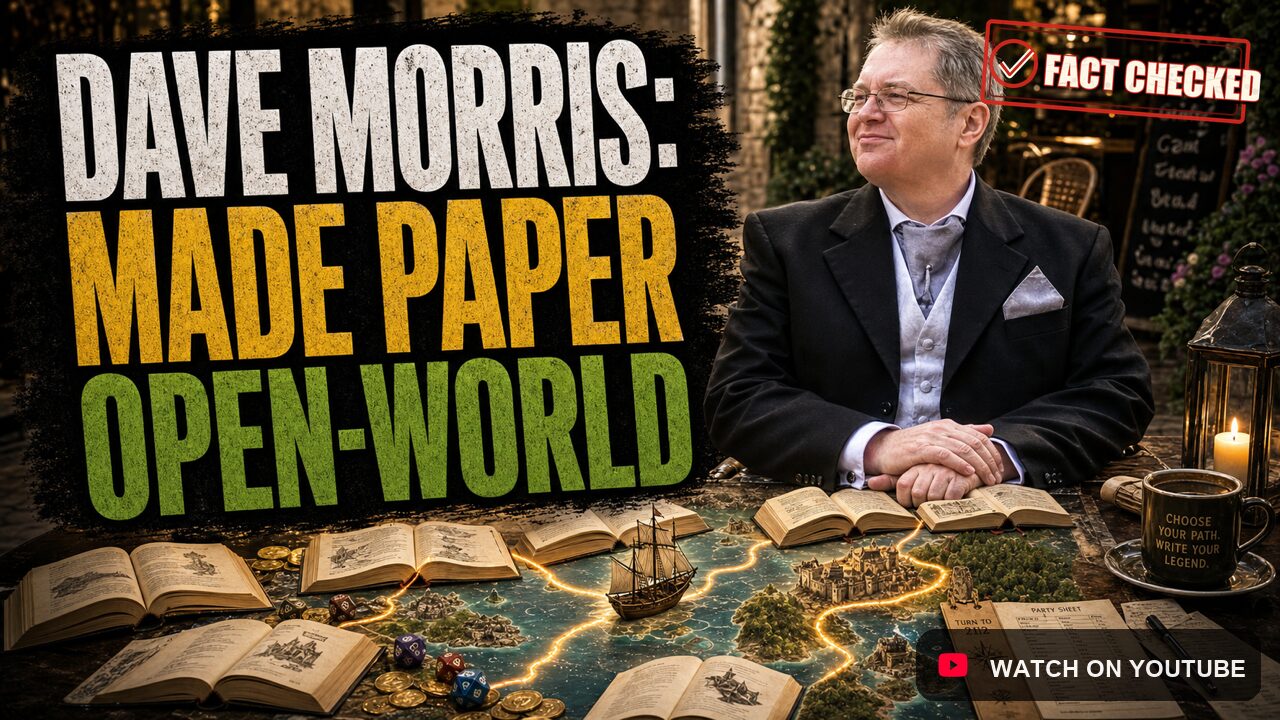
Dave Morris kept asking a simple, dangerous question:
What if the book did not have to be a corridor?
Most gamebooks gave the reader a branching path. Turn left or right. Fight or flee. Open the door or keep walking. The form was interactive, but it usually moved toward an ending like a funnel. You made choices, but the book still wanted to close around you.
Morris was interested in a different kind of paper machine.
Dragon Warriors turned the paperback shelf into a roleplaying doorway. Blood Sword asked gamebooks to handle a party. Fabled Lands opened the walls and let the reader wander between volumes with a persistent character, a ship, money, quests, scars, and unfinished business. Later work such as VulcanVerse kept returning to that same pressure point: how much world can a book hold before it starts behaving like a game engine?
That’s the through-line.
He made paper act bigger than paper.
For a certain kind of reader, that was not a novelty. It was relief.
If the world stayed open, you did not have to hunt for the one correct ending. You could wander. You could leave a problem unfinished and come back later. You could treat the book less like a riddle and more like a place.
The Physics Of Choice
Morris studied physics at Oxford, and it is tempting to make too much of that.
The degree does not explain everything. Plenty of physicists never design a gamebook, and plenty of game designers never need a lab. But the systems instinct in Morris’s best work is hard to miss.
His major projects are not just stories with choices. They are containers. They track state. They preserve consequence. They ask the reader to carry information forward and trust that the structure will remember what happened. A Morris design often feels less like a branching tree and more like a map with rules underneath it.
That’s the distinction that matters.
A branching book can surprise you once. A world can keep calling you back.
The Early Paper Engine
Morris’s Golden Dragon gamebooks came first in the public sequence, and they matter because they show him entering the form before he began pulling it apart.
Those books worked within the familiar adventure-gamebook current of the 1980s. Monsters, treasures, numbered sections, danger, choice, and consequence. They did not yet make the format open-world. They did something more basic. They gave Morris a working shop floor. He learned what the form could carry, where it resisted, and how far a paperback could be pushed before the reader lost the thread.
Then the experiments got bigger.
The Paperback Rpg
Before Fabled Lands, Morris and Oliver Johnson helped create one of British fantasy gaming’s strangest delivery systems: Dragon Warriors.
The idea sounds obvious only because later readers know how to sort it. In the mid-1980s, a full roleplaying game usually meant hobby shops, boxed sets, hardbacks, or specialist retail. Dragon Warriors arrived as a series of mass-market paperbacks. They could sit beside Fighting Fantasy, Choose Your Own Adventure, and fantasy novels, while quietly containing the machinery of a complete RPG.
That was not just a packaging trick.
It changed the threshold.
A reader could pick up Dragon Warriors as a book, then discover character creation, combat, magic, monsters, and a campaign world called Legend. The game came through the same door as fiction. For young players without a hobby store nearby, that mattered. The format said: you can start here.
Dragon Warriors also had a tone of its own. Legend was not shiny heroic fantasy. It leaned toward folklore, damp roads, old churches, superstition, and danger at the edge of the village. That atmosphere helped the paperback format feel less like a compromise and more like a spell: the book in your hand was both rulebook and invitation.
Blood Sword Brings A Party
Morris kept testing the edges of the gamebook form.
Blood Sword, written with Oliver Johnson, pushed the solo-gamebook model toward party play. Instead of a lone hero walking through a maze of numbered sections, the books could handle a group of adventurers with different roles. Warrior, trickster, sage, enchanter. The logic came closer to a tabletop party, but still had to run through paragraphs, character sheets, and reader management.
It’s a harder trick than it looks.
Most gamebooks hide complexity by narrowing the player’s body down to one character. Blood Sword asked the reader to think tactically across a group, to manage resources and roles, and to imagine an adventuring party inside a format built for one pair of hands.
It did not turn paper into a full tabletop session.
It did prove that the form could carry more weight.
The Open World On Paper
Fabled Lands is the project that makes Morris impossible to treat as just another gamebook writer.
Created with Jamie Thomson, the series took the gamebook and broke open the route structure. The books were not simply sequels. They were regions. You could move between them. A character could sail away from one volume and arrive in another. Money, equipment, titles, wounds, blessings, curses, and unfinished quests traveled with you.
That sounds like a video game pitch now.
In paper, it is audacious.
The structure had to work without a processor. The character sheet became memory. The reader became the save file. The books became nodes in a larger network. A paragraph in one volume could matter because of a choice made somewhere else. The world did not need to end because one plotline ended.
It could remain open.
This is why Fabled Lands still feels modern. Not because every mechanic is smooth by current standards, and not because the market rewarded the whole plan at the time. It feels modern because it understands a desire that later video games would make familiar: the pleasure of setting your own direction inside a coherent world.
Go trade. Go fight. Go sail. Go chase rumors. Go ignore the obvious quest and become someone stranger.
The book lets you wander.
The Bad Timing Of A Good Idea
There is a hard truth in the Morris story.
Some of his best ideas arrived in formats that could not fully protect them.
Fabled Lands was planned as a larger series, but only part of the original vision reached shelves in the 1990s. The gamebook market was cooling. Computer games were getting better at promising open worlds, persistence, and frictionless bookkeeping. A paper design that asked the reader to track state across volumes was brilliant, but it also arrived just as screens were learning to do that labor invisibly.
That trade-off matters to the emotional truth of the work.
Fabled Lands feels free because it stays open, but it also asks you to do the remembering. You become the save file. The price of the freedom is the little disciplines of paper play: notes, boxes ticked, money counted, and the awareness that you can lose your place if you stop paying attention.
Dragon Warriors had its own shadow to live under. It was beloved by many readers, but it never became the dominant fantasy RPG. Blood Sword expanded the form, but multiplayer gamebooks remained a niche within a niche.
This does not make the work smaller.
It makes the work more specific.
Morris was often testing what paper could do at the edge of its commercial moment. The market did not always follow. The ideas aged better than the shelf life did.
The Screen Did Not Erase The Book
Morris also worked in computer games, comics, novels, and other forms of interactive storytelling. That matters because it shows the same question moving across media.
If a computer can track variables, what should the player feel?
If a book cannot calculate for you, what can it ask you to remember?
If a world is too large for one route, how do you divide it into pieces without killing the sense of freedom?
Fabled Lands eventually found a digital afterlife, including a commercial adaptation on Steam. It’s a nice historical loop. The paper series had borrowed some of the pleasures that later video games would make easier, and then the digital version carried the old paper world back onto screens.
VulcanVerse, developed later with Jamie Thomson, also keeps the Morris pattern alive. The details have changed, but the appetite is familiar: linked books, mythic geography, gamebook structure, and a world that wants the reader to move through it rather than merely finish it.
What He Actually Built
Dave Morris did not invent roleplaying games. He did not invent gamebooks. He did not single-handedly create open-world design, and Fabled Lands was a collaboration with Jamie Thomson, just as Dragon Warriors and Blood Sword involved Oliver Johnson.
What Morris built was a body of work that treated paper as a serious interactive engine.
He helped put a complete RPG into paperback form. He helped make a gamebook support a party. He helped make interconnected volumes behave like a persistent open world. Again and again, he found pressure points in the format and pushed until the book became less like a path and more like a place.
That’s the achievement.
He did not make paper easy.
He made paper ambitious.
Where To Find Him
Morris’s work remains visible through Fabled Lands, Dragon Warriors, Blood Sword, VulcanVerse, and his broader career in games and fiction. The Fabled Lands blog remains a useful public hub for the gamebook world he shares with Jamie Thomson, and the digital Fabled Lands adaptation on Steam keeps that open-world paper design available to new players in another form.
VulcanVerse also shows that Morris has not abandoned the old challenge. The tools change. The shelves change. The audience moves from paperback to screen and back again.
But the question remains the same.
How much world can you fit inside a book?
Dave Morris kept asking.
And if you ever loved the feeling of carrying a world in your hands, his work is still built for that.
Paper kept saying yes.
Fact Check Notes
Publication notes
This site is AI-assisted and human-reviewed. We use artificial intelligence to help gather research, organize source material, and draft profile content. Human editors then read, revise, and check each profile before it goes live. Most profiles are built through deep AI research and two separate rounds of fact-checking.
Leave a Reply
You must be logged in to post a comment.