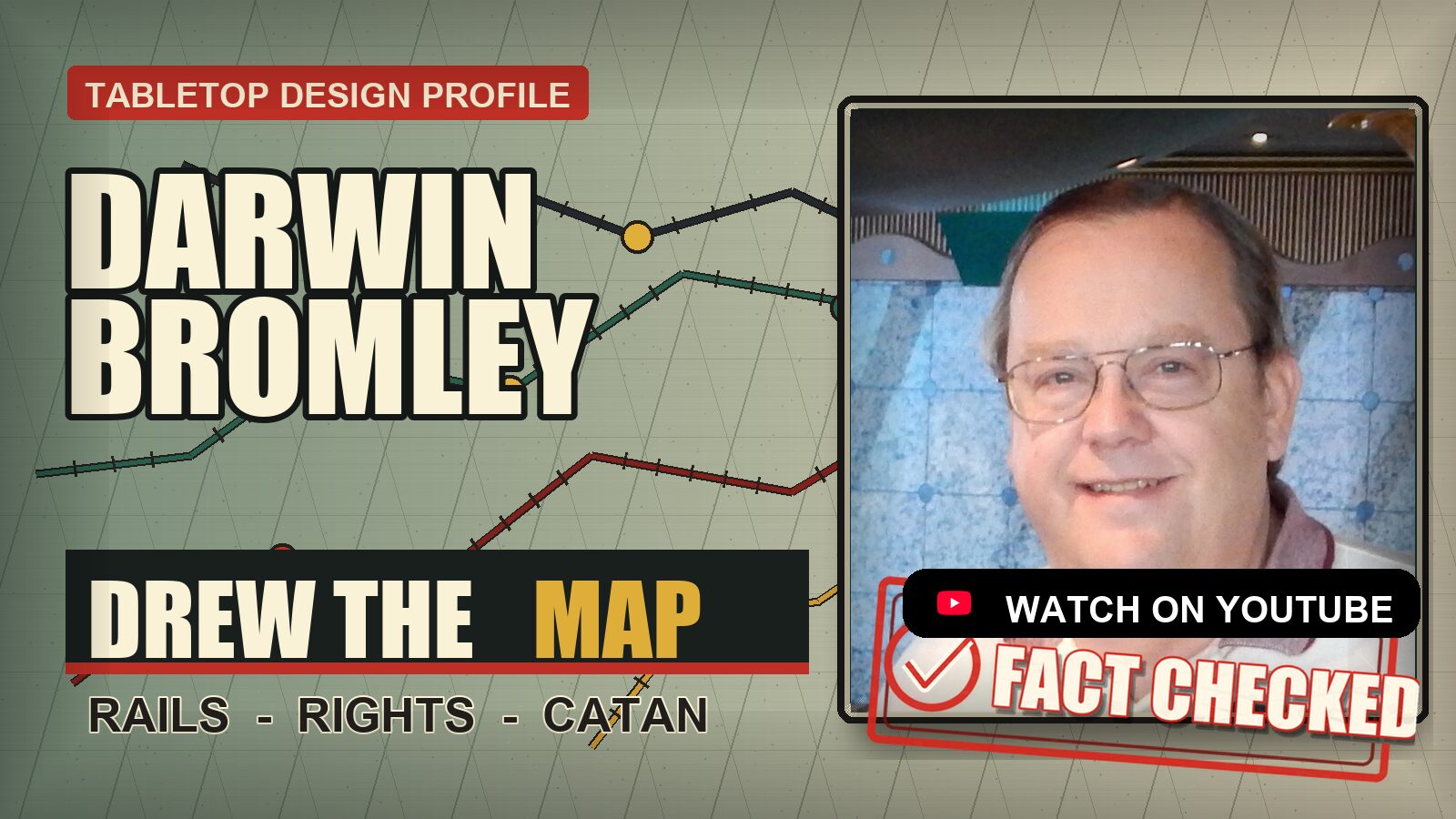
Darwin Bromley kept finding places where games needed a path.
One path was literal. In Empire Builder, players took crayons to a laminated map and drew their own rail lines across North America. They did not wait for the board to tell them where a route belonged. They made one, paid for it, and lived with the consequences.
Another was legal. At Mayfair Games, Bromley helped publish fantasy adventures that told buyers they could be used with Advanced Dungeons and Dragons, while also stating TSR had not approved the product. That wording mattered, and Bromley understood why.
A third path crossed an ocean. In the mid-1990s, Mayfair brought German-style board games into the American hobby market, including The Settlers of Catan. Jay Tummelson did the licensing work that made those editions happen. Bromley hired him, backed the strategy, and ran the company during the moment when Catan started showing up on North American tables.
That is the pattern. Bromley did not just make games. He made routes.
The Lawyer From West Virginia
Darwin Paul Bromley was born in Huntington, West Virginia, on October 23, 1950. The train connection was there early. The Strong Museum’s archival finding aid says that as a child he loved watching trains haul coal out of the Appalachians. That detail matters, because his best-known design would later turn railroads into an open problem of geography, money, and nerve.
He studied at Marshall University, graduating in 1972, then earned his law degree from Northwestern in 1975. After that he practiced law in Chicago. Those were not wasted years before the real career began. They were part of the career.
Game publishing in the late 1970s and early 1980s was a rough little business. Distribution was fragile. Contracts mattered. Trademarks mattered. A small company could be creative, beloved, and dead by Christmas if it guessed wrong. Bromley entered the hobby with the mind of a collector and the caution of an attorney.
He and his brother Peter had been collecting games and related material since the 1960s. They were not dabbling. They were building a library before the hobby knew it needed one.
Mayfair And The Crayon Rails
Mayfair Games was founded in Chicago in Spring 1981 by Darwin Bromley, Peter Bromley, Todd Fischer, Neil Zimmerer, Ken Kaufman, and Jim Griffin. Some sources use 1980 because the work that became Empire Builder was already underway. The clean version is this: the game came first, then the company took shape around the need to publish it.
Empire Builder, designed by Darwin Bromley and Bill Fawcett, gave Mayfair its identity.
The idea was elegant and strange. Instead of moving along pre-printed railroad lines, players drew track directly onto a laminated map with crayons. They built routes city by city, paid for terrain, crossed rivers, picked up freight, delivered goods, upgraded engines, and slowly turned a blank network into an economic machine.
The appeal was tactile and mathematical at once. Players could make a mess, then prove whether the mess could pay for itself.
That mechanic became the core of the crayon rails line. British Rails, Eurorails, Iron Dragon, and other titles carried the idea into different maps and moods. Iron Dragon took the rail system into fantasy. Eurorails gave it a European frame. The family kept finding new ways to ask the same question: can you draw a better route than the other players before the economy turns against you?
Bromley was not the only designer in that line, and Mayfair was not only a train-game company. But Empire Builder gave the company a durable mechanical signature. It made Mayfair feel different. The board was not a fixed maze. It was an invitation to mark the world.
The Role Aids Fight
Mayfair’s next major path ran straight into TSR.
In 1982, Mayfair began publishing Role Aids, a line of fantasy role-playing supplements meant for use with Advanced Dungeons and Dragons. This was dangerous territory. TSR guarded D&D aggressively, and the idea of third-party publishers openly advertising compatibility with AD&D sat right on the fault line between trademark law, copyright law, and hobby practice.
Bromley’s legal training mattered. Mayfair products carried a direct disclaimer saying Advanced Dungeons and Dragons was a TSR trademark and that use of the trademark was not sanctioned by the holder. That sentence was not just packaging copy. It was a strategy.
TSR challenged Mayfair. A 1984 settlement allowed Mayfair to keep publishing under strict rules. The fight returned in the early 1990s in TSR, Inc. v. Mayfair Games, Inc., a federal case that also named Darwin P. Bromley personally as a defendant.
This is where the story often gets exaggerated. Mayfair did not win a clean, sweeping victory that opened the floodgates forever. Judge Milton Shadur found that Mayfair had breached parts of the settlement and required offending material to be fixed. But the court also refused the broad remedy TSR wanted, which was rescission of the whole agreement.
That distinction matters.
The Role Aids fight did not create the modern open gaming movement by itself. It did show that compatibility, disclaimers, trademarks, and third-party support were not simple questions. It was one of the early public battles over whether the dominant role-playing game could control the entire ring of products around it.
Bromley was standing in that ring with a lawyer’s eye and a publisher’s wallet. That carried real cost and risk.
Catan Crosses The Atlantic
The decision that put Bromley’s name into a much larger board-game story came in the 1990s.
American hobby gaming was changing fast. Magic: The Gathering had rearranged retail shelves. Traditional board-game lines were under pressure. Mayfair had years of legal expense behind it and a market that no longer behaved the way it had in 1982.
Bromley had already been interested in German games. These were not just curiosities. German-style designs tended to have shorter play times, indirect competition, clean rules, and less player elimination than many American hobby games of the period. They felt social without being thin. They gave families and serious gamers something to share.
In 1995, Bromley brought Jay Tummelson into Mayfair and directed him to pursue German licenses for American publication. Tummelson’s role deserves to be named clearly. He did the work of getting rights, dealing with publishers, and turning the opportunity into actual games.
Mayfair’s 1996 wave included titles such as Modern Art, Manhattan, Streetcar, Grand Prix, and The Settlers of Catan.
Catan was the one that changed what many American hobby nights felt like.
Klaus Teuber’s design had already won the 1995 Spiel des Jahres in Germany. Mayfair’s edition helped carry it into North America, where it became one of the great gateway games of the modern hobby. People who did not care about hex-and-counter wargames, tournament card games, or dense RPG supplements suddenly had a game about roads, settlements, trading, and sheep that could sit on a kitchen table and pull everyone in.
Again, Bromley was not acting alone. Teuber designed Catan. Tummelson helped secure the rights. Retailers taught it. Players spread it. Later companies carried the line forward.
But Bromley was running Mayfair when the path opened. He saw enough promise in German games to put company weight behind them. ICv2 later called the Tummelson hire and German licensing push probably Bromley’s most momentous move.
That is a fair summary.
The Company After The Map
By 1997, Bromley was stepping away from Mayfair’s first era. Iron Crown Enterprises bought many of the company’s assets, and Mayfair continued under the trademark with new leadership. Catan kept growing. The company that Bromley helped build survived him as an idea, even when its ownership and structure changed.
That is part of the honest assessment. Bromley did not personally guide every later success attached to Mayfair. He did not run Catan Studio. He did not create the Eurogame movement. He did not write every important Mayfair product.
What he did was earlier and less glamorous.
He built the shop that could publish Empire Builder, and he kept Mayfair in the fight long enough to matter. The legal discipline was not optional in that era. When he backed a German-game strategy, American gamers were ready for something different.
That kind of contribution can look quiet from a distance. Up close, it is load-bearing.
The Archive
Bromley’s final major gift to the hobby was not a game release. It was preservation.
In 2018, The Strong National Museum of Play received the Bromley collection from Darwin and his late brother Peter. ICv2 reported more than 4,000 games and more than 7,000 library titles. The Strong described thousands of artifacts, more than 10,000 magazine issues, and over 1,500 books, trade catalogs, press kits, comic books, conference materials, and related publications.
It was the single largest gift ever recorded by the museum’s collection.
That matters because hobby games disappear easily. Zip bags split. Rulebooks vanish. Convention notes get tossed. Legal files sit in boxes until someone decides they are clutter. The paper history of tabletop gaming is fragile because so much of it was made by small companies moving too fast to imagine a future scholar caring about their invoices, drafts, maps, and letters.
Bromley cared.
The Mayfair Games records at The Strong now include business papers, game development material, legal files, correspondence, photographs, art, maps, manuscripts, audio, video, and digital media. Researchers can trace how a tabletop company actually worked in the years when RPGs, wargames, family games, and imported German designs were all fighting for space.
That is a different kind of design. It is designing memory.
What He Actually Built
Darwin Bromley’s career does not reduce cleanly to one title.
Start with Empire Builder, the signature design. Then look at Mayfair, the company he helped build around it. Add the Role Aids fight, the Catan licensing bet, and finally the museum donation. That set of routes is the career.
Put together, they show a man who understood that games need more than clever mechanics. A hobby also needs publishers willing to take risks, contracts that hold, routes to stores, and legal room to breathe. It needs collectors who save the odd stuff before it becomes important.
Bromley was not the loudest figure in tabletop history. He was not the most famous designer at the table. His work often depended on collaborators, and the cleanest version of his story should say that plainly.
But when you look at where he stood, he kept showing up at crossings.
He worked where hobby met business, where law met play, where American design traditions ran into German ones, and where disposable product became historical evidence.
He drew lines through all of it.
Where To Find The Work
Darwin Bromley died in early January 2019 after a long illness. The public record gives January 2 as the date in his obituary and on Wikipedia, while some trade coverage reported January 1.
His work is still easy to find if you know where to look.
Empire Builder remains the signature design. The crayon rails family that grew from it is still remembered by train-game players as one of Mayfair’s great mechanical inventions. The old Role Aids fight remains part of the legal folklore of tabletop RPG publishing. The Mayfair edition of The Settlers of Catan belongs to the story of how Eurogames reached American hobby tables.
And if you want the deeper trail, go to The Strong Museum’s Brian Sutton-Smith Library and Archives of Play. The Mayfair Games records are there, along with the Bromley collection.
That may be the most fitting place for him.
A map, a rulebook, a court file, a box of old games. Darwin Bromley understood that all of them were part of the same hobby.
Fact Check Notes
Publication notes
This site is AI-assisted and human-reviewed. We use artificial intelligence to help gather research, organize source material, and draft profile content. Human editors then read, revise, and check each profile before it goes live. Most profiles are built through deep AI research and two separate rounds of fact-checking.
Leave a Reply
You must be logged in to post a comment.