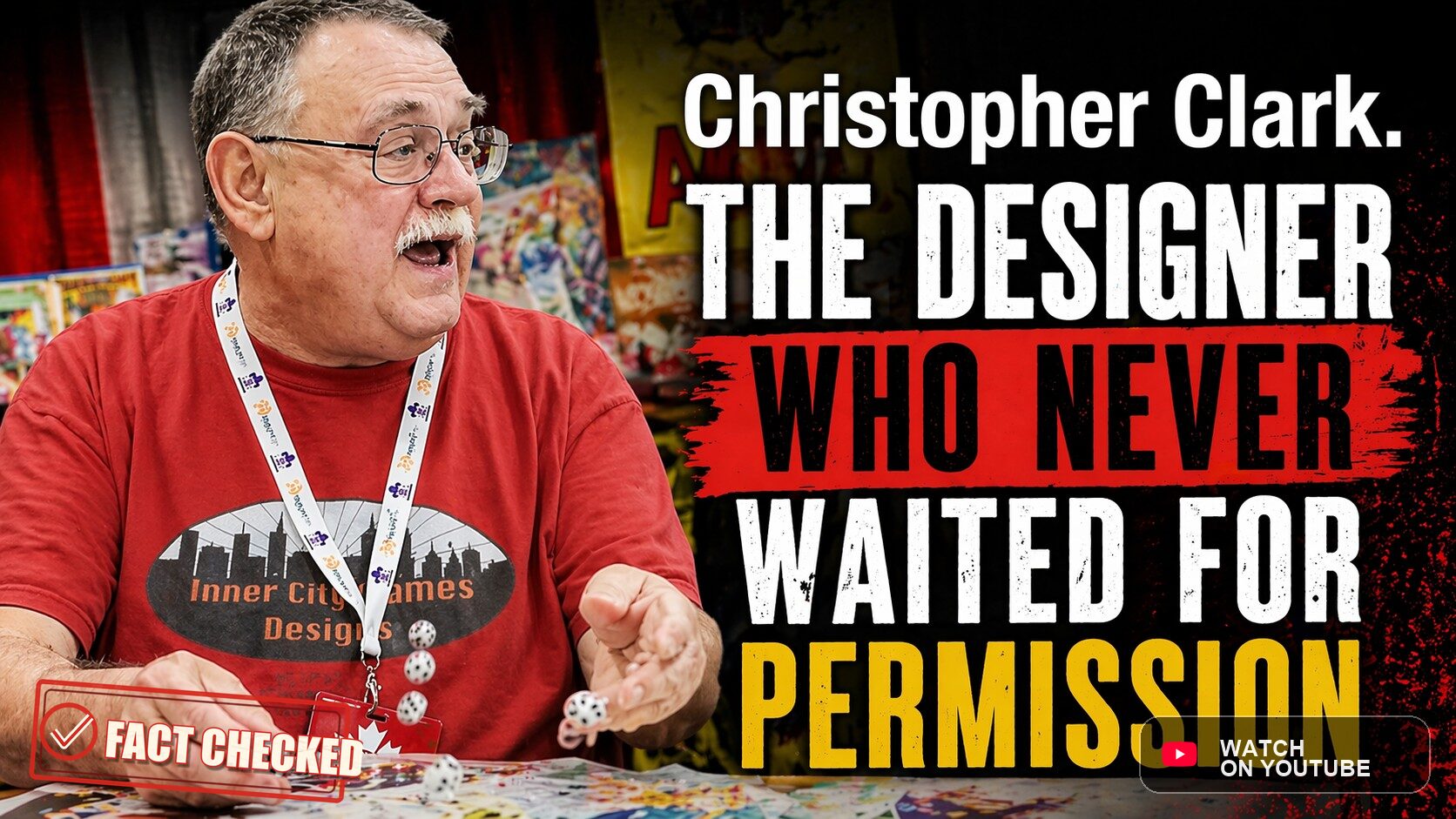
Christopher Clark never needed the industry to tell him he was allowed to make games. He started anyway.
For a long stretch of tabletop history, there was no clear front door. If you wanted your work to exist, you often had to build the path yourself.
Around the late 1970s and early 1980s, Clark ran into a simple problem: the people around him did not want to play Dungeons and Dragons. Not because of the dice or the rules, but because of the fantasy. The dragons and elves were a wall.
So he built a different entry point. No elves. No dragons. Instead, crime, cops, and television drama. A system someone could step into without learning a whole mythology first.
That became Inner City.
And before long, it was not just a game. It was the start of a small publishing pipeline.
Building Without A Safety Net
Clark did not enter the industry through a publisher. He became one.
Inner City Games Designs was never built on scale. It was built on motion. Games were written, assembled, printed, and sold with whatever tools were available at the time: stapled booklets, folded paper, small runs, direct sales, convention tables, mail orders, and later PDFs.
It is easy to romanticize that kind of work. It is also easy to miss how demanding it is. When you publish like that, there is no cushion. If you stop, the line stops.
Over the decades, that approach produced a large catalog across roleplaying games, miniatures games, board games, and modules. Not in waves. Not in cycles. It kept coming.
The Toybox Insight
In the early 1990s, Clark made a leap that should have changed more than it did.
Fuzzy Heroes removed the core barrier of miniatures gaming: the miniatures.
Instead of buying, painting, and assembling armies, players used whatever they already had. Stuffed animals. Action figures. Toys pulled from a shelf. The statistics came from the object itself: size, shape, color, limbs.
The physical world became the rulebook.
It lowered the cost. It lowered the intimidation. A kid could play immediately, and a veteran could improvise endlessly.
The Part The Industry Missed
The idea worked. The system worked.
The distribution rarely did.
Clark’s games did not always arrive with the kind of presentation the market uses as a trust signal. Packaging was minimal. Layout was functional. Production favored speed and accessibility over polish. The games were playable, but they did not always look like products competing for attention on a shelf.
And shelves matter. Before a system is understood, it has to be trusted. Before it is trusted, it has to be picked up.
Clark rarely chased that layer. Not because he could not. Because he was already building the next thing.
So the ideas moved, but mostly inside his own ecosystem. Fuzzy Heroes expanded into sequels and variations. The core mechanic proved itself again and again. The moment when the wider industry picks up an idea and carries it forward did not fully arrive.
Not because the idea failed.
Because the attention never fully landed.
What He Actually Built
Christopher Clark did not become a household name in tabletop gaming. He did not dominate the hobby’s biggest shelves.
What he built was a stubborn, self-sustaining model of output: small games, shipped fast, kept alive by persistence. And every once in a while, an idea simple enough to feel obvious only after someone else has done it.
The Other Role He Played
If Clark’s own systems did not spread widely, his influence still moved. Just in a different form.
At different points, he worked in and around small press publishing efforts connected to major names in early roleplaying history, including Gary Gygax and others from that era. The pattern was consistent: helping turn manuscripts into products and keeping work moving when bigger channels were not available.
Clark’s role in those moments was not designer alone.
It was infrastructure.
A Career That Doesn’T Spike
There is no single breakout moment in Christopher Clark’s career. No award that reframes everything. No product that dominates the market.
Instead, there is continuity.
From the early 1980s to the present, Clark has kept producing, publishing, and releasing games. The range is real. The commitment is clear.
It is not the arc most people look for.
But it is one that does not collapse.
What He’S Doing Now
Christopher Clark is still doing what he has always done. He is making games.
In recent years, he has revisited Inner City in updated form, aiming for the same core goal: accessible, immediate play, grounded in the instinct that drove the original.
You can find his work, past and present, at:
innercitygamesdesigns.com
The pipeline never stopped.
It just kept moving.
Fact Check Notes
Publication notes
This site is AI-assisted and human-reviewed. We use artificial intelligence to help gather research, organize source material, and draft profile content. Human editors then read, revise, and check each profile before it goes live. Most profiles are built through deep AI research and two separate rounds of fact-checking.
Leave a Reply
You must be logged in to post a comment.