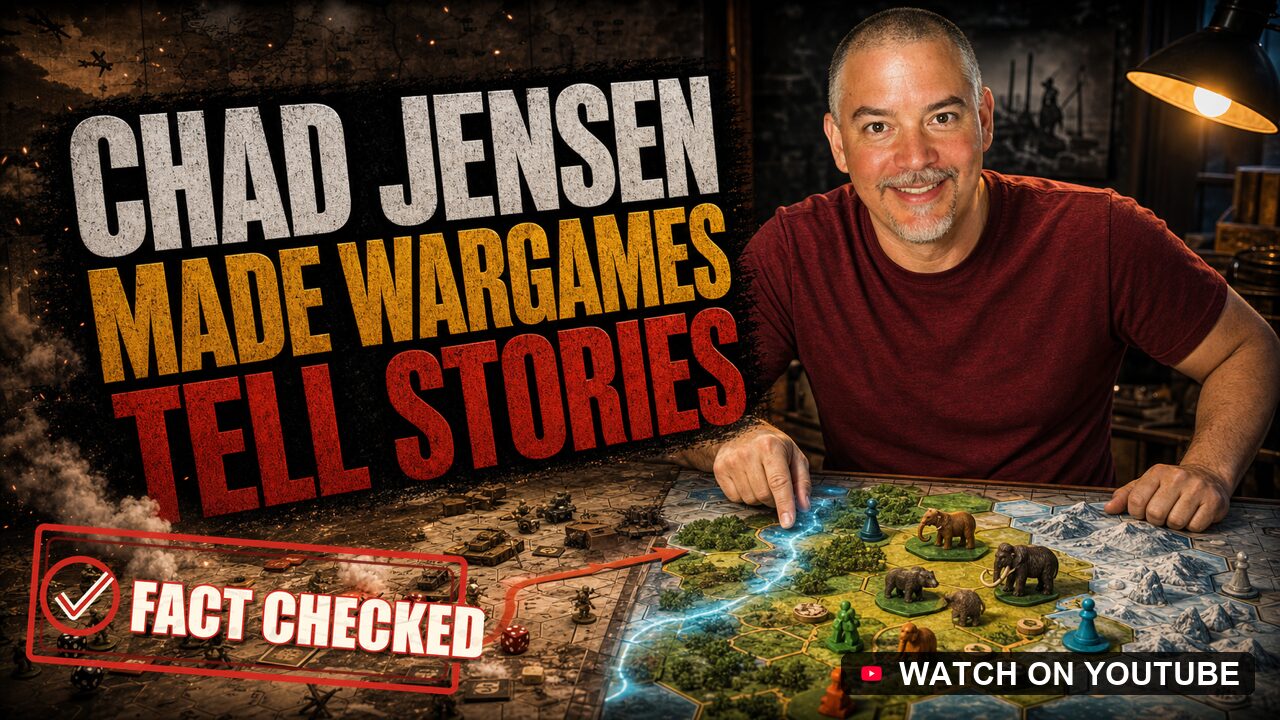
The genre speaks in hexes, firepower, line of sight, morale, initiative, supply, and combat modifiers. The players who love that language love it deeply. The players outside it often hear only machinery. For decades, one common answer was simplification: cut rules, soften friction, make the wargame feel more like a mainstream board game.
Chad Jensen found another answer.
He kept the pressure. He kept the uncertainty. He kept the feeling that history, terrain, command confusion, and bad timing were all shoving back against the player. Then he built systems that made that pressure read like story.
That was the bridge. Not from complex to simple. From complex to legible.
If you have ever sat at a table with someone who loves wargames and watched the energy drain from the room when the rules stop being shareable, you know what that bridge is worth. It is not only about complexity. It is about whether the experience can be held by more than one person at once.
The Card That Became A Battlefield
Combat Commander: Europe arrived from GMT Games in 2006 and made Jensen widely visible to a particular kind of player: the person who wanted a tactical World War II game that felt alive without requiring a tactical manual beside the table.
The game was card-driven, but not in a decorative way. The cards were the engine. They were orders, actions, events, fate, friction, and sometimes dead weight. A player might want to move a squad, fire a machine gun, recover a broken unit, or push toward an objective. Wanting was not enough. The hand of cards represented what the battlefield would actually let you do.
Many tactical games ask the player to choose the perfect action and then roll to see how well it goes. Combat Commander makes the choice itself unstable. You might have a plan, but your hand might not contain the order you need. You might be waiting for the right moment, only for an event to interrupt the sequence and turn the map into a different problem. The rules do not need to lecture the players about fog of war. The fog is already in their hands.
In play, that instability turns into narrative. The table starts speaking in scenes, not procedures, because the system keeps producing moments that feel like command trying to hold together under stress.
The Bridge
Jensen did not invent the card-driven wargame. The form had already been changed by earlier designs such as We the People and Hannibal: Rome vs. Carthage. His gift was different. He brought that energy down to squad-level combat and made it feel personal.
At that scale, a bad card draw is not only a strategic delay. It is the squad that does not move when you need it to. It is the fire order that never comes. It is the sudden event that makes the map feel less like a puzzle and more like a place where people are trying to survive.
The Combat Commander system kept expanding because the core could hold more than one battlefield. Europe came first. The Mediterranean and Pacific games followed, along with later expansions and editions. The system kept finding new ways to make the same question matter: what can you actually do when the moment arrives?
That is the emotional center of Jensen’s design voice. He liked plans. He also liked breaking them.
The Mean Euro
Dominant Species, published in 2010, showed that Combat Commander was not a one-lane success.
On paper, Dominant Species looks like a heavy strategy game about evolution before the Ice Age. Players place action pawns, adapt animal groups to changing terrain, spread across a hex map, compete for dominance, and watch the climate turn hostile. It has the silhouette of a Eurogame: worker placement, area control, careful sequencing, long-term planning.
Then you play it, and the wargamer underneath the design shows his teeth.
Dominant Species is not gentle. It lets players build position, then invites the table to tear that position apart. The action system rewards timing, but the board rewards aggression. A species that looks safe can be stranded by climate, out-adapted by rivals, or shoved out of a crucial space by a better-timed play. The theme is not pasted on as flavor. Survival is the mechanism.
Jensen built a game that could attract Euro strategy players while preserving the brutality of conflict simulation. It did not ask wargamers to leave conflict behind. It asked Euro players to accept that interaction could hurt.
The Rulebook As Invitation
One of Jensen’s underappreciated strengths was clarity.
Complex games do not only need good mechanisms. They need communication. A brilliant system can die on the page if players cannot understand what the game is asking them to do. Jensen’s reputation for rulebook craft mattered because his games asked a lot. Combat Commander needed players to grasp a battlefield where the card hand governed possibility. Dominant Species needed them to understand a layered action system where order, timing, terrain, adaptation, and extinction all collided.
The writing had to be precise without becoming lifeless.
That is one reason his games kept being played instead of merely admired. They were demanding, but they were teachable. The rules did not erase the challenge. They made the challenge reachable.
You can see the same instinct in how his games present information. Cards, maps, player aids, sequencing, layout. The player still has to do the hard thinking. Jensen’s job was to make sure the system was hard for the right reasons.
The Wider Arc
After Combat Commander and Dominant Species, Jensen kept building in ambitious directions.
He worked on tactical systems like Fighting Formations, civic systems like Urban Sprawl and Welcome to Centerville, and later reworks like Dominant Species: Marine. The throughline was not a single mechanic. It was temperament.
Jensen liked systems where planning mattered, but not enough to make the game obedient. He liked order, then interruption. He liked clean rules that produced messy consequences. His games rarely let players sit in a comfortable optimization bubble. Something was always shifting under the plan: an event card, a tactical hand, an initiative track, a climate change, a rival species, a war front that would not wait.
That combination gave his work its story quality. The story did not come from paragraphs of narrative text. It came from pressure applied to a plan until the plan became memory.
The Work Left On The Table
Chad Jensen died in November 2019 after cancer cut short a career that was still expanding. He was fifty-two.
The unfinished work matters because it shows the direction of the mind at the end. Downfall: Conquest of the Third Reich had been in Jensen’s research and experimentation for years. GMT’s own listing describes him working on it over roughly a ten-year period before John Butterfield picked up the design and brought it to completion, with Kai Jensen credited for design assistance.
Seeing a design carried across the finish line after a death is not only an industry story. It is a human one. A set of decisions that refuses to vanish.
Downfall went on to receive major Charles S. Roberts Awards recognition in 2023, including Game of the Year. The same awards program also includes the Chad Jensen Memorial Breakthrough Designer Award, created to spotlight emerging designers whose early work shows excellence in conflict simulation design.
That is a rare kind of remembrance. Not only a tribute. A door held open for the next designer.
What He Actually Built
Chad Jensen did not make wargames simple. That was never the achievement.
He made complex conflict games easier to enter without making them toothless. He showed that card-driven uncertainty could make tactical combat feel more human. He showed that a worker-placement and area-control design could be as combative as a traditional wargame. He wrote and presented systems with enough clarity that players could meet the complexity instead of bouncing off it.
The limits are real. His career was short by historical standards. His work stayed mostly within wargaming, heavy strategy, and the border between them. He did not become a mass-market name, and his systems did not become a universal template for every designer who followed.
But the bridge he built was sturdy.
Combat Commander still matters because it turns command friction into drama. Dominant Species still matters because it lets evolution behave like a knife fight. Downfall matters because the ideas survived him, passed through other hands, and still reached the table.
Where His Work Lives
Chad Jensen’s work lives at GMT Games, in the players still running Combat Commander scenarios, in the groups still dragging Dominant Species to the table for a long, mean afternoon, and in the posthumous designs and development work that Kai Jensen has helped shepherd forward.
It also lives in the award that carries his name. The Chad Jensen Memorial Breakthrough Designer Award is not a museum plaque. It faces forward, toward designers still early enough in their careers to need someone to say: keep going, your bridge might hold.
That feels right.
Jensen died with games unfinished. But unfinished is not the same as incomplete. Some designers leave a catalog. Chad Jensen left a span between two traditions, and people are still crossing it.
Fact Check Notes
Publication notes
This site is AI-assisted and human-reviewed. We use artificial intelligence to help gather research, organize source material, and draft profile content. Human editors then read, revise, and check each profile before it goes live. Most profiles are built through deep AI research and two separate rounds of fact-checking.
Leave a Reply
You must be logged in to post a comment.