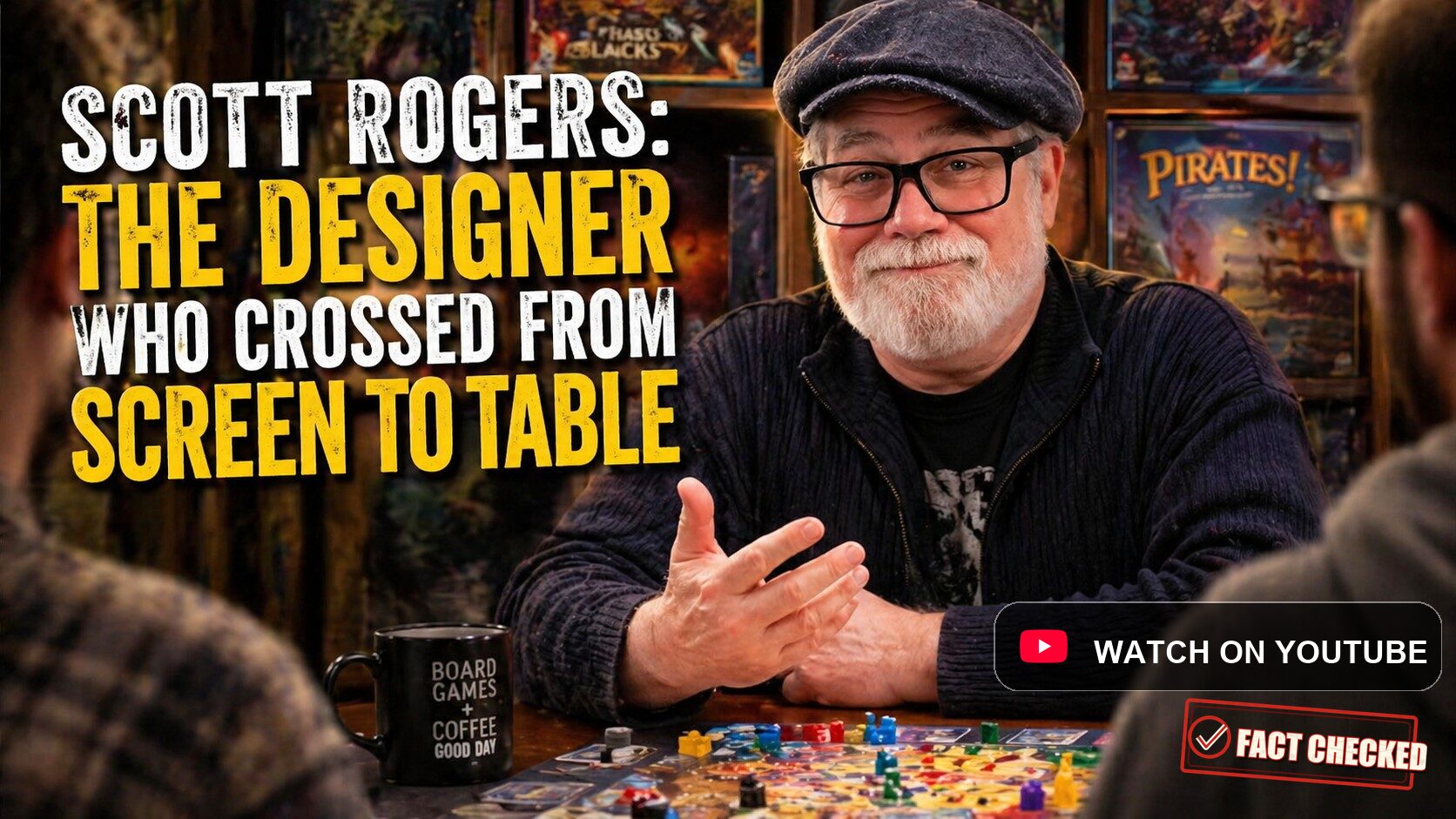
In 2009, Scott Rogers walked onto the Game Developers Conference stage and gave a talk titled Everything I Learned About Level Design I Learned From Disneyland. That sentence is the thesis of his entire career. It is also what got Walt Disney Imagineering’s attention. They hired him in 2011.
For most of the twenty years before that talk, Rogers had been making video games no one knew his name for. AAA development is a credit-roll business. The lead designer who paces a combat encounter shares a few seconds of scrolling text with the modeler who built the barrels and the engineer who tuned the renderer. By the late 2000s, Rogers had stacked enough of those credit-rolls to fill a long, quiet résumé. The work was real. The recognition was scattered.
Then he started naming what he had been doing.
The Pixel Tiles And The Internship That Vanished
Rogers studied illustration and film production at California State University, Long Beach. He wanted Hollywood. He landed an internship at Steven Spielberg’s Amblin Entertainment that looked like the door swinging open. Then a hurricane wrecked the production sets of Jurassic Park. Schedules collapsed. Budgets reset. The internship program shut down before Rogers’s chair was warm.
A friend asked him in a coffee shop if he could draw on a computer. That question routed him into the early 1990s video game industry as a 16-bit pixel artist. He has compared the work to laying bathroom tiles. Slow and meticulous. The memory budgets back then would now fit inside a single emoji. What he noticed from his desk was that the designers down the hall were having more fun. They had agency. They were deciding what the player would feel. Rogers asked for a transition. He got it.
Fifty Million Copies, No Name On The Box
Over the next two decades, Rogers worked on more than fifty AAA video games for publishers including Sony, Capcom, Namco, and THQ. The catalog runs Pac-Man World, the Maximo series, God of War, the Drawn to Life series, and Darksiders, alongside a long string of licensed properties. He has cited combined sales of his work at more than fifty million copies. He spent twenty years building digital spaces that millions of people moved through.
In theme park language, Rogers spent that time engineering "the weenie," the visible landmark that pulls you forward through a space without you noticing the pull. The weenie is what gets you from the parking lot to the castle. In a video game, it is what gets you from the tutorial to the boss fight. Same problem. Different surface.
He was good at it. He was also, outside the industry, almost completely anonymous. That asymmetry is the engine of everything he did next.
The Gdc Talk And The Call From Disney
The 2009 Disneyland talk landed because it was true. Rogers laid out a structural argument: theme park designers and video game level designers are doing the same job. They both manage crowds and use forced perspective. They place landmarks to steer attention. The work, on either side, is to orchestrate emotional peaks across a long, paced experience. Walt Disney Imagineering noticed.
He spent almost five years inside Imagineering’s Research and Development team. His credited work included Disney Kudos, a precursor to what eventually became the Play Disney app, and Legends of Frontierland: Gold Rush, an ambitious live-action role-playing layer dropped onto an existing park land. He came out of that period fluent in a vocabulary he calls "toyetic joy." The phrase covers the tactile pleasure of a well-made physical object: components, textures that ask to be touched, the weight of a thing in your palm, the kind of object you want to pick up and fidget with.
He had crossed from screens to physical space. The next crossing was already loading.
The Crossing To Cardboard
Around 2015, Rogers pitched a third-person shooter set in a 1930s pulp sci-fi universe. Digital publishers passed. He has talked about that moment as a pivot. He did not need a hundred-person team or an eighteen-month pipeline to bring the universe to life. He could build it on cardboard.
The project became Rayguns and Rocketships, published by IDW Games in 2017. The mechanics were ambitious. The game ran on two scales at once: a star map where rocketships maneuvered through space, and individual ship boards where crew miniatures stood at action stations. Where you placed your crew on the ship board determined what your ship could actually do. Engines, weapons, boarding parties. Constant tradeoffs.
Rogers has spoken publicly about going through cancer treatment during the period he was designing the game. He has described prototyping in notebooks while in isolation, and the act of designing as something that gave him forward motion when most other things had stopped. He raised his Kickstarter and got the game out the door.
The published rulebook had problems. Late-stage editing introduced confusion that the community had to patch through FAQs and threads on BoardGameGeek. For a designer who had spent two decades in digital, where the engine itself enforces the rules, this was the painful lesson: in tabletop, the rulebook is the interface. If the document is wrong, the game is wrong. He carried that lesson into everything that came after.
Alien And The Constraint That Made The Design
In 2021, Ravensburger handed Rogers a license most designers would treat as a horror-mechanics free pass: Ridley Scott’s Alien. Then they took the two most common horror mechanics off the table. No player elimination. No hidden traitor. The audience was families. Nobody was going to die and sit out.
The result, ALIEN: Fate of the Nostromo, is a small masterpiece of designing inside a fence. Getting caught by the Xenomorph does not kill you. It drains the team’s collective morale. You flee three spaces, but the whole group bleeds together. The horror moves from individual loss to shared, escalating dread. Nobody gets benched. The tension stays cooperative.
The cleanest piece of engineering is the Encounter Deck. It self-corrects. Quiet cards get removed as the game progresses, so the Alien’s appearances accelerate without anyone tracking phases. The math does the work. Players never feel the gear shift. They just feel the room get tighter.
The game won Tabletop Gaming Magazine’s Best Games of 2022. It is what you hand someone who thinks "family game" and "horror license" cannot occupy the same box.
What He Actually Built
Rogers is not the designer who reinvented a genre. He is the designer who moved the same set of architectural principles across three mediums that the rest of the industry treats as separate problems. Spatial pacing in a video game level. The way a theme park moves a crowd from gate to gate. Where the player aid sits on a tabletop next to your hand. He treats those as one job with three surfaces.
The most durable version of that thinking lives in his books. Level Up! came out in 2010 and became a standard text in university video game design programs. Swipe This! covered touchscreen design. Your Turn!, published in 2023, is the tabletop equivalent and runs more than four hundred pages.
Inside Your Turn! is the framework Rogers will probably be remembered for: the Six Zones of Play. The argument is simple. Your hands and your peripheral vision define a series of physical zones around a tabletop, each with a different psychological function. Your dominant hand holds the high-frequency, secret information, the cards. The space directly in front of you is your tableau, public but personal. The center of the table is the shared arena. The rulebook lives in the furthest zone of all. If you put information that needs to be checked every turn into the rulebook, the user experience is broken. Pull it forward. Put it on a player aid in the tableau. The framework lifts board game graphic design from decoration into ergonomics.
He did not invent that idea out of nothing. He translated it from screen UI, where information hierarchy has been a measurable science for decades. That translation is the move he keeps making. Other designers will name new mechanics. Rogers names the structure underneath them.
Where To Find Him
Rogers continues to teach, write, and design. He has taught game design at the University of Southern California’s School of Cinematic Arts and at the New York Film Academy, where he tells students that a design is meaningless until it exists as a working prototype.
His tabletop pipeline stays active. He has talked publicly about projects in development with publishers including All Play, By Night Studios, Burnt Island, Squid Ink, and Cryptozoic. His independent project, the board game I DO MY OWN STUNTS, has been moving through fulfillment to backers.
He is also the writer of Bedbug, an independent comic about a single father superhero, and shows up as a featured voice in the 2020 documentary Gamemaster alongside Klaus Teuber and Eric Lang. He continues to appear on industry podcasts, including Monster Party, where he talks about design theory, theme park work, and whatever obscure piece of comic book history he has been chewing on that week.
For most of his career, Rogers built things you played without ever knowing his name. The crossing to tabletop changed that. The name is on the box now. The architecture is in the books. Both are still moving.
Fact Check Notes
Publication notes
This site is AI-assisted and human-reviewed. We use artificial intelligence to help gather research, organize source material, and draft profile content. Human editors then read, revise, and check each profile before it goes live. Most profiles are built through deep AI research and two separate rounds of fact-checking.
Leave a Reply
You must be logged in to post a comment.