Iconic Tabletop Game Convention
GAMA Expo
The retailer school that became the tabletop industry's working trade show.

GAMA Expo, Part 1: The Retailer School That Became a Trade Show
Before it was an expo, it was a question.
How could a young tabletop business teach hundreds of scattered shop owners what to stock, how to sell it, and whom to call when the next new game arrived?
In 1982, the American hobby-game trade was still a patchwork. Publishers could make games. Distributors could move boxes. Local stores had the hardest job: turning unfamiliar titles into purchases, play groups, and repeat customers. There was no social feed that could demonstrate a release overnight. No crowdfunding campaign could assemble an audience before manufacturing began. The store owner was the interpreter between the game and the player.
The convention that became GAMA Expo grew around that person.
A trade floor inside Origins
The earliest firm clue does not come from a GAMA Expo program. It appears in a 1982 issue of Pegasus, the magazine published by Judges Guild. A notice about Origins '82 in Baltimore said a trade show was tentatively scheduled and that almost all members of the Game Manufacturers Association, or GAMA, were expected to attend with old and new products.
This was a trade-show function, but it was inside Origins. It should not be mistaken for a proven first edition of the later stand-alone retailer event. The distinction matters. GAMA operated Origins as a consumer convention, while the spring trade show eventually became a closed business meeting for the people who made, distributed, and sold games.
The 1982 notice proves that GAMA's members already needed a marketplace within the convention calendar. It does not prove when that marketplace became its own numbered annual show.
An archival trail points to the next step.
The Strong National Museum of Play's finding aid for the Mayfair Games records labels the March 8–11, 1993 event the “7th Annual GAMA Retailers' Seminar and Trade Show.” The same archive calls the 1994 meeting the eighth annual Retailers' Trade and Seminar Show. If that numbering ran without interruption, the series began in 1987.
No located first-year program names the 1987 city, hotel, or dates. So 1987 is the likely beginning of the numbered stand-alone retailer series, not a date to decorate with invented precision.
The clue is in the long name
“GAMA Retailers' Seminar and Trade Show” sounds cumbersome. It is also a nearly perfect description of the event's purpose.
The show was not designed only to rent tables to manufacturers. It joined a trade floor to a school.
A contemporary advertisement for the March 20–22, 1988 meeting in Las Vegas promised direct contact with manufacturers. It also offered sessions on store displays, marketing, inventory, customers, clubs, and conventions. These were not abstract lessons in game design. They were the operating problems of a small specialty retailer.
In the late 1980s, a game store owner might be a buyer, bookkeeper, event organizer, rules teacher, and community referee in the same afternoon. A weak inventory choice tied up scarce cash. A strong demonstration could turn one copy into a weekly group. The seminar side of the show treated retailing as a craft that could be learned and shared.
Around 1989 or 1990, GAMA president Frank Chadwick described the annual Las Vegas retailer seminar and trade show as the association's central activity. His account emphasized product presentations, seminars, and workshops. A 1991 advertisement called that year's GAMA Trade Show the industry's “show and tell.”
That phrase captures the machine in miniature. Publishers needed to show. Retailers needed to understand. Both needed to talk.
A room where a small company could become real
The early show mattered because the hobby trade was relational. A new company did not simply upload a catalog and wait for orders. It needed people inside distribution and retail to take a chance.
Peter Adkison later described attending the March 1991 GAMA Trade Show while Wizards of the Coast was still a tiny company. In a 1993 Usenet post, he recalled learning from people already in the business and making contacts that helped the young publisher find its way.
The show did not create Wizards' later success, and a meeting cannot explain the rise of Magic: The Gathering. What the recollection shows is the value of access. A company could enter the room without being a giant. It could ask how the business worked, find names behind the invoices, and leave with a more accurate map of the trade.
That service became more valuable as tabletop publishing expanded. More products meant more choices for stores, but also more risk. The retailer had to decide which games deserved shelf space and which publishers could support them after launch. A focused business convention concentrated those decisions into a few days.
The show learns to move
The surviving record does not support a neat story in which the convention settled in Las Vegas from its first year. Las Vegas is documented in 1988 and again in 1991. The trail then leads elsewhere.
Dragon magazine placed the 1995 GAMA Trade Show in New Orleans and identified Andon as the convention operator. Green Ronin founder Chris Pramas later recalled attending his first GTS in Atlantic City in 1996. Those two stops are enough to break the myth of one continuous early Vegas residency.
The movement also reveals what the event had not yet become. It was an annual institution, but not yet an immovable one. Its organizers could test cities and hotel arrangements while the game business itself was changing at speed.
By the mid-1990s, collectible card games had transformed ordering, inventory, and customer demand. Publishers could arrive with products that stores needed to understand immediately. Retailers faced both opportunity and speculation. The seminar-and-trade-show design was well suited to that pressure because it joined sales information to peer education.
The public name was also shortening. The archival title still preserved “Retailers' Seminar,” but the industry increasingly called the event the GAMA Trade Show, or simply GTS. The school did not disappear when the name became cleaner. It moved inside the institution.
What the first era built
By 1996, the show's lasting structure was visible.
It was business-to-business, not a public game fair. It put retailers in the same place as publishers and distributors. It treated education as part of the show's product. It offered a small company access to the trade's human network. And it could move from city to city while keeping the same central purpose.
The evidence leaves gaps. We still do not have a verified program for the first numbered edition. We cannot prove that the 1982 Origins trade floor and the 1987 retailer series were one unbroken administrative event. That uncertainty is part of the history, not a problem to hide.
What can be seen clearly is a convention built for the person behind the game store counter. The booth mattered, but the lesson mattered too.
At the end of the 1990s, GTS returned to Las Vegas and began to settle into a more stable rhythm. Hotel ballrooms, retailer seminars, distributor meetings, product previews, and late-night games would turn the traveling school into the business week behind the local game store shelf.
That is where Part 2 begins.
Sources
- Pegasus 8, “Pegasus Flies to Origins '82”
- The Strong National Museum of Play, Mayfair Games records finding aid
- Challenge 33, 1988 GAMA Trade Show advertisement. Contemporary scan consulted; the former public mirror now returns 404.
- Gateways Special 1, Frank Chadwick open letter. Contemporary scan consulted; the former public mirror now returns 404.
- Challenge 56, 1991 GAMA Trade Show notice. Contemporary scan consulted; the former public mirror now returns 404.
- Peter Adkison, 1993 Usenet recollection
- Dragon 217, 1995 trade column
- Green Ronin, “The Pre-History of Green Ronin Publishing”
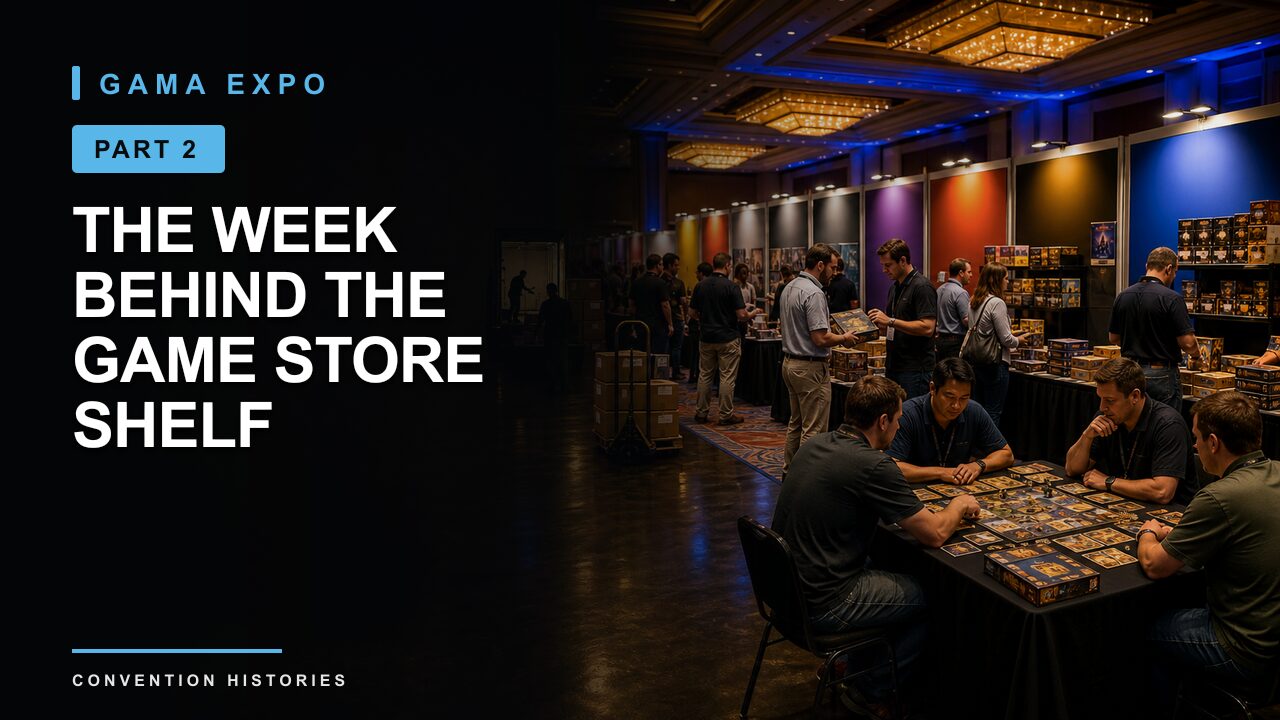
GAMA Expo, Part 2: The Week Behind the Game Store Shelf
The games on a store shelf look still.
Behind them is a chain of decisions. A publisher chooses what to make. A distributor chooses what to carry. A retailer decides what to order, display, teach, discount, restock, or abandon. By the time a customer sees a box, the trade has already debated its prospects for months.
For much of the 2000s and 2010s, the GAMA Trade Show compressed that chain into one week in a Las Vegas hotel.
It was not a convention built for autograph lines or public tournaments. It was a working meeting where store owners learned the business, publishers introduced releases, distributors maintained relationships, and competitors traded information after the exhibit hall closed.
The retailer school had become an industry machine.
Back to Las Vegas
After the mobile years of the mid-1990s, GTS returned to Las Vegas by 1999. A contemporary RPGnet report dates that year's meeting to March 23–25 and notes 1,030 booked room nights. In 2000, a Chaosium notice placed the show at the Orleans Hotel and Casino from March 20–23.
The move toward a stable resort home changed the event's rhythm. Attendees could sleep, meet, exhibit, eat, and play within one property. A hotel show also kept the trade together after official hours. The conversations that did not fit a seminar or scheduled appointment could continue at dinner, over a game, or in the hallway.
The physical floor kept growing. A Steve Jackson Games newsletter said the 2004 show would move into a larger room at the Orleans. A distributor notice that year relayed GAMA's claim of more than 2,000 representatives and six consecutive attendance records. Those were organizer-supplied figures, not an independent audit, but they show how GAMA was presenting the event to the trade: as a maturing national marketplace.
What one week did
The exhibit hall was the most visible part of GTS, but it was not the whole show.
Publishers used the floor to put upcoming products in front of buyers. A store owner could compare lines without relying only on a catalog description. Distributors could explain ordering and availability. Retailers could ask the questions that rarely fit on a sell sheet: When would the next wave ship? Was organized play planned? Would the publisher support demonstrations? Was the line built for one sale or a long customer relationship?
Education ran beside commerce. The old “Retailers' Seminar” language faded from the masthead, but its function remained. Seminar tracks addressed the work of operating a specialty store. Product presentations explained new lines. Retailers compared experience with inventory, staffing, events, and community building.
Play mattered because games are difficult to sell from specifications alone. A buyer who had played a title could describe its pace, audience, and table presence. That knowledge traveled home with the retailer and reappeared in a recommendation across the counter.
The show therefore moved information in both directions. Publishers pitched their plans, but retailers brought back local reality. They knew which players were showing up, which price points met resistance, and which organized-play programs could survive contact with a weekly store calendar.
The Riviera year
In 2005, GTS moved from the Orleans to the Riviera Hotel and Casino. Contemporary retailer reporting gives the clearest snapshot of the show at this stage: about 200 exhibiting companies, more than 540 retail stores from 44 states, and more than 2,175 total attendees.
Those numbers describe different populations. Exhibitors, stores, and people cannot be folded into a single attendance measure. They are still useful because they show the breadth of the network. Hundreds of independent stores had sent someone to Las Vegas. Hundreds of companies were trying to reach them.
The local game store was often a small business with little spare labor. A trip to GTS meant airfare, hotel costs, and days away from the counter. The show had to repay that investment with more than samples. Its value came from concentration: many suppliers, many peers, and many decisions in one place.
That concentration also made the convention a reading of the market. One could see which categories were crowding the hall, which publishers had grown, and which distributors still anchored the supply chain. The show did not decide what the public would love. It revealed what the trade was preparing to sell.
Bally's and the long middle
GAMA announced in 2006 that the show would leave the Riviera for Bally's in 2007. The April 23–26 meeting opened with more exhibit space, though ICv2 reported lower attendance than the previous year.
The decline did not end the institution. Bally's became the durable home for the next decade. A 2009 program concentrated education and exhibit hours into an April 14–17 schedule. Publisher records place the 2015 show there from March 16–20. The steady repetition was part of the value. Retailers and publishers could plan around a familiar annual checkpoint.
During those years, the market around GTS changed. Crowdfunding let some publishers finance games directly through customers. Online stores competed with local shops. Publishers found new ways to communicate without waiting for a spring trade show.
Those changes did not erase the event's purpose. They made its relationship work more visible. A digital campaign could attract thousands of backers, but it did not automatically teach a store owner how the product fit a local community. A video could demonstrate a game, but it could not replace every conversation about terms, restocks, events, and support.
GTS remained a place where the separate layers of the business could meet as people instead of purchase orders.
Reno and a new name
In 2018, the show left Las Vegas for the Peppermill Resort in Reno. The archived official site called it the first Reno year. A WizKids release from that March still used the name GAMA Trade Show and treated the convention as a place to unveil an upcoming line of board games.
The Reno move did not abandon the hotel model. It placed the trade inside another self-contained resort, one built to hold the official program and the unofficial conversations around it.
By 2019, retailer and introductory-retailer badges had sold out. The event was still GTS in ICv2 reporting on September 3. By December 18, the same publication was calling the next meeting GAMA Expo 2020. In January 2020, ICv2 said GAMA had recently changed the name. Executive Director John Stacy confirmed the change in a February interview.
The public evidence narrows the rename to September 4 through December 18, 2019. It does not reveal the exact board vote. The design company behind the rebrand explained that “Expo” better represented a program built around networking, education, and advocacy, not only a conventional trade floor.
That explanation returned the show to its oldest idea. The event had always been more than booths. The new name finally admitted it.
The machine and its limits
By the end of 2019, the convention had spent two decades refining a business week for the tabletop trade.
The hotel gave the network a temporary home. The exhibit hall made products visible. Seminars turned retailer experience into shared knowledge. Presentations let publishers explain more than a box could say. Games turned sales claims into experience. Repetition made the meeting reliable.
None of this guaranteed a hit. The show could introduce a product to the trade, but it could not command public demand. It could strengthen a store, but it could not remove the economic pressures facing independent retail.
Its power was coordination. For a few days, the people behind the shelf could see the same market at the same time.
The first event under the GAMA Expo name arrived in Reno in March 2020. It opened just as a global crisis was closing public life. The decision to proceed would become one of the most disputed moments in the show's history.
Part 3 begins there.
Sources
- RPGnet, “GAMA Trade Show 1999”
- Chaosium, March 2000 R'lyeh Report
- Steve Jackson Games, Where We're Going 76
- Diamond Comics, “GAMA Trade Show Coming to Las Vegas”
- ToyDirectory, “GAMA Trade Show Unveils CCGs”
- RPGnet, “Behind the Counter 25”
- Matt Forbeck, “GTS Moving”
- ICv2, “GTS Ends on Up Note”
- ICv2, “GAMA Announces GTS Exhibitors”
- WizKids, 2018 GAMA Trade Show release
- Archived official GAMA Trade Show site
- ICv2, January 23, 2020 rebrand report
- ICv2, February 10, 2020 John Stacy interview
- Matt Paquette & Co., GAMA Expo rebrand case study

GAMA Expo, Part 3: The Show That Outgrew Its New Home
On March 5, 2020, GAMA said its Expo would proceed.
The association reported 190 registered exhibitors. Seven had canceled because of coronavirus concerns. The organization said it was monitoring official guidance and preparing additional health measures for the March meeting in Reno.
Four days later, the tabletop trade gathered at the Peppermill as the crisis accelerated around it.
The first convention under the GAMA Expo name had arrived at the worst possible moment. Its next six years would include a disputed decision, a virtual replacement, a new city, a conflict over civil rights and contractual cost, and attendance growth that outran the venue selected to hold it.
The show survived. It did not emerge unchanged.
The week the world closed
The 2020 event became one of the last large American trade meetings held before the first wave of widespread shutdowns.
Cancellations increased during the week. ICv2's on-site report counted 30 final exhibitor cancellations, partly offset by nine companies brought in from the waitlist. The publication reported 1,395 total attendees, down from 1,680 in 2019, and 598 retailer attendees, down from 728.
GAMA's year-end review later said more than 1,500 people attended. The two figures may count different badge populations, and neither should silently erase the other. For a contemporary operational count, ICv2's 1,395 is the more specific number. For the association's own account, the correct wording is “more than 1,500.”
The controversy was not only numerical. Attendees and exhibitors questioned whether the event should have opened as the risk became clearer. According to ICv2, the GAMA board did not vote on the decision to hold the show. That detail should not be stretched into a claim about every internal conversation, but it does show how quickly the crisis overtook the convention's normal process.
The very features that made Expo useful created the danger. It brought people from across the trade into seminars, meetings, meals, game sessions, and one shared exhibit hall. Coordination had always been the product. In March 2020, proximity became the problem.
A convention without a room
GAMA did not hold an in-person Expo in 2021. It moved the program online.
The virtual edition preserved recognizable parts of the show: an exhibit hall, Premier Presentations, professional development, game nights, and opportunities for designers to pitch publishers. The format could transmit information, but it could not fully reproduce a business convention built on repeated human contact.
The in-person event returned to Reno in 2022. ICv2 reported 1,360 attendees and 271 represented stores. Those categories tell two different stories. The total population was close to the 2020 contemporary count, while store representation remained far below the rough 480-store figure reported for 2019.
Recovery accelerated the next year. The final Reno edition in 2023 brought 2,041 attendees and 356 represented stores. The exhibit floor sold out, and 16 first-time exhibitors were placed in a separate hall.
Expo had returned as a larger event than the one that entered the pandemic. Its next home, however, had been chosen before anyone could see that growth.
The Louisville contract
GAMA selected Louisville in 2019 for a three-year run from 2024 through 2026. The plan placed Expo at the Kentucky International Convention Center, with the Galt House serving as the connected hotel hub.
By 2023, the destination had become controversial. Members raised concerns about Kentucky policies affecting human and civil rights, including measures directed at transgender people. They asked the association to reconsider the move.
GAMA's June 6, 2023 board statement described both the objection and the contractual bind. The association said canceling the agreement was estimated to cost exactly $1,822,716. It called that degree of outlay financially unfeasible and said it would have a “lethal impact” on the organization.
That is the strongest supported wording. It is not the same as a verified fact that cancellation would have bankrupted GAMA.
The board chose to honor the contract. Its statement also promised measures intended to support attendees, including work with local partners and attention to safety. A fair history has to keep all parts of the decision in view: member concerns, the political setting, a preexisting agreement, the precise cancellation estimate, and GAMA's response.
Reducing the episode to money would ignore the people who questioned whether they would be safe or welcome. Reducing it to politics would hide the scale of the association's contractual exposure.
Growth changes the argument
The first Louisville Expo ran March 3–7, 2024. Its preliminary numbers were the largest in the event's history: 2,736 total attendees, including 890 retailer attendees, with 436 stores represented and 300 booths.
Each number measures something different. A store can send more than one person. A booth is not an exhibitor or an attendee. Keeping the categories separate makes the growth more credible, not less impressive.
In 2025, total attendance rose to 3,425. ICv2 reported 1,092 retailer attendees and 350 booths. The building that had looked sufficient when contracted in 2019 was now under pressure from a show operating at a different scale.
The 2026 Expo, held March 1–5 in Louisville, reached 3,827 attendees. The program still carried the event's old retailer-school DNA: seminars, Premier Presentations, an annual meeting, retailer roundtables, game nights, a creator pavilion, portfolio review, media access, and a multi-day exhibit hall.
One current program makes the exchange unusually concrete. GAMA's Retailer Appreciation Box offers product to qualifying retailer members who register and meet presentation-attendance requirements. The details change by year, but the logic is old. Publishers want informed retailers. Retailers need enough value to justify a week away from their stores. Education, access, and product move together.
GAMA Expo was no longer only the quiet trade meeting behind a consumer convention. It had become a large professional gathering with hundreds of exhibitors and thousands of participants. Louisville had hosted that growth, but it could not remain the long-term answer.
Baltimore on the calendar
GAMA's official schedule now places Expo at the Baltimore Convention Center from 2027 through 2032. The first Baltimore edition is planned for April 25–29, 2027.
Those dates belong to the future. A contract and a schedule are strong evidence of intent, not proof that six conventions have already happened. The careful word is “planned.”
The move also restores an East Coast thread to a convention that visited New Orleans and Atlantic City before spending two decades in western resort cities. Baltimore offers a convention center built for more growth, while the event must decide what size does to its culture.
Can a show built to educate independent retailers add creators, media, manufacturing services, and larger publishers without making the store owner secondary? Can it preserve candid peer learning when the rooms become bigger and the commercial stakes rise? Can a member association choose destinations that satisfy capacity, cost, access, and safety at the same time?
Those are modern versions of the question the event has faced since its first documented years: what does the tabletop trade need from a room it shares?
What remains
The name changed because “trade show” no longer described the whole program. The venue changed because the program outgrew its forecast. The audience broadened because the tabletop business now includes more routes from creator to customer than the old publisher-distributor-retailer chain could contain.
Yet the most durable idea is still the one visible in the 1988 advertisement. A retailer comes to meet manufacturers, learn the business, understand the products, and return home better able to serve a local community.
GAMA Expo's history is not a straight rise from one first edition. It begins with an Origins-era predecessor, passes through a likely 1987 numbered start, moves across several cities, settles into Las Vegas, changes its name in Reno, and grows beyond Louisville.
Baltimore is the next planned chapter. The retailer school is the inheritance it has to carry there.
Sources
- GAMA, March 5, 2020 coronavirus status
- ICv2, “GAMA Expo Wraps Up a Bad Week”
- GAMA, 2020 year review
- ICv2, 2022 attendance report
- ICv2, 2023 record attendance report
- GAMA Board statement on Louisville
- GAMA, 2024 exhibitor and sponsorship guide
- ICv2, 2024 Louisville attendance
- ICv2, 2025 attendance
- GAMA, 2026 schedule
- ICv2, 2026 attendance
- GAMA Expo current page
- GAMA Expo future dates
- GAMA, Retailer Appreciation Box
Fact Check Notes
Publication notes
This site is AI-assisted and human-reviewed. Research from independent sources was reconciled, revised, and fact-checked before publication.
Leave a Reply
You must be logged in to post a comment.