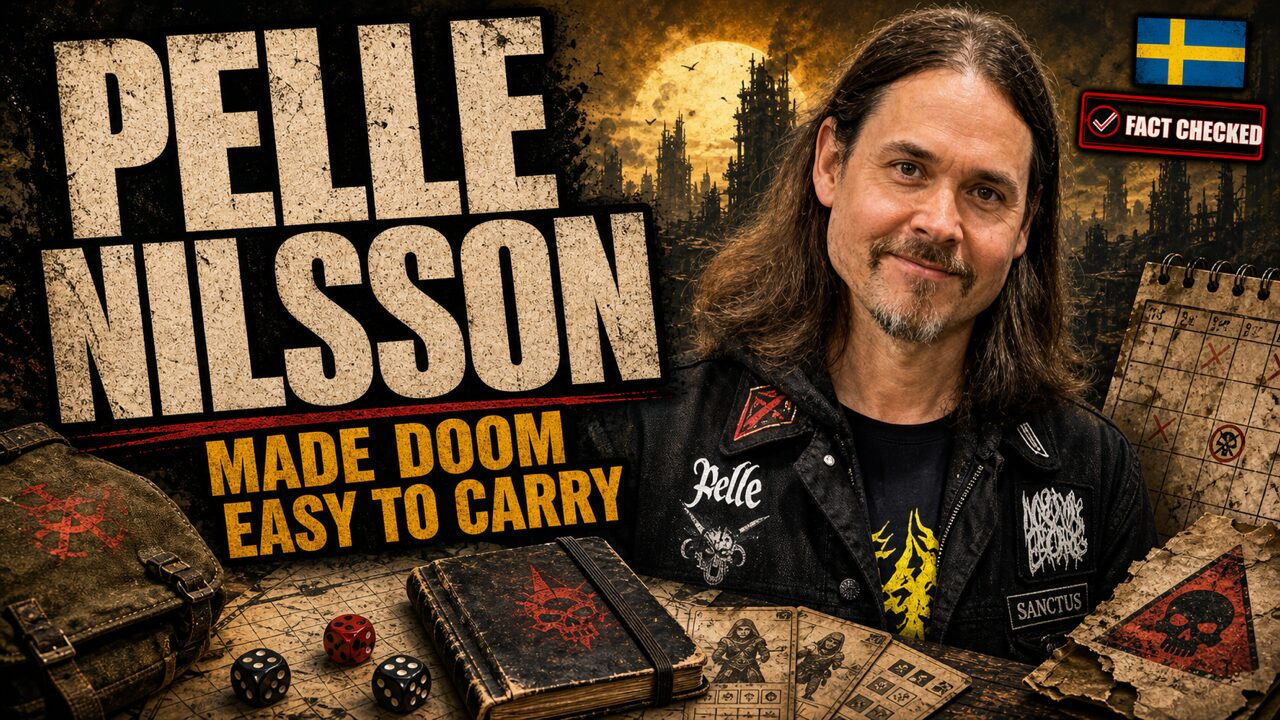
The book arrives in acid yellow, blackletter, torn images, violent contrast, and pages that seem ready to come apart. Its world is dying. Its calendar counts toward an apocalypse. Characters are fragile, equipment is filthy, and the rules have no interest in promising a balanced heroic career.
Then play begins, and the machinery is small.
Pelle Nilsson wrote the text and designed the rules. Johan Nohr created the art, typography, layout, and visual identity. Together they made MÖRK BORG, but their credits are not interchangeable. Nilsson’s part of the collaboration is the compact engine under the noise.
The game can be learned quickly. Characters can be created fast. A referee can carry the structure into a new scenario without hauling a large rules architecture behind it. Death may be close, but preparation does not have to be.
Nilsson made doom portable.
Before The Yellow Book
Pelle Nilsson is a Swedish roleplaying game writer and designer. His full legal name, birth year, birthplace, and current residence are not reliably established in the available sources. The common name also belongs to other people. The public work is the safer place to begin.
Before MÖRK BORG, Nilsson was already testing how much a roleplaying game could remove while preserving a distinct place and tone.
Ut mot skären explored the Swedish archipelago. Barkhäxan moved through folk horror, with Nilsson writing and designing while Nohr handled the visual work. GrittR compressed a doomed fantasy game into a small form. Dark Fort developed a solo procedure that could create danger with little setup.
These projects were not rough drafts of one future success. Each had its own subject and credit history. Together, they reveal a persistent question. How quickly can a game become playable without becoming empty?
Rules-light design is often described as subtraction. That misses the hard part. Removing a rule is easy. Knowing which rule must remain is design.
Nilsson kept the procedures that create pressure, risk, and immediate choice. Everything else had to justify the weight.
The End Has A Calendar
MÖRK BORG emerged from that work in collaboration with Johan Nohr. The Swedish and backer edition belongs to 2019. Its broader English release and international recognition followed in 2020.
The setting is a doomed world governed by prophecies. At the start of a game day, a die can determine whether another misery comes true. The exact pace can change by campaign, but the direction does not. The world is not waiting to be saved because the book never promises that salvation is available.
That decision changes play.
A conventional fantasy campaign can make advancement feel like insurance. Characters gain more powers, more hit points, and a larger claim on the future. MÖRK BORG makes the future unreliable. The useful question is not what the hero will become after twenty sessions. It is what this desperate person will do before the world closes.
Nilsson’s rules support that scale. Tests use a direct difficulty procedure. Combat is dangerous. Characters can be generated from tables that produce equipment, flaws, strange traits, and immediate trouble. The referee is given enough structure to make rulings without waiting for a complete simulation.
The game does not become simple in mood. It becomes simple in operation.
That distinction lets the table spend its attention on bad choices, unstable alliances, grotesque discoveries, and the black humor of people still looting a dungeon while the sky is ending.
Words And Pages
The most famous feature of MÖRK BORG is visual. That work belongs to Johan Nohr.
Nohr built the yellow and black cover, the blackletter, the collages, the angled text, and the page architecture. Nilsson supplied the core text, ideas, and game design. Patrick Stuart contributed to the English writing and creative adaptation. Free League published and distributed the game through Free League Workshop.
The clean split matters because the book succeeds through contact between two different disciplines.
Nilsson’s writing is terse enough to survive an aggressive page. A rule can be moved, enlarged, broken into a block, or surrounded by art because it does not require a textbook around it. Nohr’s graphics make the world arrive before the reader has learned the procedure. Nilsson’s rules let that arrival become playable.
Neither contribution cancels the other. The object works because they meet.
This is also why the game cannot be understood as a Free League house style. Free League gave the project international publishing and distribution. The original game came from Nilsson and Nohr through Ockult Örtmästare Games and Stockholm Kartell.
Three Gold, One Silver
At the 2020 ENnie Awards, MÖRK BORG received Gold for Product of the Year, Best Writing, and Best Layout and Design. It received Silver for Best Game.
The wording matters. It did not win four Gold awards.
The results recognized both sides of the collaboration. The writing award belongs in the record of Nilsson’s contribution. The layout and design award belongs in the record of Nohr’s visual work. Product of the Year recognized the combined object, while the Best Game result was Silver.
Feretory, a later community anthology co-curated by Nilsson and Nohr with many contributors, received Gold for Best Supplement in 2021. It should not be described as though two people created every piece inside it.
Awards helped bring attention, but the larger consequence came from what the creators allowed other people to do.
The Open Door
MÖRK BORG’s third-party license invited other creators to publish compatible material. The license provided attribution language and boundaries without demanding a share of independent creators’ work.
The number of compatible products changes constantly, so any live total will age quickly. The durable fact is the existence of a large ecosystem of adventures, classes, monsters, hacks, generators, zines, and related games.
Nilsson did not design every title with BORG in its name.
CY_BORG was written by Christian Sahlén and visually designed by Johan Nohr. Death in Space was created by Christian Plogfors and Carl Niblaeus. Pirate Borg is the work of Luke Stratton and its own team. Those games may use, adapt, or respond to the MÖRK BORG framework, but influence is not authorship.
The license extended Nilsson’s design through permission rather than control. A small rules engine became useful precisely because other people could understand it, alter it, and publish around it.
That is portability at another scale. The game travels not only in a referee’s bag but through other creators’ hands.
The Rules Under The Attitude
MÖRK BORG is often copied visually. Yellow fields, blackletter, distressed images, and blasphemous captions can be reproduced faster than a design method.
Nilsson’s deeper contribution is quieter.
He builds procedures that reach play before explanation becomes a burden. Tables produce playable trouble. Lethality shortens the distance between choice and consequence. A limited character sheet asks for decisions without demanding a career plan. The apocalypse gives every session a direction even when the characters have none.
The work before MÖRK BORG supports that reading. Ut mot skären, Barkhäxan, GrittR, and Dark Fort each tested compact forms, specific places, and reduced preparation. The famous book did not discover economy by accident. It made an existing design habit visible to a much larger audience.
What Nilsson Actually Built
Pelle Nilsson did not create MÖRK BORG alone. He did not make its illustrations, typography, or layout. He did not design CY_BORG, Death in Space, Pirate Borg, or every third-party game that adopted the label.
What he built was a rules text with enough identity to survive compression.
The apocalypse supplies urgency.
The tables supply people and problems.
The light engine leaves room for rulings.
The lethal consequences keep decisions close to the surface.
Nohr’s art made that structure impossible to ignore. The license made it easy for other creators to use. Nilsson’s contribution is the playable skeleton that both achievements could wrap around.
That skeleton does not promise fairness, longevity, or a world that rewards effort. It promises that a group can sit down, create doomed people, and discover what they do next.
The end of the world fits in the book because the rules know how little they need.
Where To Find His Work
MÖRK BORG is published internationally by Free League at https://freeleaguepublishing.com/games/mork-borg/. The official site at https://morkborg.com/ maintains game resources, the third-party license, compatible material, and routes into the wider community.
Nilsson’s earlier and independent work is associated with Ockult Örtmästare Games. Credits should be checked by edition, especially for anthologies, revised solo games, and community projects where several contributors share the book.
The next time a yellow cover makes the game look enormous, look underneath it. Pelle Nilsson’s achievement is that the rules remain small enough to pick up, change, and carry toward the end.
Fact Check Notes
Publication notes
This site is AI-assisted and human-reviewed. We use artificial intelligence to help gather research, organize source material, and draft profile content. Human editors then read, revise, and check each profile before it goes live. Most profiles are built through deep AI research and two separate rounds of fact-checking.