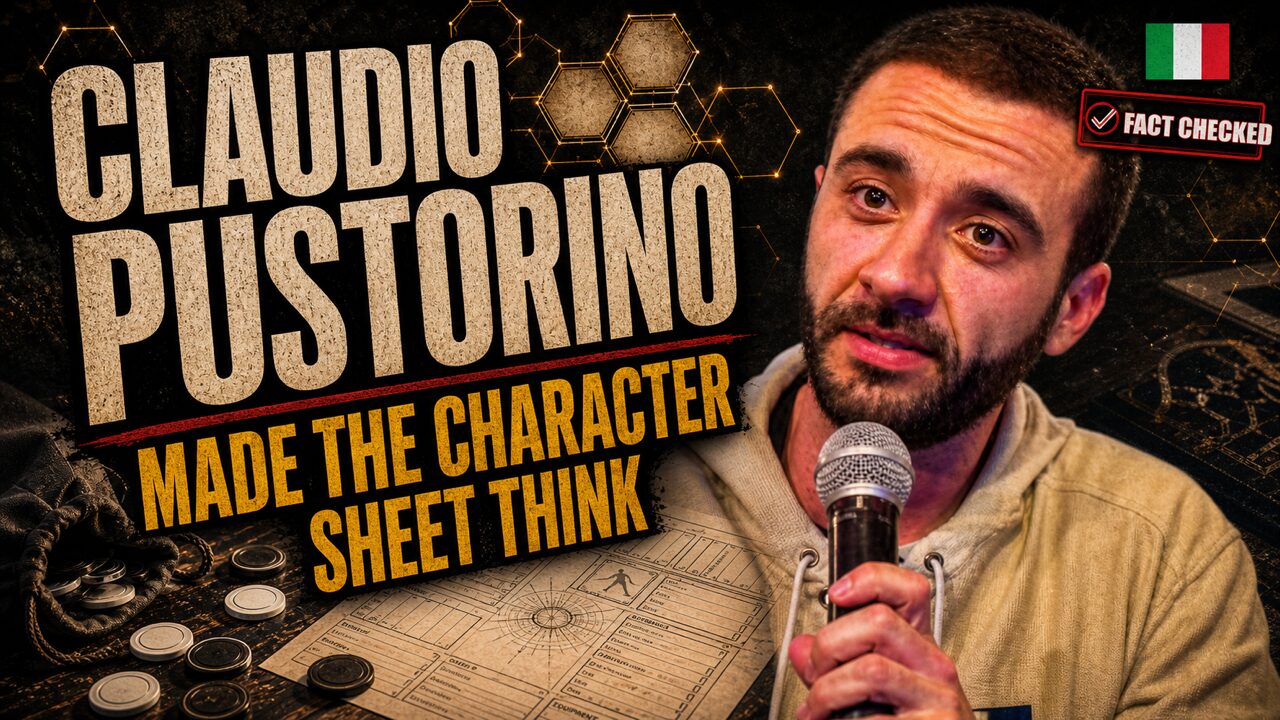
It is a hive of hexagons. The hero’s identity sits near the center. Traits, abilities, bonds, and flaws spread around it in words chosen by the player. Their placement creates relationships that can be understood before a rule is looked up.
Then the player reaches into a bag.
Positive tokens can produce success. Negative tokens create complications. They do not cancel each other. A character can achieve exactly what mattered and still make the situation much worse.
Claudio Pustorino brought the original idea, art direction, and layout to Not the End. The game-design credit is shared with Fabio Airoldi and Claudio Serena. That distinction is essential, because the story of the game is not a lone-designer story. It is the story of a team building an interface for risk.
Pustorino’s recurring move is to make the information at the table carry emotional weight. The sheet thinks because its shape helps the player think. The bag matters because the hand must decide how much danger to draw.
The rule is not hidden behind the experience. The rule creates the experience.
Before Level One
Pustorino grew up at an older brother’s table, playing early Dungeons & Dragons. Years later, he returned to that material from an unusual direction.
Il Manuale dei Livelli Infimi: La Forgia degli Eroi explored the awkward life of adventurers before conventional first level. The title began as a joke about epic-level play, then became a serious design problem. What happens when level one is the finish line?
The project originated with Pustorino, but development and writing were shared with Tiziano Furlano and Fabio Passamonti. Paolo Pustorino and Noemi Mancini handled narrative contributions, and Claudio Trangoni created the cover art. The surviving credits place the work in the 2006 to 2008 period. Later digital appearances should not be mistaken for the original date.
The supplement reduced competence instead of adding power. It asked players to inhabit the fragile stage before a fantasy hero could rely on a finished class package. That inversion already contained a pattern Pustorino would revisit: vulnerability is not a delay before the interesting story. Vulnerability is where the interesting story begins.
There is no reliable product-credit evidence for a MethyrFall design role, despite a later community description calling Pustorino a collaborator. The published author records name Alessandro Santori and Fabio Passamonti. The claim stays outside this article.
The Podcast As Playtest Lab
Pustorino later joined Fumble GDR, which began as an Italian actual-play podcast and grew into an independent publishing operation. He first entered as a speaker. Working with Claudio Serena helped pull him back toward publishing.
Actual play made design friction audible. A rule that required repeated consultation did not merely slow one player. It interrupted a broadcast, broke a conversation, and forced everyone to wait while the table reconstructed the procedure.
Fumble also exposed Pustorino to many kinds of games. He has described that range, rather than one single influence, as central to his design education. The podcast gave him a place to feel different systems at table speed.
When Fumble expanded into publishing, roles multiplied. Pustorino worked on layout and game-design consultation for projects by other authors. Serena carried administration, logistics, and fulfillment. Those jobs belong to the people who performed them. Publishing a line does not make every title an original Pustorino design.
It did give him a close view of how a rule moves from an idea into an object somebody else can use.
Forty Character Sheets
Work on Not the End began before the game’s 2020 release. In a direct interview, Pustorino recalled meeting with Fabio Airoldi in a home tavern to map ideas, test them, discard working systems that missed the goal, and try again.
One problem was the hive.
Pustorino wanted the physical arrangement of traits to mean something, but early versions tried to define those relationships for the player. He said he iterated at least forty character sheets before recognizing that the useful move was not to provide the correct diagram. It was to give players enough open structure to apply their own mental models.
The token bag went through the same pressure. The team wanted outcomes without numerical arithmetic. Early custom dice still required players to read and interpret symbols. Tokens reduced the procedure to physical choices that remained narratively rich.
For a test, positive and negative tokens enter the bag. The player chooses how many to draw, up to four. Drawing more can produce more success, but it also opens more space for complications. Because the results coexist, the game does not reduce a dramatic moment to pass or fail.
The player is not asked, "Can I beat the number?"
The player is asked, "How much am I willing to let happen?"
Character growth follows the same logic. A player can declare a test Crucial before knowing the result. The experience changes the hero whether the attempt succeeds or fails. A trait can be added or reshaped. The hive becomes a record of what the story did to the character.
Even a hero’s final ending remains under player control. A single unlucky draw cannot erase the character without narrative choice. The system protects consequence without turning randomness into authorship.
Not the End won Italy’s Gioco di Ruolo dell’Anno for 2020. Its English edition later received six nominations in the 2024 ENNIE Awards, including Best Rules, Best Layout and Design, and Product of the Year. It did not win those categories. The official ENNIE listing preserves the shared author credit for Pustorino, Airoldi, and Serena, with layout and design credited to Pustorino and art credited to Pietro Bastas.
The Page Is Part Of The System
Pustorino’s professional work in experience design helps explain why the sheet, page, and procedure receive so much attention. His current portfolio describes more than fifteen years in UX and a concern with information clarity, onboarding, and cognitive load.
That language can sound abstract until it reaches a table.
Cognitive load is the moment a player knows what a hero wants but cannot find the rule. Onboarding is the distance between opening the book and making a meaningful choice. Information architecture is whether the answer appears where the eye expects it.
Pustorino treats these as game-design questions, not decoration applied after the mechanics are finished.
PRISM sharpened the method. Characters and the dystopia are described with words written on reusable tokens. Drawing and marking those tokens turns psychological pressure into a visible object shared by the table. Pustorino is credited as author, art director, and layout artist, with Claudio Serena named as a collaborator. Proceeds from its original campaign supported the La Gilda LGBTI+ center, a fact Pustorino identifies as a point of pride.
Vileborn moved into coming-of-age dark fantasy. Pustorino’s portfolio credits him as author, art director, and layout artist, with Cecilia Gordigiani and Stefano Mancuso named as collaborators and Horrible Guild as publishing partner. The game uses a different resolution system, but the design question remains familiar: how can a procedure make inner conflict legible without turning it into a lecture?
MemoryCore carries the interface idea toward 32-bit console nostalgia. Horrible Guild credits Pustorino as designer of the anthology, while its preview document separately credits development, artwork, graphic design, and art direction across a larger team. As of July 20, 2026, it is a crowdfunded project with future delivery. It should not be described as a finished product that has already been inspected in full.
Those later games are not extensions of one mechanical trick. They are extensions of one habit: build the emotional promise into the object players touch.
What He Actually Built
Claudio Pustorino did not create Not the End alone. Its game design belongs to Pustorino, Fabio Airoldi, and Claudio Serena. Pietro Bastas created its illustrations. Other collaborators, editors, publishers, and playtesters carried distinct parts of the work.
He also did not design Fabula Ultima. Pustorino appears in supporting and consultation contexts around other Italian RPG projects, but proximity is not authorship.
What he built is a body of work in which the interface is allowed to make a dramatic argument.
The hive says identity is relational.
The bag says success and harm can arrive together.
The Crucial Test says growth comes from what mattered, not from winning.
The marked token says pressure should leave visible evidence.
Pustorino keeps asking the rulebook to do more than explain a system. He asks it to prepare the player for the kind of decision the game wants.
That is why the character sheet seems to think. It does not supply the answer. It arranges the question so the player can answer it.
Where To Find Him
Pustorino maintains a current English-language portfolio at https://claudiopustorino.com/. It includes pages for Not the End, PRISM, and Vileborn, along with role and collaborator information.
Horrible Guild lists Vileborn and MemoryCore through its official roleplaying catalog. The official Gioco dell’Anno archive records Not the End as the 2020 winner, and the ENNIE Awards preserve the 2024 nomination and credit record.
The credited name is Claudio Pustorino. "Fabio Pustorino" is unsupported. Fabio Airoldi is a real co-designer of Not the End, but no source proves that the earlier name error came from combining their names. That explanation remains plausible, not established.
The more useful correction is built into the work itself. Three designers made the game’s system. One of them spent years learning how to place information where a hand, an eye, and a story could all reach it.
Fact Check Notes
Publication notes
This site is AI-assisted and human-reviewed. We use artificial intelligence to help gather research, organize source material, and draft profile content. Human editors then read, revise, and check each profile before it goes live. Most profiles are built through deep AI research and two separate rounds of fact-checking.