Fact-Checked Icon
Emanuele Galletto
Designer Who Put The World In Every Player’s Hands
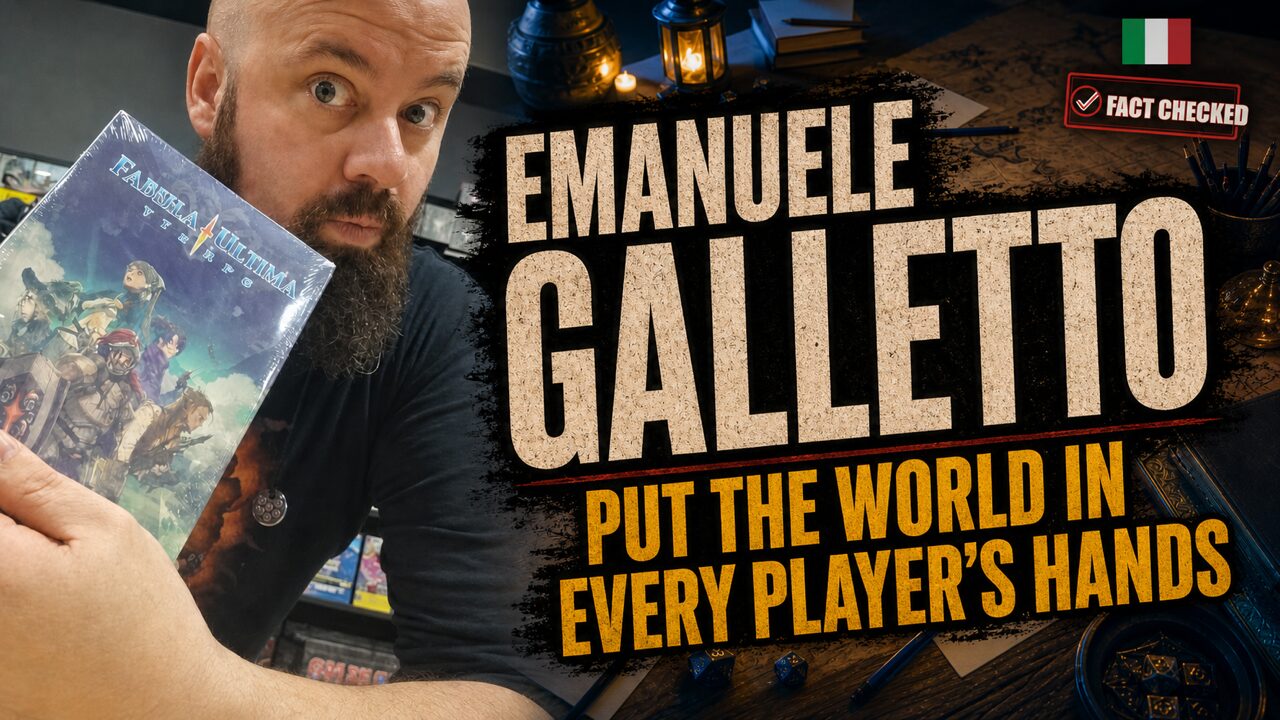
Fabula Ultima begins before the heroes have a kingdom to save.
There is no official world map waiting inside the core rulebook. The group creates the world together. Players place nations, ruins, threats, mysteries, and relationships on the table before the first campaign scene begins. The Game Master has authority, but not sole ownership.
That decision is the center of Emanuele Galletto’s design. Fabula Ultima looks toward the bright colors, job systems, rivalries, and impossible finales of Japanese console roleplaying games. Underneath that familiar energy sits a less familiar proposition: everybody at the table should help decide what matters.
Galletto did not invent collaborative worldbuilding. The designer says so directly. The achievement was to bring lessons from experimental tabletop games into a form that could feel as immediate and inviting as a beloved JRPG.
The party does not merely enter the world. The party helps build it.
The One-Person Workshop
Galletto was born in Piedmont in 1992 and studied Comics and Illustration at the Academy of Fine Arts in Bologna. The early goal was visual work. Tabletop design grew beside it.
Small independent games offered a practical education. A creator with limited resources could write rules, draw creatures, choose type, build a character sheet, and release a complete object without waiting for a large studio. Galletto has described that early identity as a one-person army, able to handle writing, illustration, mechanics, and presentation.
That range matters because rules do not reach players as mathematics alone. They arrive on a page. The size of a heading, the order of a procedure, and the amount of information visible at once all affect whether a rule can be used during play.
Fleshscape made the connection visible in 2017. The game grew from Galletto’s illustration work at the academy and became a compact roleplaying game set in a world of flesh, bone, and enormous dead bodies. GG Studio published the Italian edition. Rooster Games, Galletto’s own authorial imprint, carried the English work.
Other small projects explored different constraints. Broken Binary compressed cyberpunk play into a folded sheet. Seppuku: Fury of the Samurai used a solo format and a document designed to fold like a death poem. Fan projects and hacks tested how existing systems could carry different genres. They were not official adaptations of the properties that inspired them, and they should not be confused with licensed commercial games.
The catalog was uneven by design. A short experiment could answer one question, then clear space for the next. Galletto was learning how much structure a game needed and how little friction a page could create.
The Work Around The Rules
Before Fabula Ultima became an international line, Galletto also worked across illustration, translation, cartography, graphic design, and layout.
Those roles must stay separate from original game design. Creating a map for another writer’s setting does not make the cartographer the setting’s author. Laying out a rulebook does not transfer ownership of its mechanics. Translation carries somebody else’s text across languages.
The distinctions do not make the work minor. They explain part of Galletto’s later strength.
Working on projects such as The Silence of Hollowind required communication across writing, visuals, and production. Cartography work for settings such as Shintiara and Chronica: Age of Exploration turned worlds into usable reference objects. Layout work for other publishers trained the eye to see where readers hesitate, search, or lose the thread.
Galletto eventually brought that full toolkit to a much larger project.
The Impossible Project
Fabula Ultima was already taking shape by 2017 and had a substantial draft by 2018. Galletto wanted a complete tabletop expression of the Japanese roleplaying games that had shaped a generation of players: heroic parties, modular jobs, escalating villains, emotional reversals, and worlds that could mix magic with technology.
The title is a playful echo of Final Fantasy, but the game is not an unofficial Final Fantasy adaptation. It is its own system and setting framework.
Need Games became the publishing partner. The company now describes Fabula Ultima as a game by Emanuele Galletto, published in 2022. Rooster Games remains part of the rights and authorial structure, while Need Games handles the commercial line. The published book also depends on many credited contributors, including editors, sensitivity readers, graphic designer Erica Viotto, cover artist Moryo, and an international art team.
Galletto led game design, writing, development, and art direction. That is a large creative center. It is not a reason to erase the people who helped turn the system into a book.
Borrowed Parts, Named Sources
Fabula Ultima’s strongest design claim may be the honesty of its assembly.
Galletto has described the game as beginning like a hack: pieces came from several places and were reassembled for a different purpose. Ryuutama informed the four attributes represented by die sizes and the idea of building a world together. Clocks arrived through Blades in the Dark and the lineage of Apocalypse World. The clear presentation of Dungeons & Dragons Fourth Edition helped shape how information could be organized. Japanese tabletop games and console job systems informed the modular class structure.
The designer contacted creators when questions of permission or provenance arose. In interviews, those sources are named rather than buried under a claim of total originality.
Fabula Ultima then makes the combination its own.
Characters distribute levels across multiple classes instead of following one locked profession. A hero can become a blend of roles, built for party combinations rather than individual dominance. Fabula Points reward players for bringing identity, bonds, and complications into the story. Villains receive Ultima Points, giving major antagonists the dramatic resilience expected from a console boss without pretending that the Game Master is simply ignoring the rules.
The system’s battles use elemental weaknesses, status effects, and coordinated abilities. Its scenes use clocks and shared narrative authority. The Eight Pillars give every created world a recognizable dramatic skeleton without supplying a canonical map.
The result is neither a direct simulation of a video game nor a collection of references. It is a tabletop answer to a genre question: what must players do together for a JRPG story to feel alive without a computer running it?
The Book As Interface
Galletto’s graphic background is not decoration around that answer. It is part of the answer.
Fabula Ultima uses a compact format, visible procedures, and modular information. Character building resembles the pleasure of opening a job menu, but the choices must remain legible with paper, pencils, and dice. Enemies can be assembled to challenge a particular party. The book’s visual structure helps a group find the rule that makes the next decision possible.
This is where the early one-page games matter. Compression taught Galletto to ask what could be removed. Freelance layout taught what readers needed to see. Illustration training taught how a page could create emotional expectation before the rule was understood.
The game is colorful because the genre is colorful. It is organized because a table cannot pause for a hidden menu.
Awards Without A National Trophy
Fabula Ultima won Italy’s Gioco di Ruolo dell’Anno for 2022. In 2023 it received the Gold ENNIE for Best Game and the Silver ENNIE for Product of the Year.
Galletto resisted turning those awards into a nationalist story. In a public note after the ENNIE wins, the designer emphasized that the game was made by people from several countries and was meant for players across borders. The point was not to deny the Italian publishing origin. It was to protect the collaborative truth of the work.
That distinction appears throughout the project. The original language was Italian. Need Games is an Italian company. The game then moved into English, French, German, Spanish, Polish, and other markets through different publishing and localization teams. Each edition involved additional people whose labor should not disappear behind one author’s name.
The line grew through the High Fantasy, Techno Fantasy, and Natural Fantasy Atlases, a Game Master’s Toolkit, introductory material, free supplements, and a later Celebration Edition and bestiary campaign. The official Need Games page continues to route players to the game, its expansions, and a third-party license for community creators.
What Galletto Actually Built
Emanuele Galletto did not invent collaborative worldbuilding, progress clocks, or attribute dice. Galletto did not create every illustration, edit every sentence alone, or perform every localization. Work on other publishers’ games does not make those games original Galletto designs.
What Galletto built was a bridge between forms of play that had often been kept apart.
Fabula Ultima takes the immediate language of console RPGs and connects it to shared authorship, narrative currencies, modular character construction, and explicit design lineage. It invites players who recognize a job screen or a final boss, then asks them to accept more responsibility than a digital game usually allows.
The world is not delivered. The group makes it.
The hero is not assigned one path. The player combines several.
The story is not protected by one authority. Everyone has a hand on it.
That is the design move underneath the awards and international editions. Galletto put the world in every player’s hands, then built rules that made the responsibility playable.
Where To Find The Work
Need Games maintains the official Fabula Ultima page at https://need.games/fabula-ultima/. It includes the core line, free Press Start material, downloads, retailer routes, and the third-party license.
Galletto’s independent work and current project notes remain available through the Rooster Games Patreon at https://www.patreon.com/roosterema. The ArtStation portfolio at https://roosterema.artstation.com/ preserves examples of illustration, cartography, graphic design, and Fabula Ultima work.
Current first-party profiles do not state a pronoun preference. A direct 2023 interview recorded Galletto welcoming any pronoun, and a public profile from that period displayed he/she/they. Because personal language can change, this article avoids converting that older statement into a permanent label.
The disputed economics-degree and Aosta project-officer profile is also omitted. Available records do not prove that it belongs to the game designer, and parts of the research treat it as a separate namesake.
The verified story is already enough. A creator trained to draw and arrange pages spent years learning how systems speak. Then Fabula Ultima gave an entire party the right to answer back.
Fact Check Notes
Publication notes
This site is AI-assisted and human-reviewed. We use artificial intelligence to help gather research, organize source material, and draft profile content. Human editors then read, revise, and check each profile before it goes live. Most profiles are built through deep AI research and two separate rounds of fact-checking.