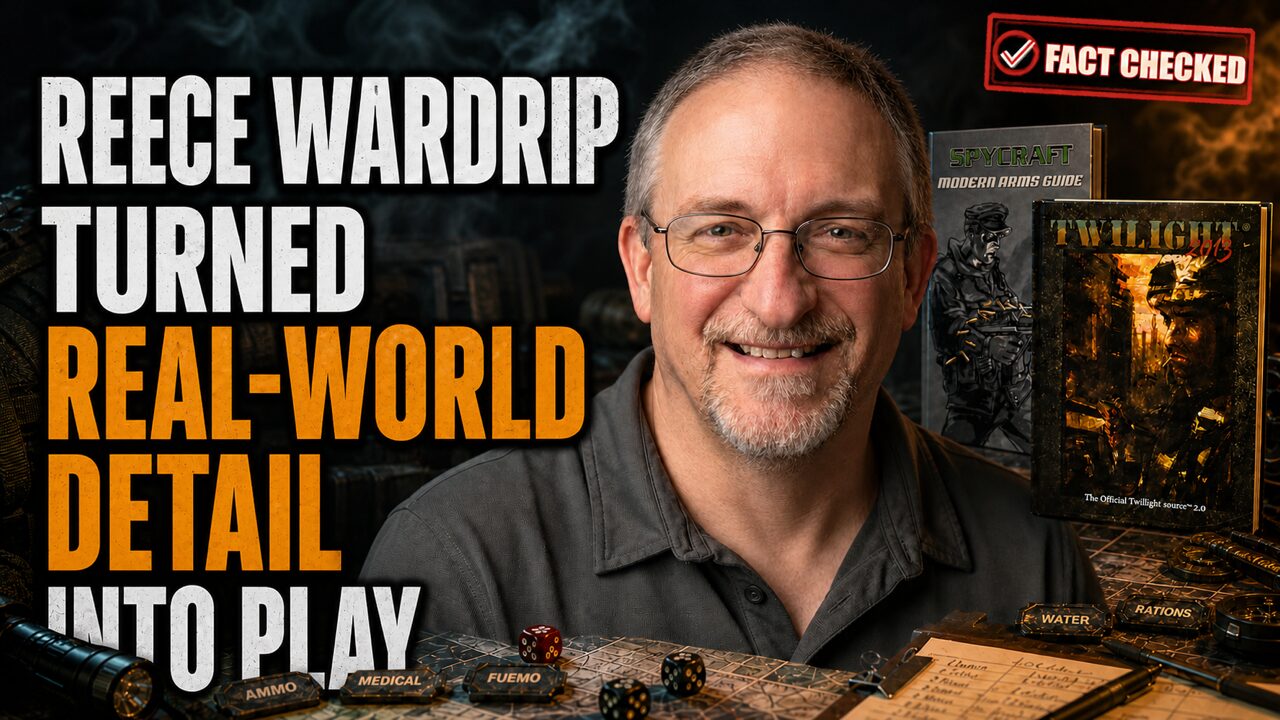
Weapons need ranges. Equipment needs limits. Training needs to become an ability a player can use. Military organizations need to be recognizable without forcing everyone at the table to read a field manual. The details have to be convincing, but the result still has to be a game.
That was Wardrip’s territory.
His older credits usually appear under Jim Wardrip, while Reece Wardrip is his current public name. The change can make a compact career look even smaller when databases split the same person’s work between names. Once the printed credits, magazine bylines, and archived pages are brought together, a much broader record appears.
Wardrip was part of the original Spycraft/Shadowforce design team. He coauthored Spycraft: Modern Arms Guide and received an author credit on Spycraft: U.S. Militaries. He served as a consultant on Spycraft: Battlegrounds and later received additional conceptual and design assistance credit on Twilight: 2013. He wrote about firearms for Games Unplugged and Demonground, published his own detailed d20 Modern supplements through RPGNow, and listed the SnarfQuest role-playing project among his published work.
This was not a career built around one famous cover.
It was built around knowing how things work.
Practical Knowledge Before Game Rules
Wardrip’s interest in military systems did not begin as library research.
In a biography preserved from his early-2000s website, he described entering the Army Reserve as a combat engineer while still in high school. He later served in the Kentucky Army National Guard as an M1 tank crewman and in the United States Navy as an Electrician’s Mate aboard USS Simpson.
Those experiences do not automatically make someone a good game designer. They do give a designer a different set of questions.
How much training does a task require? What can an average operator reasonably do? Which technical differences matter in practice? What breaks when equipment is pushed beyond its intended use? What information helps a player make a decision, and what information only slows the game down?
Wardrip carried those questions into tabletop work.
His archived biography says that after military service he pursued freelance assignments in the adventure-game industry. It also identifies him as a lifelong player of pen-and-paper role-playing games. The combination is important. He was not simply translating specifications into statistics. He understood that a technically correct answer can still fail as a rule.
The objective was usable detail.
The Design Team Behind Spycraft
Spycraft arrived in 2002 as a cinematic espionage role-playing game built on the d20 System. Its central authors were Patrick Kapera and Kevin Wilson, and the game was produced by a large team of writers, developers, editors, and designers.
Wardrip’s place in that history should be stated precisely.
The original credit material lists Sean Michael Fish, B.D. Flory, Scott Gearin, and Jim Wardrip as the Spycraft/Shadowforce design team. That does not make Wardrip the sole designer or author of the core rulebook. It does establish that his involvement began inside the line’s design structure, not as a distant association added years later.
Spycraft needed rules for a world of agents, covert operations, modern weapons, vehicles, surveillance, and specialized training. The game had to feel more technically grounded than a fantasy dungeon while still moving with the speed of an action film.
That tension became even more visible in Spycraft: Modern Arms Guide.
Published by Alderac Entertainment Group in 2002, Modern Arms Guide was a collaborative sourcebook with Wardrip among its credited authors. It expanded firearms, melee weapons, tactical equipment, weapon modifications, movement, morale, initiative, and other combat options. It was not simply a catalog of guns. It was an attempt to decide how much modern combat detail the d20 framework could carry.
No surviving chapter byline reviewed for this profile assigns an individual section to Wardrip, so it would be wrong to credit him with every rule in the book. His independent writing from the same period does reveal the design problem he cared about.
On his archived Gunfighter Quarterly page, Wardrip explained why his firearm ranges differed from those in other d20 products. He argued that the base range should represent what an average trained shooter could reasonably accomplish, while feats should extend the performance of more experienced characters.
That is a small design decision with a clear philosophy behind it.
Start with a practical baseline. Let expertise expand it. Do not make ordinary competence feel artificially weak just to reserve usefulness for special abilities.
From The Core Book To The Military Guides
Wardrip’s Spycraft work continued beyond Modern Arms Guide.
The Spycraft Official Master Index and RPGnet both preserve an author credit for him on 2004’s Spycraft: U.S. Militaries, alongside Brannon Boren, B.D. Flory, Clayton A. Oliver, and Patrick Parrish. The book examined military careers, training, personnel, equipment, vehicles, and missions as material for espionage campaigns.
Here again, the job was translation.
A real military is an enormous organization made from doctrine, logistics, bureaucracy, specialized occupations, and chains of command. A role-playing sourcebook cannot reproduce all of it. The designer has to select the parts that create meaningful choices for agents and game masters.
Wardrip’s wider work list also names World Militaries, though the surviving author records reviewed for this profile do not identify his exact role on that volume. The distinction matters. Being connected to a project is not the same as writing it, and a responsible history should not turn an uncertain contribution into a false author credit.
His role on 2005’s Spycraft: Battlegrounds is clearer. The book credits Wardrip as a consultant. Battlegrounds moved the line into small-unit warfare, historical conflict zones, post-collapse campaigns, equipment retention, battlefield hazards, and simplified mass-combat effects. Consultants helped the writing team test its treatment of subjects that could easily become either vague action-movie scenery or unusable technical overload.
Wardrip’s name belongs in that supporting structure.
That kind of credit is less visible than the name on a cover, but games depend on it. A consultant can catch the assumption that sounds plausible but is not. A systems specialist can notice when the numbers produce the wrong behavior. A designer with practical experience can ask whether the rule rewards the decision the game claims to model.
The Magazine Work
Wardrip was publishing technical game material before his better-known book credits were complete.
His archived credit page identifies two pieces in Demonground. Issue 8 carried an article on caseless ammunition. Issue 11 included his Heckler & Koch MP5 article, cataloged by RPGGeek as "Weapons Development: The Versatile MP5."
Games Unplugged issue 8 carried two more pieces under his name: "D20 Firearms" and a review of Knuckleduster.
Those credits show two sides of his work.
The firearm articles required research, selection, and rules judgment. The review required criticism. It is one thing to build a system. It is another to explain whether someone else’s system succeeds, what it offers, and where it falls short.
Magazine work also demanded compression. A designer could not solve every question with another chapter. The subject had to be reduced to the information a reader could understand and use within a few pages.
That discipline would carry into Wardrip’s independent publishing.
The Rpgnow Years
Long before digital-first tabletop publishing became ordinary, Wardrip was selling his own PDF supplements through RPGNow.
Gunfighter Quarterly: Tools of the Trade for the Modern Gunfighter appeared in 2003. Wardrip described it as a collection of firearms, gear, customization options, and optional rules for d20 Modern. It included material for precision rifles, shotguns, weapon modifications, feats, and contemporary military firearms.
He was also unusually direct about the audience.
The product was not designed for everyone. Wardrip said its added detail and rule variations would create more complexity than some players wanted. Its purpose was to serve the players who wanted more technical depth than the base d20 rules provided.
That admission makes the design stronger.
Complexity is not automatically realism, and realism is not automatically fun. A designer has to know who the rule is for. Wardrip was not claiming every campaign needed another firearm table. He was making a focused tool for groups that wanted the differences between weapons, ammunition, training, and customization to matter.
Gunfighter Quarterly 2: Full Auto continued the approach. Its archived product page describes new rules and feats for automatic fire, ammunition choices, revised damage values, legal and illegal access to automatic weapons, weapon conversion, and a machine-gun guide covering systems such as the M60 and M249.
Both products were advertised as RPGNow exclusives.
A contemporary review of the first issue, dated June 11, 2003 and later preserved by Geek Native, gave it a 9 out of 10. The reviewer praised the technical and historical material, the usefulness of the d20 statistics, and Wardrip’s responsiveness when a missing rule was identified.
That last point matters. Independent PDF publishing allowed a designer to hear from a customer, correct a problem, and update a product without waiting for another print run.
Wardrip was using that model when it was still new.
Snarfquest And A Different Kind Of Detail
Wardrip’s archived credits also list Elmore Productions’ Snarfquest d20 project.
The surviving preview for The SnarfQuest RPG World Book does not name Wardrip among its principal writers and designers, so his exact assignment should not be guessed. His own historical credit list establishes that he worked on the project, not that he authored the book.
Even with that boundary, SnarfQuest adds something important to the picture.
Wardrip’s most visible work involved modern weapons, military organizations, and technical systems. SnarfQuest adapted Larry Elmore’s comic fantasy world into role-playing material built around humor, strange characters, adventure hooks, and deliberately ridiculous situations.
Technical discipline is not limited to serious subjects. Comedy also needs structure. A joke in a comic strip can happen once because the author wants it to happen. A joke in a role-playing game has to survive player choice, repeated use, and rules interaction.
The project shows that Wardrip’s production history was not confined to firearms.
Twilight: 2013
Wardrip later returned to military survival gaming through Twilight: 2013, the licensed third edition of Twilight: 2000 published by 93 Games Studio in 2008.
The credit page lists him under "Additional Conceptual and Design Assistance." It also includes him among the game’s consultants, with his surname misspelled in that second line.
Again, the exact role is more useful than an inflated one.
Wardrip was not one of the book’s three credited designers and was not part of its main writing team. He contributed conceptual and design assistance to a game built around military expertise, equipment, survival, logistics, and the collapse of normal systems.
That credit fits the pattern established by the rest of his career.
Wardrip’s strength was not attaching his name to every page. It was bringing specialized knowledge into a design process and helping turn that knowledge into decisions players could manage.
What His Career Adds Up To
Reece Wardrip’s tabletop record is easy to miss if someone searches only his current name or looks only for lead-designer credits.
The record is spread across a design-team page, collaborative sourcebooks, consultant lists, magazine contents, an archived personal website, and early digital products that disappeared when storefronts and domains changed.
Put together, those pieces tell a coherent story.
Wardrip worked where modern role-playing games meet real equipment and real institutions. He helped Spycraft build its technical foundation. He coauthored books that turned weapons and military structures into game material. He advised projects that needed credible battlefield and survival detail. He wrote compact magazine pieces, evaluated other publishers’ work, and created his own specialized supplements for players who wanted more depth.
He also understood the limit.
The purpose of research was not to bury the table under information. It was to produce a better choice.
How far can the character reasonably shoot? What does training change? Which piece of equipment fits the mission? When should a rule remain simple, and when does the audience want more?
Those questions rarely produce a dramatic origin story. They produce a game that feels more believable when the dice hit the table.
Today, Reece Wardrip continues to make games independently. His career is not the story of one title or one company. It is the story of a specialist whose work moved through teams, books, magazines, consulting credits, and early digital publishing.
He made the complicated material usable.
That is design.
Fact Check Notes
Publication notes
This site is AI-assisted and human-reviewed. We use artificial intelligence to help gather research, organize source material, and draft profile content. Human editors then read, revise, and check each profile before it goes live. Most profiles are built through deep AI research and two separate rounds of fact-checking.
Leave a Reply
You must be logged in to post a comment.