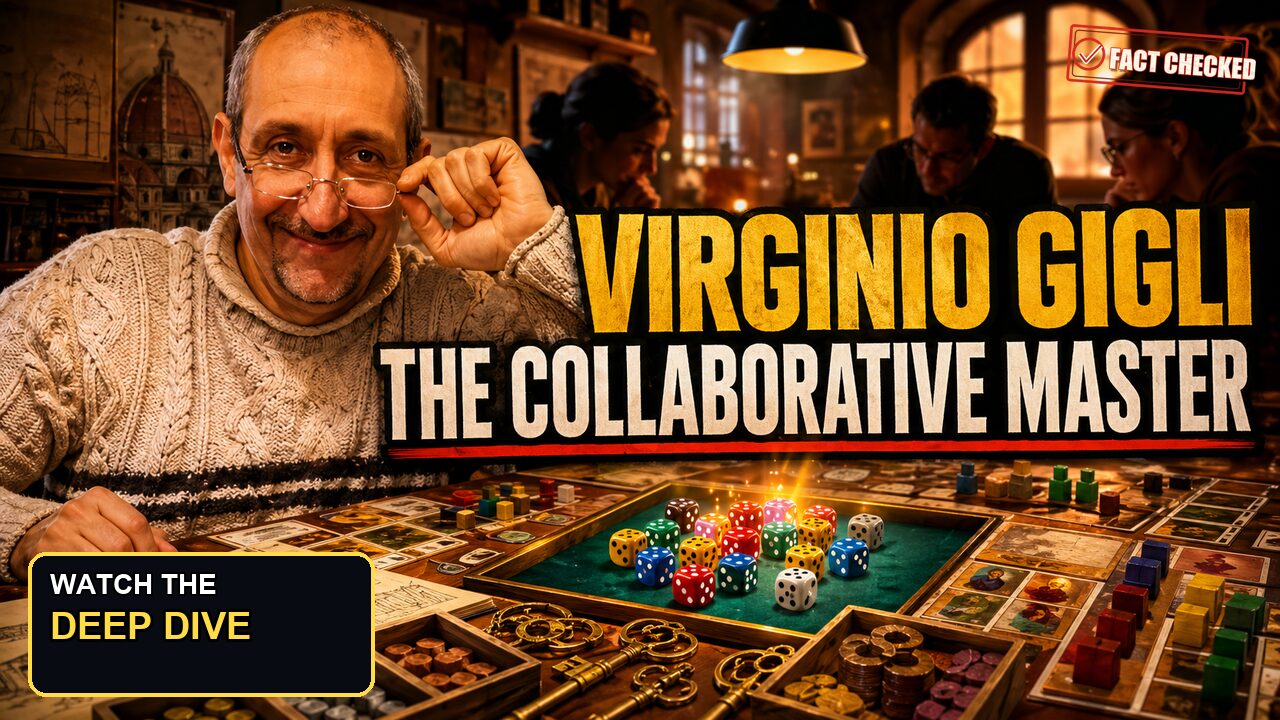
That is not a footnote.
It is the point.
Modern heavy Euro design is full of partnerships, testing groups, shared notebooks, and designers who build by argument. One person brings the central mechanism. Another sees the economy. Another finds the theme that makes the mechanism feel inevitable. The final box carries several names because the game was not born from one locked room.
Gigli belongs to that tradition.
His best-known games do not ask to be understood as solo monuments. They ask to be understood as collaborative machines: tuned, pressured, clever, and built with the Italian school’s appetite for mechanisms that make every choice hurt a little.
The Collaborative Master
Virginio Gigli has co-designed some of the most acclaimed heavy Euro games of the 2010s, working consistently with Italian collaborators Simone Luciani and Flaminia Brasini.
Grand Austria Hotel, co-designed with Luciani, is widely considered one of the best medium-heavy Euros of its decade. It uses a dice-draft system where players select actions from a shared pool of rolled dice, creating a tight economy where the value of every choice depends on what everyone else has left available.
Lorenzo il Magnifico, designed with Brasini and Luciani, refined the shared-dice-value concept into a worker-placement framework where dice rolls set the strength of everyone’s workers at the same time.
The collaborative nature of Gigli’s work is both its defining strength and the challenge of describing it cleanly. The games are excellent. The question of which specific design contributions belong to Gigli versus his co-designers is difficult to answer from outside the design room.
What is clear is that Gigli is a consistent presence in some of the most architecturally sophisticated Euro games of the modern era, and that his partnerships produce results greater than any individual credit would suggest.
The Italian School
Gigli is part of the same Italian design wave as Luciani, Brasini, and Tascini: a collaborative culture based around the Italian board game community and especially associated with mechanism-forward Euro design.
Coimbra, designed with Brasini, used a dice-draft-to-card-acquisition system with elegant many-path rewards. Alma Mater tackled university management. The catalog sits deep in the heavy Euro tradition, with each game featuring a distinctive central mechanism that drives strategic decisions.
The Italian school values collaboration, iterative playtesting, and systems that make players feel pressure through choice rather than through chaos. Gigli’s role within that school is as a consistent contributor whose presence on a design team correlates with high-quality output.
Whether he is the engine or the engineer, the primary creative force or the refinement specialist, the results speak to a designer who understands how to build games that work at a high level of strategic depth.
The Pleasure Of Pressure
Gigli’s games tend to make resources feel alive.
In Grand Austria Hotel, dice are not just randomizers. They are a shared market. A die face tells you what kind of action is available, but the number of dice on that face tells you how strong the action will be. The roll creates a temporary economy, and every player watches it change.
That is the kind of mechanism heavy Euro players remember.
Not because it is complicated on the surface. It is not. You look at the dice. You choose. The pain comes from what the choice costs, what it reveals, and what it leaves for the next player.
Lorenzo il Magnifico finds a related pressure point. Worker placement is familiar. Dice are familiar. The invention is how the dice sit above the whole table, setting the strength of everyone’s workers at once. A single roll becomes a weather system.
That is the Italian school at its best: not rules for their own sake, but a mechanism that turns the table into a shared nervous system.
What He Actually Built
Gigli helped build some of the cleanest medium-heavy Euro experiences of the 2010s.
The careful word is "helped."
That matters because credit should be honest. Grand Austria Hotel belongs to Gigli and Simone Luciani. Lorenzo il Magnifico belongs to Gigli, Flaminia Brasini, and Luciani. Coimbra belongs to Gigli and Brasini. Marco Polo II carries other names too.
But across those partnerships, a pattern holds. Dice become action economies. Resources tighten. Timing matters. The theme gives the mechanism a recognizable shape without smothering it.
Gigli’s importance is not that he stands alone above the table.
It is that his name keeps appearing at the table where excellent games are being made.
What Remains
The collaborations continue. Gigli remains an active presence in the Italian design community, and each new co-designed game arrives with the expectation of quality that his track record has established.
The heavy Euro tradition he works within values the kind of iterative, partnership-driven design process that makes individual attribution difficult and collective excellence undeniable.
The games are monuments built by teams, and Gigli is consistently part of the teams that build monuments.
The dice are rolled and placed in the shared pool. Every player sees the same options, but the value of each choice depends on what you need and what everyone else will take before your next turn.
The economy is tight. The decisions are agonizing. Somewhere in Italy, the design team is already working on the next one, and it will have a mechanism that makes you remember the game by remembering how it felt to choose.
Fact Check Notes
Publication notes
This site is AI-assisted and human-reviewed. We use artificial intelligence to help gather research, organize source material, and draft profile content. Human editors then read, revise, and check each profile before it goes live. Most profiles are built through deep AI research and two separate rounds of fact-checking.
Leave a Reply
You must be logged in to post a comment.