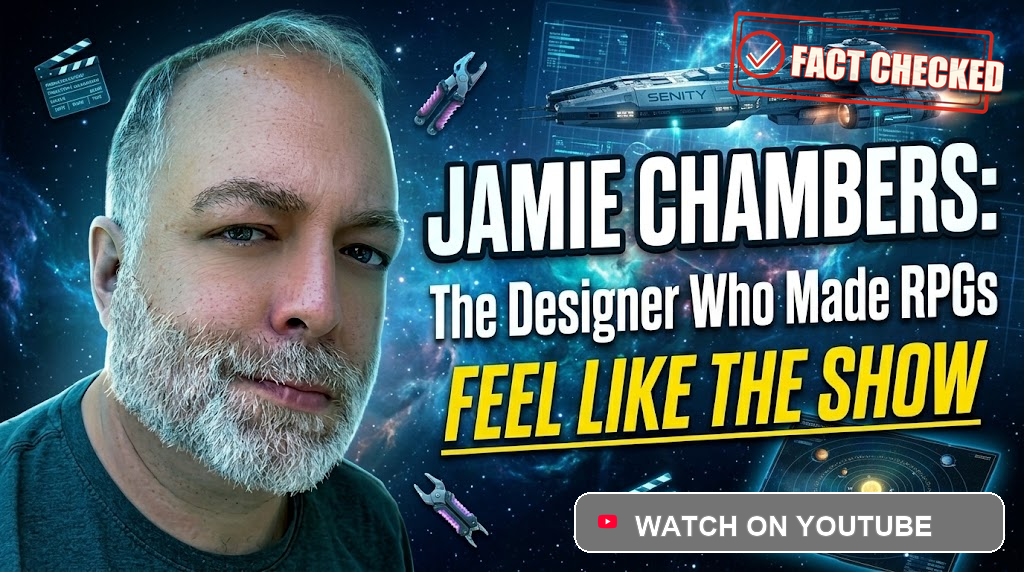
For most of tabletop RPG history, licensed games had a predictable flaw.
You’d buy a game because you loved the show. You’d expect to step inside that world. Instead, you got a familiar engine wearing a different skin. The setting changed. The rules didn’t. Whether you were playing fantasy, sci-fi, or crime drama, the underlying experience often felt the same.
In 2005, Jamie Chambers approached that problem differently.
Instead of adapting the Firefly universe to the dominant d20 system, he built a new engine from the ground up. One designed to reflect how that world actually worked. That system became Cortex, first released with the Serenity Role Playing Game.
The result wasn’t a new genre of RPG design. That shift was already happening elsewhere. What Chambers did was more specific, and more practical. He showed that a licensed game could feel like its source material, not just reference it.
From Community To Design
Chambers’ path into the industry didn’t begin with system design.
He grew up in north Georgia, surrounded by tabletop games and speculative fiction from an early age. Before he ever published anything, he spent years in organized play: working with TSR-era communities and the Role Playing Game Association, running events and coordinating tables.
That background matters more than it sounds.
Rulebooks don’t run games. People do. And the gap between those two is where most systems break.
He learned how players actually behave at the table before he ever designed mechanics for them.
The Dragonlance Translation
His professional work began with Margaret Weis Productions and Sovereign Press in the late 1990s.
When Wizards of the Coast released the Open Game License and d20 system, the industry consolidated around a shared rules framework. Sovereign Press adapted, and Chambers became part of the team responsible for translating Dragonlance into that system.
He co-authored the Dragonlance Campaign Setting (2003) alongside Margaret Weis, Don Perrin, and Christopher Coyle.
That project required balancing two pressures:
* A deeply established fictional world with a devoted readership
* A rules system built for tactical gameplay, not narrative tone
The book went on to receive the 2003 Lucca Comics & Games Award for Best Translated Game.
Between 2003 and 2007, Chambers contributed to multiple Dragonlance sourcebooks, working at the intersection of fiction and system design.
The Cortex System
The Dragonlance work proved Chambers could translate story into mechanics inside an existing framework.
Cortex proved he could build the framework itself.
Designed for the Serenity Role Playing Game (2005), Cortex shifted focus away from pure combat resolution and toward character-driven outcomes:
* Step-dice (d2 through d12) created consistent performance curves instead of swingy randomness
* Assets and Complications treated advantages and flaws as narrative drivers, not spreadsheet modifiers
* Plot Points let players spend mechanical currency to influence outcomes and, critically, redirect the story itself
Meta-currencies existed before Cortex. That wasn’t new.
What Cortex did was tie character flaws directly to player agency. The same choice that created drama also generated mechanical advantage. You didn’t play your character’s worst impulses despite the rules. You played them through the rules.
The system worked commercially and critically. Serenity won the 2005 Origins Award for Gamer’s Choice Best Role Playing Game of the Year.
Cortex expanded into multiple licensed games:
* Battlestar Galactica (2007), tuned for paranoia and slow-burn desperation
* Demon Hunters (2008), proof the engine could handle comedy
* Supernatural (2009), giving blue-collar ghost hunters a framework that matched the show’s tone
Afterward, lead development passed to Cam Banks, who evolved the system into Cortex Plus and later Cortex Prime.
A Decade In Industry Leadership
From 2007 to 2016, Chambers served as Vice President of GAMA (Game Manufacturers Association).
This period coincided with major structural shifts. Kickstarter changed how games got funded. PDF distribution reshaped what publishing even meant. Virtual tabletops started competing with physical game stores. And then D&D 5th Edition and streaming shows expanded the audience faster than anyone planned for.
The role wasn’t visible to most players, but it mattered.
Trade organizations sit between publishers, retailers, and creators, groups whose incentives rarely point the same direction. Maintaining that balance during rapid growth is less about innovation and more about keeping things from flying apart. Chambers spent nearly a decade in that position before returning to independent work.
Signal Fire And Later Work
After leaving Margaret Weis Productions, Chambers founded Signal Fire Studios.
His most notable project from this period was the revival of Metamorphosis Alpha (5th Edition, 2016), developed in collaboration with original designer James M. Ward and funded through Kickstarter.
He also released smaller-scale products like A Delve in the Cave, designed as practical, table-ready modules. The kind of product built by someone who spent years running convention tables and knew what a GM actually needs when the session starts in twenty minutes.
What He Actually Changed
It’s easy to overstate influence in hindsight. This isn’t that.
Chambers did not invent narrative RPG design. Systems like Fate and later Powered by the Apocalypse explored similar territory from different angles.
What he solved was narrower, and important: licensed game fidelity.
Before systems like Cortex, licensed RPGs often felt interchangeable at the mechanical level. Afterward, there was a clearer expectation. A Firefly game should feel like Firefly. A Battlestar game should feel like Battlestar. A Supernatural game should feel like Supernatural.
Cortex demonstrated that tone, pacing, and character tension could be embedded directly into system design, not just described in the setting.
That shift didn’t belong to one designer alone. But Chambers’ work made it visible at scale, inside commercially licensed games.
Fact Check Notes
Publication notes
This site is AI-assisted and human-reviewed. We use artificial intelligence to help gather research, organize source material, and draft profile content. Human editors then read, revise, and check each profile before it goes live. Most profiles are built through deep AI research and two separate rounds of fact-checking.
Leave a Reply
You must be logged in to post a comment.