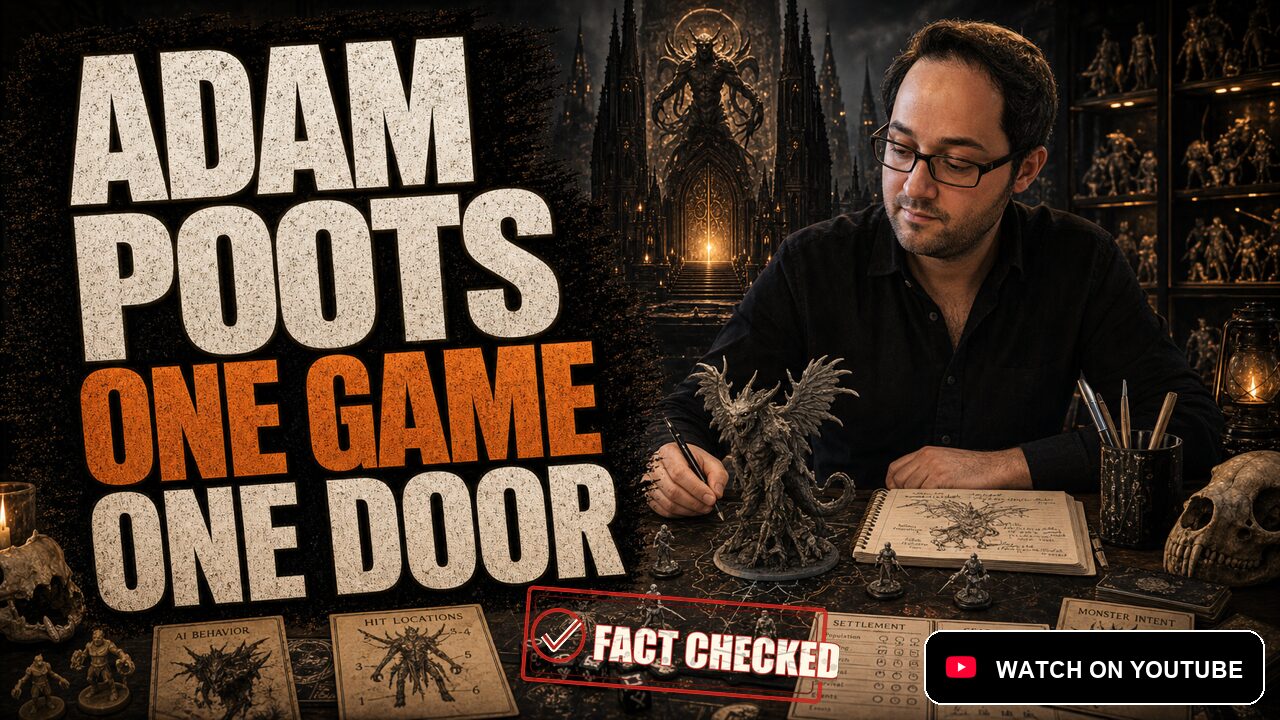
Adam Poots is best known for one game, and that phrase can mislead people.
Kingdom Death: Monster is not a box you beat and shelve. It is a campaign engine, a settlement chronicle, and a miniature line that dares you to spend hours painting a survivor who might die in ten minutes. It is also a long-running design project that keeps getting revised because the maker keeps returning to the same doorway and finding another edge to sharpen.
Poots built one cathedral and kept carving it.
Most designers learn by changing problems. They move from system to system, clean to messy, fast to slow. Poots seems to have found one problem big enough to hold a whole career: fragile people hunting impossible monsters in a world with almost no mercy, then limping home to build a civilization that might collapse anyway.
That is Kingdom Death, and it is also the boundary around Adam Poots.
The Spark Story
The old ranked story that this profile is based on frames the beginning in a blunt, almost ordinary way.
Before Kingdom Death, Poots worked in web development. Then there is a spark moment, described as happening during jury duty. Waiting around, he picked up a fantasy or roleplaying rulebook and felt the dangerous thought that launches a lot of creative lives: I could make something better.
Whether you treat that as literal origin or the kind of myth an artist tells later, it fits the work. Kingdom Death is not polite, and it is not built to be universally welcoming. It is built to feel like walking into a beautiful place that does not care if you survive.
The Hunt, The Fight, The Home
Kingdom Death: Monster runs on three repeating movements: the hunt, the showdown, and the settlement.
The hunt pushes survivors toward the quarry through events and uncertainty. The showdown is the tactical fight, where the monster is not controlled by another player, but by its own behavior deck. Then the settlement phase turns aftermath into civilization: crafting, innovation, population, principles, locations, and the slow accumulation of consequences.
If the game has a heartbeat, it is the monster AI deck. It gives each monster a personality you can learn, but never fully script. It is both opponent and wound track, because damaging the monster can remove behavior cards and change what it is capable of doing. You are not only reducing numbers. You are changing the creature.
The hit location deck adds another kind of danger. When survivors strike, they do not just deal generic damage. They hit a body part, trigger a reaction, discover a weakness, or flip over a trap that punishes the overconfident. The monster stops feeling like a stat block and starts feeling like a hostile body.
Then the gear grid turns equipment into spatial planning. Items do not just sit on a character sheet. Their positions matter. Adjacencies create synergies. Loadout becomes a puzzle before the hunt even begins.
The Settlement As Memory
The settlement is what makes Kingdom Death more than a boss-fight game.
Survivors die. New ones are born. Innovations change what your people believe. Settlement events can undo a night of careful planning. The campaign remembers.
Many cooperative games ask players to beat a scenario. Kingdom Death asks them to survive a culture. Permanent death is not there only to prove the game is hard. It is there because loss is the main storyteller. A heroic survivor can vanish. A settlement that felt stable can spiral. The best equipment can be carried into a fight by someone who never comes home.
This is the bargain the game offers. Beauty, expense, punishment, and a kind of grim intimacy that some players find addictive and others bounce off immediately.
The Refinement Loop
Kingdom Death: Monster broke out through crowdfunding in the early 2010s, and it did not stay small.
A later major campaign for Kingdom Death: Monster 1.5 raised far more money and turned the project into a small industry of expansions, revisions, and long-tail fulfillment. At the time of the record, Guinness World Records credited the 1.5 campaign as the fastest Kickstarter project to reach $1,000,000.
The important part is what the scale enabled. Poots did not take the success and pivot to a new franchise. The movement stayed inward. Version 1.0 to 1.5 to the current 1.6 framing is not a designer changing genres. It is a designer returning to the same cathedral with sharper tools: balance, component quality, rules clarifications, new monsters, and new campaign content.
That kind of devotion is rare, and it comes with a cost.
The Empty Hallway
Here is the honest boundary.
Adam Poots has not become known for a broad public catalog across many different games. His public identity is overwhelmingly Kingdom Death. That is enough to matter. It is also not enough to answer every question about range, because we do not have a long list of unrelated designs that test the same instincts in other formats.
The other boundary is influence.
Kingdom Death has passionate players, painters, collectors, strategists, and campaign chroniclers. It has inspired table stories and shelves of miniatures. But its specific mechanical mix has not become a standard template the way some other blockbuster designs have. The AI deck, hit locations, gear grid, and settlement loop are admired, but they still feel like the architecture of one particular world more than a general kit that the rest of the hobby adopted.
The cathedral has visitors, but it does not have many architects copying the floor plan.
The Miniatures Are Not Separate
Kingdom Death is inseparable from its miniatures.
The game does not treat plastic as decoration. The figures sell the scale of the monsters, the fragility of the survivors, and the strange intimacy of the world before a rule is read. The object is part of the design argument.
Many games start with mechanisms and later commission art to explain them. Kingdom Death often feels like it started with a sculpture and asked what kind of rules could make that sculpture terrifying to face across a table.
That is why the experience works for its audience. The table has to make the punishment feel worth enduring, and Kingdom Death does that through presence: enormous enemies, fragile humans, lantern light, gear cards, and a board state that looks like a ritual more than a puzzle.
The price and production model are part of the same story. This is not a cheap, frictionless product. It is elaborate, often delayed, and demanding. For Kingdom Death, the excess became part of the identity. The object feels like it belongs to the world it depicts: beautiful, hostile, and hard to enter.
What He Actually Built
Adam Poots built a single enormous design object and made it commercially real.
Not a family of games. Not a broad catalog of experiments. One door.
Behind that door is a complete world: monsters with behavior, survivors with scars, gear arranged like ritual objects, settlements that remember loss, and campaigns that turn failure into myth.
The craft is deep. The range is narrow. The commercial achievement is undeniable. The influence is strangely contained.
That is the Poots story. He did not become the kind of designer who keeps opening new rooms. He became the kind who spends years making one room impossible to forget.
Where To Find Him
Poots appears to still be professionally active through the Kingdom Death product line.
Clean public starting points:
Kingdom Death official shop (core game 1.6 listing): https://shop.kingdomdeath.com/products/kingdom-death-monster-1-6
Kickstarter campaign history:
https://www.kickstarter.com/projects/poots/kingdom-death-monster
https://www.kickstarter.com/projects/poots/kingdom-death-monster-15
If you only take one lesson from his career shape, take this.
A single game can be a life’s work if you decide to keep carving.
Fact Check Notes
Publication notes
This site is AI-assisted and human-reviewed. We use artificial intelligence to help gather research, organize source material, and draft profile content. Human editors then read, revise, and check each profile before it goes live. Most profiles are built through deep AI research and two separate rounds of fact-checking.
Leave a Reply
You must be logged in to post a comment.