
Alan R. Moon designs strategic games that show people where to begin. Ticket to Ride opens a welcoming path into consequential choices, so players with different levels of experience can meet in the same game. Accessibility is part of that design achievement: there is something to learn, and a newcomer can still find an entrance.
Moon designed the game. The published rules separately credit Julien Delval for illustrations and Cyrille Daujean for graphic design. Their distinct contributions meet in the object a group brings to the table. [AM-02]
That invitation sits at the center of his best-known work.
A Career Spent Working with Games
Before Ticket to Ride, Moon worked across several parts of the games business. His publisher biography records roles with Avalon Hill, Parker Brothers, White Wind, F.X. Schmid USA, and Ravensburger. [AM-01]
In an interview, he discussed game-development work at Avalon Hill, followed by work in Parker Brothers’ video-game division. An author-attributed biography identifies Black Spy as his first published game design. [AM-04] [AM-05]
Those details give the later games a working history. Development and publishing reach beyond the initial idea: a game must be explained, produced, and encountered by people who were not there when it was designed. Moon’s career included those practical demands alongside the creation of games of his own.
Ticket to Ride came after that work in development and publishing.
Finding Elfenland Within Elfenroads
Elfenland won the 1998 Spiel des Jahres. The official award archive names Moon as its designer and connects it with his earlier Elfenroads, describing the later game as intended for a broader audience. [AM-03]
Here, revision becomes creative work. A design can advance through decisions about what to retain and what to simplify. The challenge lies in preserving what makes the game interesting while giving more people access to it.
For players, a simpler entrance does not have to mean an empty experience. Pressure, identity, and room for decisions still matter. Elfenland’s documented development from an earlier design lets that balance be discussed through actual work, rather than treating accessibility as a compliment that explains nothing.
Elfenland is the documented result: an earlier design revised for a wider audience.
Letting Players Reach the Choices
Ticket to Ride brings the question into focus: how much does someone need to understand before the game becomes interesting?
Days of Wonder identifies Moon as its designer, and the printed rules carry that credit. The design makes entry feel natural, presenting a path into play before asking the player to consider the architecture behind it. [AM-01] [AM-02]
Deciding what a player needs immediately, and what can wait, is part of the work. An accessible game offers enough to act, then lets the significance of those decisions emerge through play.
The appeal at a mixed-experience table is easy to understand. Familiarity with strategy games need not be a prerequisite for sitting down. A welcoming design lets a newer player participate while preserving choices worth considering for someone who has played more often.
Revision and restraint offer one way to read Moon’s work. Elfenland provides the documented example of reworking an earlier design; Ticket to Ride is another game whose accessibility is central to its appeal. Together, they show what Moon makes available to players.
A Lasting Invitation
At the August 27, 2026 evidence cutoff, the Days of Wonder author page provided the publisher’s route to Moon’s biography and work. A Days of Wonder announcement also identified him as an executive producer for a stated screen adaptation of Ticket to Ride. That credit belongs to the announced adaptation; it does not establish that a program has been released. [AM-06]
For readers looking for the games themselves, the publisher’s rules and the official Elfenland award record preserve both the work and the names of the people responsible for it.
Moon’s contribution is easiest to value at the moment someone joins a game. Complexity has pleasures of its own, but it need not be the price of every worthwhile decision. His best-known designs make room for people to begin together and discover the choices as they go. That invitation is a generous thing for a game to offer.
References
- AM-01. Days of Wonder, Alan R. Moon author page. https://www.daysofwonder.com/games/author/alan-r-moon/
- AM-02. Days of Wonder, original Ticket to Ride rules. https://ncdn0.daysofwonder.com/tickettoride/en/img/tt_rules_2015_en.pdf
- AM-03. Spiel des Jahres, Elfenland 1998 archive. https://www.spiel-des-jahres.de/1998-elfenland-von-alan-r-moon/
- AM-04. Game Design Workshop, “Alan R. Moon.” https://www.gamedesignworkshop.com/alan-r-moon
- AM-05. BoardGameGeek author-attributed biography. https://boardgamegeek.com/wiki/page/person%3A9
- AM-06. Days of Wonder adaptation announcement. https://www.daysofwonder.com/adaptation/netflix-punches-its-ticket-to-ride-with-global-wide-ranging-deal-on-board-game-phenomenon/
Cinematic
Transcript
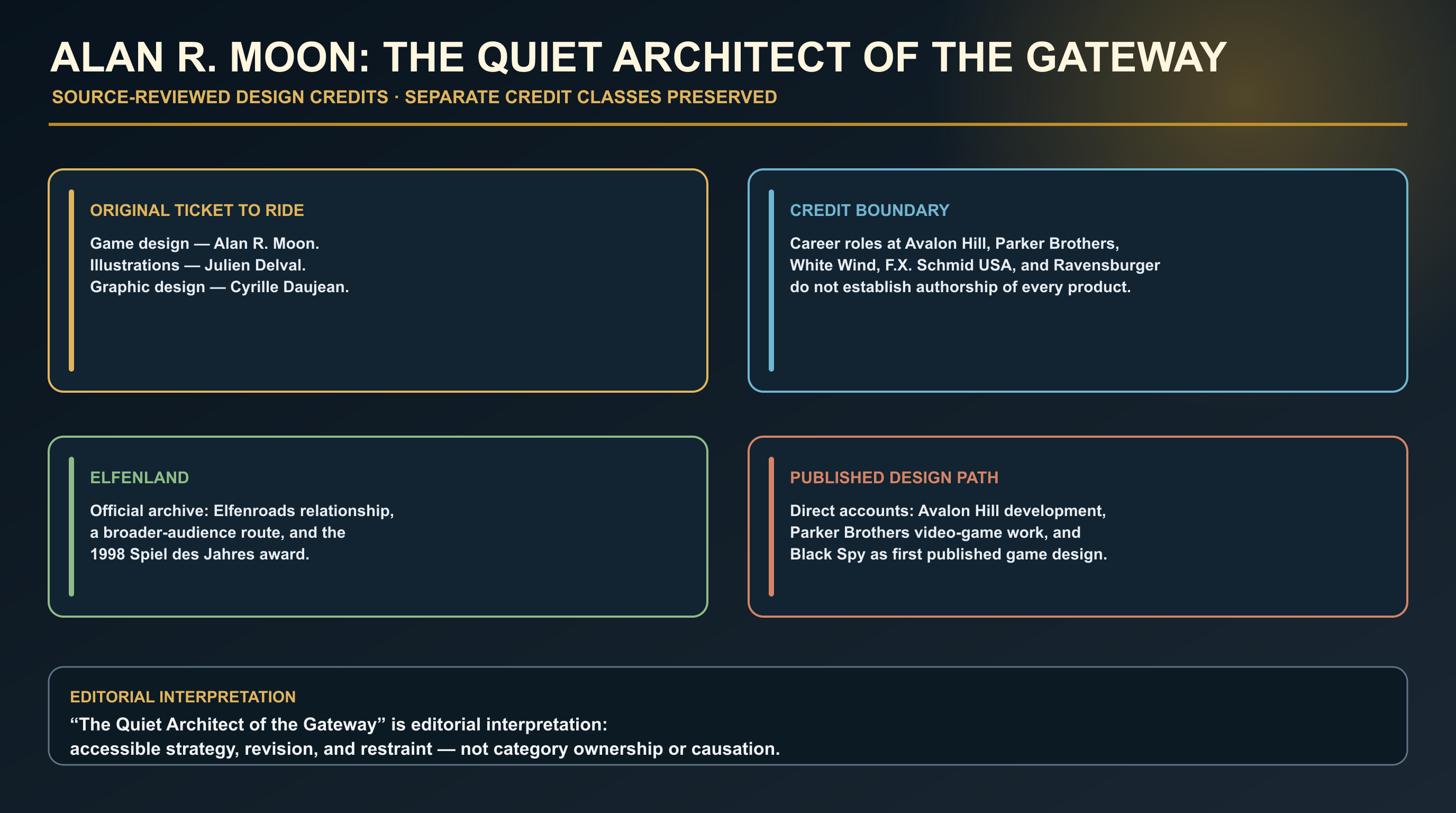
Alan R. Moon is credited with game design for the original Ticket to Ride. Its publisher credits Julien Delval with illustrations and Cyrille Daujean with graphic design; those roles remain distinct. Moon held bounded career roles at Avalon Hill, Parker Brothers, White Wind, F.X. Schmid USA, and Ravensburger. Direct accounts support Avalon Hill development work, Parker Brothers video-game work, and Black Spy as his first published game design. The Spiel des Jahres archive connects Elfenland to Elfenroads and records its 1998 award. A current publisher announcement identifies Moon as Ticket to Ride’s author and executive producer for that stated adaptation only. The gateway-architecture idea here is editorial interpretation, not a category-ownership claim.
Vertical
Transcript
Alan R. Moon is credited with game design for the original Ticket to Ride. Its publisher credits Julien Delval with illustrations and Cyrille Daujean with graphic design; those roles remain distinct. Moon held bounded career roles at Avalon Hill, Parker Brothers, White Wind, F.X. Schmid USA, and Ravensburger. Direct accounts support Avalon Hill development work, Parker Brothers video-game work, and Black Spy as his first published game design. The Spiel des Jahres archive connects Elfenland to Elfenroads and records its 1998 award. A current publisher announcement identifies Moon as Ticket to Ride’s author and executive producer for that stated adaptation only. The gateway-architecture idea here is editorial interpretation, not a category-ownership claim.
Audio Overview
Transcript
Alan R. Moon is credited with game design for the original Ticket to Ride. Its publisher credits Julien Delval with illustrations and Cyrille Daujean with graphic design; those roles remain distinct. Moon held bounded career roles at Avalon Hill, Parker Brothers, White Wind, F.X. Schmid USA, and Ravensburger. Direct accounts support Avalon Hill development work, Parker Brothers video-game work, and Black Spy as his first published game design. The Spiel des Jahres archive connects Elfenland to Elfenroads and records its 1998 award. A current publisher announcement identifies Moon as Ticket to Ride’s author and executive producer for that stated adaptation only. The gateway-architecture idea here is editorial interpretation, not a category-ownership claim.
Infographic
Leave a Reply
You must be logged in to post a comment.