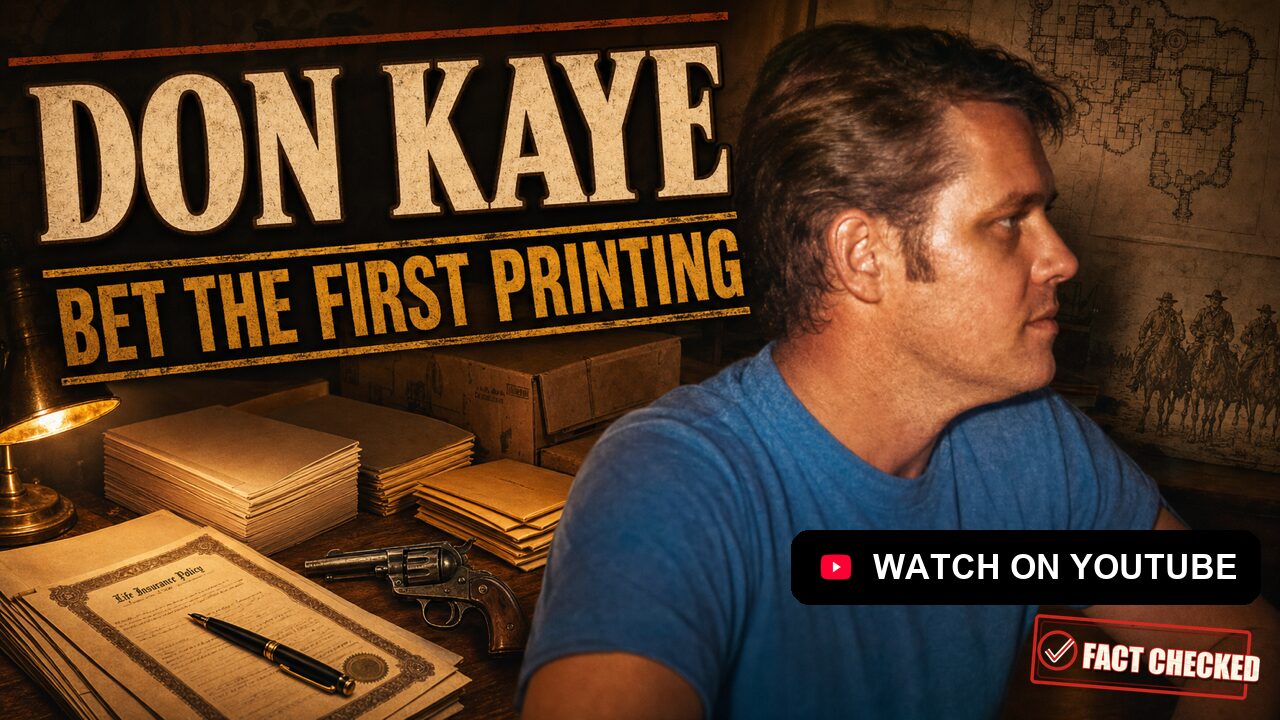
Before Dungeons & Dragons could become a game industry, a cultural object, a film franchise, a video game ancestor, or a shelf of hardcovers in every bookstore, it had to become a physical thing.
Three little booklets. A box. Orders. Envelopes. Postage. Money that the founders did not really have.
That is where Don Kaye enters the story.
Kaye did not design the central engine of D&D. Dave Arneson made the first leap into character-centered fantasy campaigning. Gary Gygax codified, expanded, edited, and sold the rules with the force of a man who believed the hobby could become something larger than the hobby itself. Brian Blume brought the additional capital that made the first printing possible.
Kaye’s role was quieter and easier to lose in the glare. He was Gary Gygax’s childhood friend, one of the earliest players in the Greyhawk campaign, the creator of Murlynd, the first president of Tactical Studies Rules, and one of the three men whose money got the first D&D boxes into circulation.
According to the standard accounts of TSR’s founding, Kaye borrowed against his life insurance policy to put up his share.
That is not romantic symbolism. That is risk.
He bet future security on a strange manuscript full of clerics, fighting men, magic-users, monsters, treasure, and rules nobody quite knew how to categorize yet. He did it before there was an RPG market. Before there was a D&D brand. Before anyone could know that a thousand hand-assembled boxes would become the first industrial seed of modern tabletop role-playing.
The table remembers Gygax and Arneson first. It should. But the company that printed the game had a first president, and his name was Don Kaye.
Lake Geneva Before D&D
Kaye and Gygax were friends before there was a hobby for them to help invent.
They met as boys in Lake Geneva, Wisconsin, after Gygax’s family moved there from Chicago. By their teens, the two were already deep in miniature wargaming. They played with large toy soldiers, wrote their own rules, and staged battles with a level of physical enthusiasm that feels almost mythic now: ladyfinger firecrackers standing in for explosions.
That detail matters because it shows the root of the thing. D&D did not appear from nowhere. It came from a culture of players who were already dissatisfied with rules as received objects. They did not merely consume games. They argued with them, modified them, expanded them, and made new procedures when the old ones could not hold the situation at the table.
In 1965, Kaye, Gygax, Mike Reese, and Leon Tucker formed the Lake Geneva Tactical Studies Association. The group met in basements and garages, including Kaye’s garage. It was small, local, informal, and crucial. Before there was TSR, there was a circle of people testing the limits of miniature rules, military history, fantasy literature, and shared imagination.
That circle was not yet a company. It was not yet a market. It was a workshop.
Kaye belonged to that workshop from the beginning.
Murlynd Walks Into Greyhawk
In 1972, after Dave Arneson had shown Gary Gygax the new style of fantasy play that would become D&D, Gygax began running his own Castle Greyhawk campaign.
Kaye joined early. His character was Murlynd.
Murlynd is one of those early D&D details that sounds like a joke until you realize how much design history is hiding inside it. Kaye loved Westerns, so his fantasy character carried that love into Greyhawk. Murlynd became associated with cowboy clothes, six-shooters, and later the strange collision of frontier imagery with magical technology.
Gygax’s campaign did not allow ordinary gunpowder. A clean high-fantasy referee could have simply said no. Instead, the table found a loophole. Murlynd’s six-shooters were treated as magical wands that looked and sounded like firearms, but functioned by fantasy logic.
That compromise is tiny and enormous at the same time.
It shows how early role-playing bent around the player. The world had rules. The player brought desire. The referee found a way to make both survive. Murlynd was not just an oddball cowboy in a fantasy dungeon. He was proof that the new form could absorb genre intrusion, personal taste, table jokes, and house rulings without breaking.
That kind of flexibility became one of D&D’s permanent traits.
Later Greyhawk material would turn Murlynd into a hero-deity tied to magical technology. Spells and magic items carried his name. The tabletop memory of Don Kaye survived inside a world where a Western-loving player character could become sacred lore.
That is a very D&D kind of immortality.
Tactical Studies Rules
By 1973, Gygax and Arneson had a game that established publishers did not know how to handle. It was part wargame, part fantasy campaign, part toolkit, part invitation. It did not fit the old categories neatly enough for cautious companies to understand it.
Kaye and Gygax decided to publish it themselves.
They formed Tactical Studies Rules in October 1973. Kaye and Gygax each put in $1,000. Kaye’s share, according to widely repeated historical accounts, came from borrowing against his life insurance. The two men first tried to use Cavaliers and Roundheads, an English Civil War miniatures game, as a stepping stone to raise more money for D&D. Sales did not solve the problem.
Then Brian Blume entered with another $2,000 and became an equal partner.
The resulting company was not yet the TSR of corporate memory. It was three men, limited capital, and a product nobody fully understood yet. Kaye served as president. Blume became vice president. Gygax was editor. Those titles sound grand now, but in 1974 they meant practical labor at household scale.
Business moved through Kaye’s home at 542 Sage Street. Early advertisements and order materials used his address. Shipping and warehousing ran through domestic space. The first thousand D&D boxes were hand-assembled. This was not a polished publishing operation. It was a cottage industry balanced on a table, and Kaye helped keep the table from collapsing.
That labor is easy to undervalue because it does not look like design.
But in a new medium, logistics are design’s first test. A rulebook that never ships does not change the world. A game that cannot be ordered, packed, mailed, tracked, and paid for remains a manuscript. Kaye’s presidency sat at that unglamorous crossing: the place where imagination had to become inventory.
He did not make D&D famous. He helped make it available.
Boot Hill And The Second Door
Kaye’s Western obsession did not stop with Murlynd.
In late 1974, he helped develop rules for Boot Hill, TSR’s Western role-playing game. The game would not appear until after his death, credited to Brian Blume, Gary Gygax, and Don Kaye, and dedicated to his memory.
Boot Hill matters for more than sentiment. It was one of TSR’s first demonstrations that role-playing did not belong only to underground fantasy. The same basic idea could move to gunslingers, saloons, posses, duels, and frontier violence. It was a rough, lethal game, closer in temperament to skirmish wargaming than to later narrative Western RPGs. That roughness fits the moment. Nobody yet knew what role-playing games were supposed to become.
The door had only just opened.
Kaye helped point toward the second door: genre expansion. D&D was fantasy, but the underlying act of play could travel. Murlynd had already smuggled the Old West into Greyhawk. Boot Hill made the reverse move explicit. The tabletop character could leave the dungeon and walk into a dusty street at noon.
That idea is normal now. In 1975, it was still being discovered.
The Empty Chair
Don Kaye died on January 31, 1975. He was thirty-six years old.
His death landed at the worst possible moment for Tactical Studies Rules. D&D’s first printing had sold out. Demand was rising. The company was starting to become real, but its structure was still fragile. Kaye had been a partner, a president, and part of the trust network holding the operation together.
After his death, his widow Donna Kaye briefly took up his stake and some of the work around the business. That arrangement did not last. The partnership had to be reorganized, and the capital needed to buy out Kaye’s interest came through the Blume family.
That reorganization produced TSR Hobbies, Inc.
It also changed the balance of power.
Here is where the story can become too neat if told carelessly. Kaye’s death did not single-handedly cause every later corporate conflict at TSR. The company’s future would be shaped by fast growth, uneven management, ownership disputes, product strategy, debt, ambition, and personalities far beyond one missing founder.
But his death removed a specific stabilizing relationship at a decisive time. Kaye was not just an investor. He was Gygax’s old friend, a founding partner, and the first president of the company. Once his share had to be bought out and the company incorporated under new ownership realities, TSR was no longer the same partnership that had assembled the first D&D boxes.
The empty chair mattered.
What He Actually Built
Don Kaye did not invent role-playing games. He did not write the definitive rules of Dungeons & Dragons. He did not build the TSR empire that followed. His career in published gaming was brief because his life was brief.
What he built was the first layer of confidence around the thing.
He helped create the local wargaming culture from which D&D emerged. He sat at the early Greyhawk table and brought Murlynd into it, forcing fantasy to make room for a cowboy with magical six-shooters. He believed enough in the business possibility to risk personal security on it. As TSR’s first president, he helped turn D&D from a draft into a product that could be ordered from an address and shipped to strangers.
That is not the same as authorship.
It is infrastructure.
Every creative industry has people like this near the beginning. The person who signs the forms. The person who stores the boxes. The person who keeps the orders straight. The person whose house becomes the office before anyone admits there is an office. The person whose belief arrives early enough that it still looks irrational.
Kaye was that person for D&D.
The tragedy is that he did not live long enough to see what the risk became.
What Remains
Don Kaye remains one of the lost founders of tabletop role-playing.
You can find him in the early business records of Tactical Studies Rules. You can find him in the 542 Sage Street address on old TSR mailings. You can find him in Boot Hill, the Western game he supported and did not live to see published. You can find him most vividly in Murlynd, the cowboy of Greyhawk, still carrying the strange lesson of the early table: if the player wants six-shooters and the world forbids gunpowder, maybe the guns are wands.
That is the whole invention in miniature.
Rules matter. Worlds matter. So does the person willing to make room.
Don Kaye’s story ends before the empire begins. That is why it is easy to miss him. But the first printing needed money, the first company needed a president, and the first business needed someone willing to turn a basement idea into mail-order reality.
He bet on the box before the world knew what was inside it.
Fact Check Notes
Publication notes
This site is AI-assisted and human-reviewed. We use artificial intelligence to help gather research, organize source material, and draft profile content. Human editors then read, revise, and check each profile before it goes live. Most profiles are built through deep AI research and two separate rounds of fact-checking.
Leave a Reply
You must be logged in to post a comment.