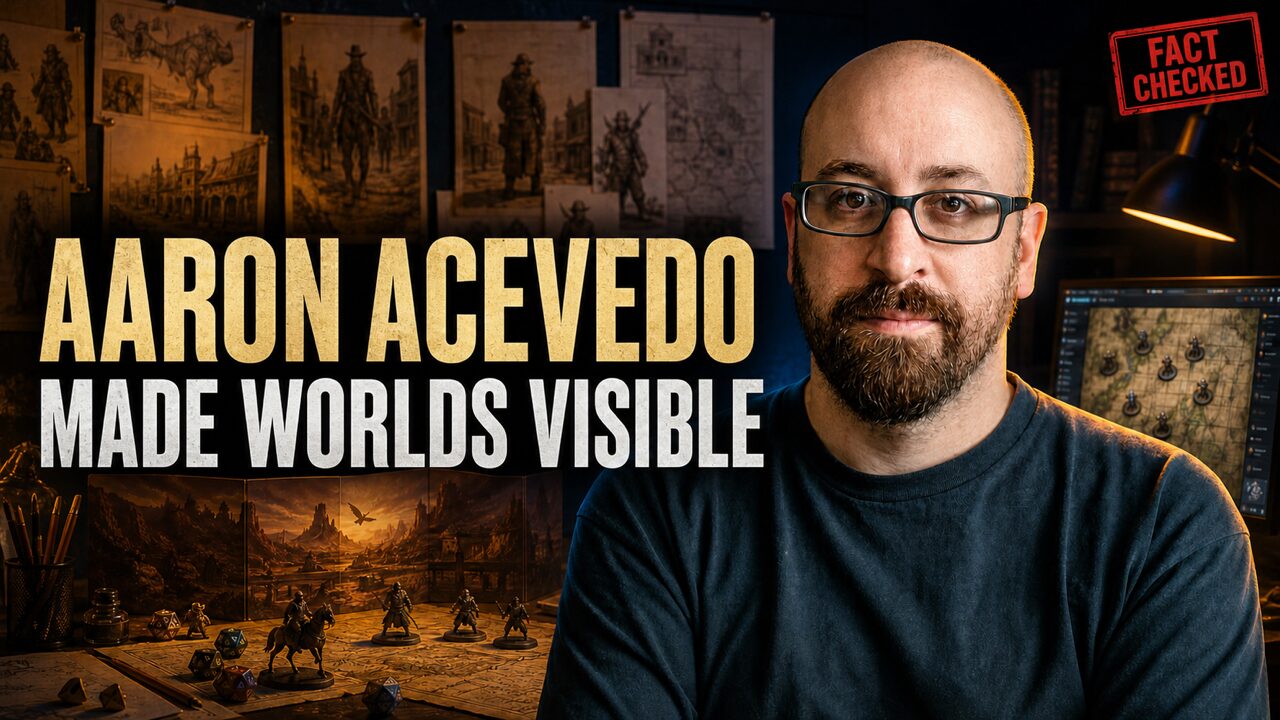
Some build them by inventing mechanics, drawing maps, editing books, running companies, or making sure the thing actually reaches a table.
Aaron Aurelio Acevedo built them by making worlds visible.
That sounds simple until you remember what tabletop games ask artwork to do. A roleplaying book does not move by itself. It does not have a camera, soundtrack, animation pass, or lighting engine. It has pages. It has covers. It has maps, character pieces, layout choices, color, typography, and the strange pressure of making a reader believe in a place before anyone has rolled dice there.
Acevedo spent decades in that pressure. He was an artist, art director, art manager, game designer, studio founder, Navy veteran, husband, caregiver, and one of the people who helped give the modern tabletop roleplaying field a professional visual spine. His name appears around Pinnacle Entertainment Group, Sigil Entertainment, Savage Worlds, Deadlands, VTT production, licensed worlds, and independent publishers who needed more than a single illustration. They needed a visual system.
Aaron was good at systems.
From Service To Structure
Before the tabletop credits, there was the Navy.
Public family sources describe Aaron serving nine years in the United States Navy, including time connected to the USS John F. Kennedy. That part of his life matters here because art direction is not only taste. It is logistics. It is pressure. It is the ability to keep people, files, deadlines, publishers, artists, printers, and expectations moving in the same direction while the project keeps changing underneath you.
Aaron’s later career reads like the work of someone who understood that beautiful art is only one part of production. The cover has to match the interior. The map has to support play. The character art has to set tone without breaking the setting. The layout has to carry the voice of the game. Digital assets have to work in virtual space. Freelancers need direction. Publishers need files that will not explode at the finish line.
That is not the glamorous side of game history.
It is the side that lets the glamorous part exist.
Sigil And The Production House
Jeannine Acevedo’s obituary says that Aaron and Jeannine’s shared love of tabletop and video games led Aaron to found Sigil Entertainment in 2005. That sentence matters because Sigil was never just a name on a business card. It became the shape of his working life.
Sigil’s current public site describes the studio as a tabletop creative production house with more than twenty-five years of experience and more than a thousand published credits across games and properties including Savage Worlds, Deadlands, Call of Cthulhu, Talisman, and World of Darkness. It presents the work as full production: art direction, visual development, illustration, layout, cartography, editing, writing support, brand identity, and final files.
That is the key to Aaron’s contribution.
He was not only making pictures for someone else’s game. He was building a machine that could take imagination and turn it into publishable form. For small publishers and crowdfunded projects, that can be the difference between an idea and an actual book. A creator may know the world perfectly and still need someone who can make the public see it.
Aaron became that kind of person.
In 2022, Pinnacle announced that Pinnacle Entertainment Group and Sigil Entertainment had joined forces to develop Sigil brands for Savage Worlds and 5E under Aaron’s guidance. That same announcement described Sigil Services as a VTT production group creating conversions and assets for clients including Pinnacle, Paizo, and Onyx Path. Pinnacle’s later memorial note says Aaron created Sigil Services to serve the growing virtual tabletop market and that it was later sold and became MetaMorphic, incorporating much of the team he built.
That is not just a business footnote. It shows where his eye was pointed.
The hobby was changing. Tables were moving online. Maps, tokens, books, character tools, and visual assets had to survive a new kind of use. Aaron saw that tabletop art was no longer only the thing printed on paper. It had to operate inside screens, platforms, modules, and remote play.
He helped move that work forward.
The Weird West And The Pinnacle Family
For many gamers, Aaron Acevedo’s name is tied most tightly to Pinnacle.
Pinnacle’s public pages describe him as Art Director, a long-time friend of the company, and a good friend of Shane Hensley and the crew for more than twenty years. A 2022 Pinnacle support post put it in plain terms: crack open many Pinnacle games and supplements, and you would see Aaron’s name in the credits.
That kind of sentence tells you a lot.
Pinnacle’s worlds have strong visual identities. Savage Worlds has to feel fast and pulpy without becoming generic. Deadlands has to look like the West, but wrong in exactly the right ways: dust, guns, cards, fear, infernal machinery, frontier myth, and things waiting out past the lantern light. Necessary Evil needs comic-book scale with a crooked moral engine. Rifts for Savage Worlds and Pathfinder for Savage Worlds ask an art director to translate already-loud visual worlds into another rules family without losing recognition.
Aaron worked in that zone where tone becomes production.
Pinnacle’s about page credits him as an incredible artist, art director, art manager, and visionary. It also names game designs and settings connected to him, including Strange Aeons, Savage Signs, and Supers 5E with Gwendolyn Marshall. The same page lists broad work by Aaron and his team across A Song of Ice & Fire, Babylon 5, Call of Cthulhu, L5R, Suzerain, Unknown Armies, Wheel of Time, World of Darkness, and more.
That list could turn into a resume paragraph very quickly.
The better way to understand it is this: Aaron knew how to move between worlds without flattening them. Weird West horror is not occult conspiracy. Four-color superhero design is not grim fantasy. VTT conversion is not print layout. Licensed fiction is not original setting development. Each demands a different visual grammar.
Aaron’s career was built on changing the grammar without losing the sentence.
A Life Of Care
There is another part of Aaron’s story that cannot be separated from the work, because the people closest to him did not separate it.
Jeannine Marie Strnisa Acevedo died on March 12, 2023, at home in Amsterdam, New York, after a fifteen-month battle with glioblastoma. Her obituary says Aaron, her husband of thirty-two years, was at her side. It also says he sold his business to care for her full time.
That is a fact worth handling carefully.
It should not be turned into melodrama. It should not be used as decoration for a career tribute. But it belongs here because it reveals the same pattern that shows up in his professional life: Aaron built support systems around people who needed them.
He did it for projects. He did it for artists. He did it for teams. And when Jeannine became ill, he did it at home.
The obituary remembers the two of them meeting young, marrying in 1990, and building a life around family, games, work, and loyalty. It includes a story from Aaron’s Navy years, when Jeannine crossed the Atlantic to meet him in Marseille while he was on leave. Her train did not arrive when expected. In a world without cell phones, Aaron waited until nightfall. The last train came in, and Jeannine was on it.
That story is not about games.
It is about waiting for the person you love until the world gives them back.
The Community That Came Back
After Jeannine’s death, Aaron’s own health struggles became more severe.
Ben Acevedo’s GoFundMe for Aaron’s double transplant journey described a long chain of illness: kidney failure, dialysis, open-heart surgery, hearing loss in one ear, detached retinas, significant vision loss, and eventually the discovery that Aaron needed both a heart and kidney transplant. By 2026, Aaron was at Mount Sinai Hospital in New York City, with Ben staying nearby to help him communicate with doctors and endure the process.
Again, the point is not to inventory suffering.
The point is what happened next.
The tabletop community rallied. Pinnacle promoted support for Aaron through GoFundMe and DriveThruRPG bundle efforts. One Pinnacle shop post described a seventy-product PDF bundle valued at $420 and sold for $30, with sales supporting Aaron’s recovery. Geek Native covered the effort in the same season as Deadlands 30th Anniversary activity, noting that one of Pinnacle’s foundational creative voices was hospitalized and that the community was being asked to help.
This was not a ceremonial tribute after the fact.
It was people trying to carry a man who had carried a lot of work for them.
That matters in tabletop history because this industry is small enough that production credits are also relationships. Artists remember who gave clear direction. Publishers remember who saved a deadline. Freelancers remember who treated them like collaborators instead of replaceable parts. Players may never know the name in the credits, but the people who made the books know.
When Aaron needed help, many of them answered.
What He Actually Built
Aaron Acevedo did not create Savage Worlds. He did not invent Deadlands. He did not single-handedly build every game, setting, or property his name touched.
What he built was visual and production architecture.
He helped make tabletop worlds legible. He helped make them professional. He helped make them ready for print, screens, shelves, crowdfunding pages, virtual tabletops, and the first emotional judgment a reader makes when a cover or spread tells them whether a game has a soul.
That is hard work to measure because good art direction often disappears into the finished thing. If the visual identity works, the reader does not stop to notice the traffic control. They just believe the world.
Aaron gave that belief structure.
He did it through Sigil. He did it through Pinnacle. He did it through VTT production. He did it through teams of artists and designers who needed someone with taste, discipline, and steadiness. He did it in a career that crossed horror, fantasy, pulp action, superhero gaming, licensed properties, and digital play.
And from the public tributes, he did it without turning the work into a monument to himself.
Pinnacle called him a visionary, a true friend, a great partner, and someone easy to work with even in times of crisis. That is not a small sentence in game publishing. Crisis is where the real personality of a production person shows. Deadlines slip. Files break. Budgets shrink. People get tired. The wrong kind of leader makes the room worse.
Aaron seems to have made the room steadier.
That is part of the legacy too.
Where His Work Lives
Aaron Aurelio Acevedo passed away on July 4, 2026, surrounded by family, according to Pinnacle’s public memorial note. He was fifty-five.
His wife Jeannine had gone before him, and Pinnacle notes that she is immortalized in Deadlands: Carnage in the Cascades as Ranger Jeannine Strnisa, with Aaron doing the art for her. That detail is almost too fitting. The person he loved became part of the imagined world he helped shape.
Aaron’s work lives in Sigil Entertainment, in Pinnacle’s catalog, in Deadlands, Savage Worlds, Supers 5E, VTT conversions, and the long shelf of projects where his name appears in the credits. It lives in the teams he built, the artists he directed, the clients Sigil helped, and the players who opened a book and believed the place inside it was real enough to enter.
Some designers leave behind rules.
Some writers leave behind lore.
Aaron Acevedo left behind visibility.
He helped the hobby see its worlds.
Fact Check Notes
Publication notes
This site is AI-assisted and human-reviewed. We use artificial intelligence to help gather research, organize source material, and draft profile content. Human editors then read, revise, and check each profile before it goes live. Most profiles are built through deep AI research and two separate rounds of fact-checking.