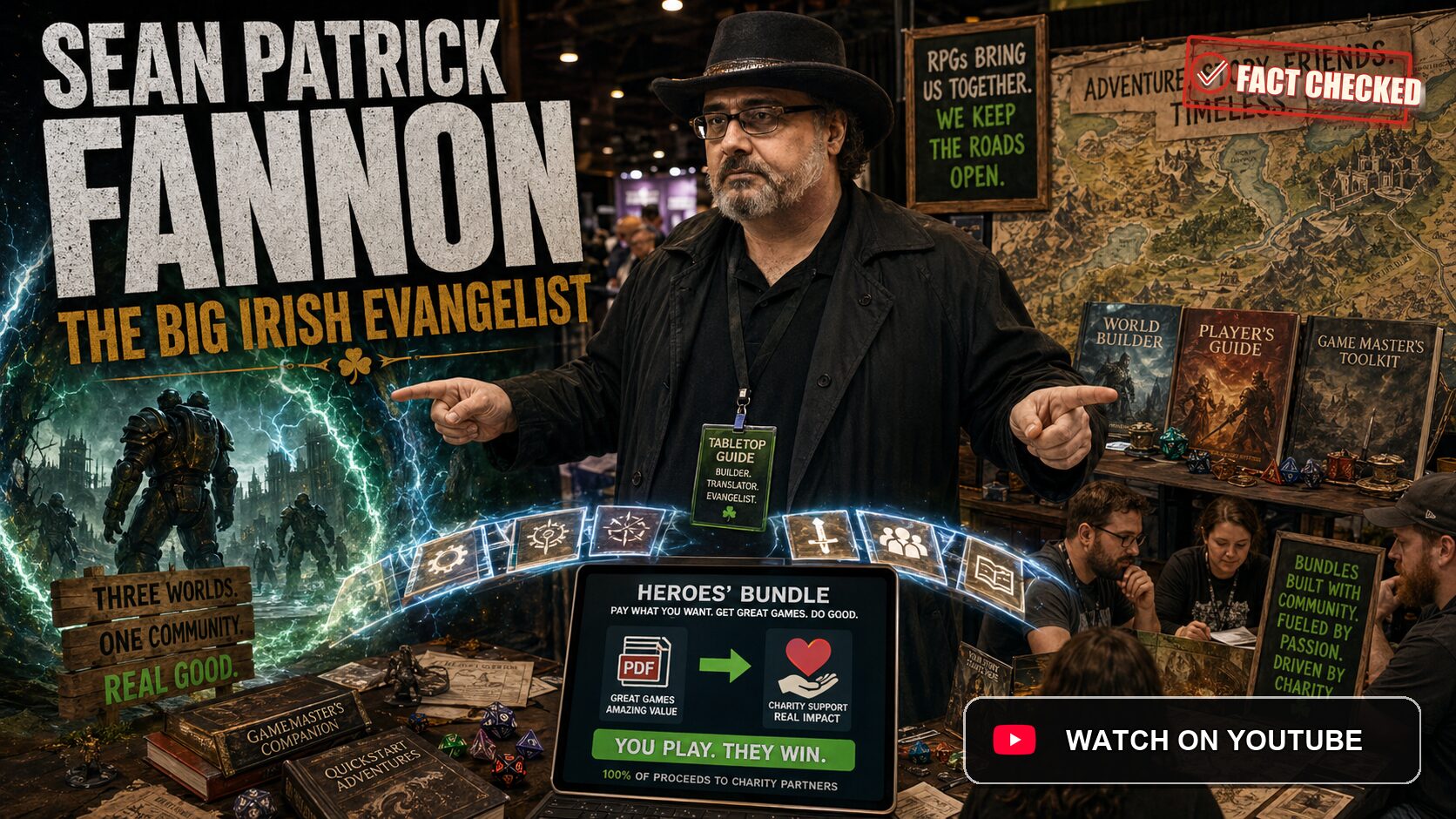
Sean Patrick Fannon did not build the engine.
That is the first honest sentence.
He did not invent the Hero System. He did not invent West End’s d6. He did not invent Savage Worlds. He did not invent Rifts, or Champions, or the core mechanics behind Prowlers & Paragons. His career is not the story of a designer who created one clean mechanism and watched the industry copy it.
Fannon’s career is about something else.
He built on-ramps.
He explained the hobby to outsiders. He carried settings from one system to another. He helped turn digital RPG storefronts into places where publishers could also raise money for disaster relief. He took a beloved, unwieldy gonzo setting and made it playable for a different rules culture. He spent decades telling people why games mattered, and then finding practical ways to get those games into their hands.
That kind of work can be hard to measure because it rarely sits in the middle of the rulebook.
But the on-ramps matter.
The Champions Years
Fannon’s professional game career began in 1988 with freelance writing and reviews. He soon moved into Hero Games’ Champions line, writing books such as High Tech Enemies, The Mutant File, and Champions Universe. That work led to a role as Continuity Director for the Champions Universe.
That title tells you a lot.
Continuity work is not glamorous in the way a new dice mechanic is glamorous. It is maintenance, memory, and discipline. It means knowing what has already been established, what can be contradicted, what cannot, and how multiple books by multiple writers can still feel like they belong to one world.
Fannon was learning how to manage shared fictional infrastructure.
He would later bring that skill to West End Games, contributing to Star Wars and Shatterzone material. Again, the pattern holds. He was not building the core system. He was working inside an established architecture, adding useful material, translating setting needs into playable content, and keeping the fictional machinery pointed in the right direction.
For some designers, that would be a limitation.
For Fannon, it became the job.
The Gamer’S Bible
In the mid-1990s, Fannon wrote The Fantasy Roleplaying Gamer’s Bible for Prima Entertainment.
The book was not an RPG. It was not a sourcebook. It was not an adventure. It was a guide to the hobby itself, published through a mainstream channel at a time when role-playing games were still badly misunderstood by many people outside the subculture. RPGGeek credits the book with selling more than 10,000 copies in its first few months, a strong number for a book trying to explain tabletop role-playing to general readers.
This is one of Fannon’s most revealing projects.
He was not speaking to the people already deep in the dungeon. He was speaking to the person standing at the door, wondering what the strange voices inside were doing. The book said: here is what this hobby is, here is how it works, here is why people care.
That is not system design.
It is cultural translation.
The Fantasy Roleplaying Gamer’s Bible is not famous in the way Dungeons & Dragons is famous, but it shows Fannon’s instinct clearly. He wanted the hobby to be understandable. He wanted the wall around it lower. He wanted people to have a map.
The Digital Storefront And The Charity Model
From 2008 to 2012, Fannon worked in marketing and communications for OneBookShelf, the company behind DriveThruRPG and RPGNow.
That was not a design chair. It was an infrastructure chair.
DriveThruRPG mattered because it changed how small publishers reached players. A tiny press could put a PDF online and have a storefront. Back catalogs could stay available. Odd games could find odd audiences. The long tail of role-playing did not need shelf space in a physical store to survive.
Fannon’s work there included communications, promotions, business development, and public-facing advocacy for the platform. The most important example was Gamers Helping Haiti in 2010.
After the Haiti earthquake, publishers donated PDF products to a charity bundle. Customers gave to Doctors Without Borders and received a large bundle of digital RPG material. Contemporary coverage described the package as more than a thousand dollars’ worth of PDFs for a twenty-dollar donation, with DriveThru matching donations at certain levels. RPGGeek and related summaries credit the effort with raising more than $175,000.
That is not a game.
It is one of the clearest examples of the RPG industry discovering what digital distribution could do when pointed at a crisis.
Fannon did not invent charity. He did not invent digital bundles. But he helped make visible a model the hobby would keep using: publishers pool digital goods, fans donate, the infrastructure makes giving easy, and the industry briefly acts as one body.
Again, an on-ramp. This time, from games to help.
Shaintar
Shaintar is Fannon’s personal fantasy world.
Beginning in the 2000s, he developed it primarily for Savage Worlds, carrying it through Talisman Studios, Savage Mojo, Evil Beagle Games, and other publishing arrangements. The line grew across sourcebooks, campaigns, and setting material. Shaintar: Legends Arise and Shaintar: Legends Unleashed received ENnie nominations in 2014.
Shaintar matters because it is the place where Fannon was not only translating someone else’s property. It was his world, his heroic fantasy, his long-running campaign setting.
It also illustrates the boundary around his contribution.
Shaintar runs on Savage Worlds. That means its rules engine belongs to Shane Hensley and Pinnacle’s design tradition. Fannon’s contribution is setting, presentation, community, and support. That is real work, and fans of the line can tell you why the setting mattered to them. But it is not the same thing as inventing a system other designers then built upon.
This is the constant tension in understanding Fannon.
He made things playable, understandable, and available. He rarely made the underlying machine.
Savage Rifts
Savage Rifts is Fannon’s strongest design case.
Rifts is one of the great maximalist settings in RPG history: post-apocalyptic Earth, magic, cybernetics, giant robots, dragons, dimensional portals, fascist states, alien worlds, psychic warriors, and more genre collisions than most games could survive. It is beloved because it is excessive. It is difficult because it is excessive.
The task was not simply "convert Rifts to Savage Worlds."
The task was: keep the feeling of Rifts without making Savage Worlds collapse under it.
Fannon and the team needed to preserve the fantasy of the Glitter Boy pilot, the cyber-knight, the rogue scholar, the dragon hatchling, the ley line walker, and the Coalition soldier. Those archetypes do not live at the same power level in any ordinary sense. A translation that flattened them would betray Rifts. A translation that let them run wild would break Savage Worlds.
The key adaptation structure was the Iconic Framework.
An Iconic Framework gives a character a package of identity, power, permissions, and limits. It lets a player step into one of Rifts’ big archetypes without requiring the system to pretend every archetype is the same kind of character. Alongside MARS packages for more flexible character concepts, the framework gave Savage Rifts a way to handle the setting’s famous imbalance as a playable feature rather than a fatal bug.
That is good adaptation design.
The Savage Rifts Kickstarter raised more than $400,000. Designers & Dragons notes how large that was for Pinnacle’s crowdfunding history at the time. Polygon named Savage Rifts among the best tabletop RPGs of 2017. The line expanded beyond the initial books.
This is the best proof of Fannon’s design signature.
He did not create Rifts. He did not create Savage Worlds. He built the bridge.
What He Actually Built
Sean Patrick Fannon built access.
That is the cleanest way to say it.
He built access to Champions continuity for superhero players. He built access to role-playing itself through The Fantasy Roleplaying Gamer’s Bible. He helped build access to digital RPG products through DriveThruRPG communications work. He helped build access to industry-wide charity giving through Gamers Helping Haiti. He built access to Shaintar through years of Savage Worlds support. He built access to Rifts for players who loved the setting but wanted a different rules experience.
The limitations are just as clear.
He did not create a signature resolution mechanic. He did not invent a game category. He did not build a system architecture that other designers copied across the field. His strongest design work is translation, adaptation, continuity, and evangelism.
That is the boundary of the legacy.
The career is not small. It is wide, unusually wide. But it is not mainly a career of mechanical invention. Fannon’s legacy lives in paths, bridges, and microphones more than engines.
Where To Find Him
Start with Savage Rifts if you want the strongest design artifact: a beloved setting rebuilt for a different engine without losing its wildness.
Look at Shaintar if you want the personal world: heroic fantasy carried across years of publishing changes because its creator kept bringing it back to the table.
He is also still active at the table, running games constantly and preparing a new project called The Realm, which he has described as his latest major work. That matters here because Fannon’s career has always been about access: getting people to the table, keeping worlds playable, and refusing to treat games as museum pieces.
Find The Fantasy Roleplaying Gamer’s Bible if you want the evangelist in print, trying to explain the whole strange hobby to someone standing outside it.
And remember Gamers Helping Haiti, because sometimes the most important infrastructure is not a rulebook. Sometimes it is a way for a scattered hobby to act together when the world needs help.
He did not build the attractions.
He built roads to them.
Fact Check Notes
Publication notes
This site is AI-assisted and human-reviewed. We use artificial intelligence to help gather research, organize source material, and draft profile content. Human editors then read, revise, and check each profile before it goes live. Most profiles are built through deep AI research and two separate rounds of fact-checking.
Leave a Reply
You must be logged in to post a comment.