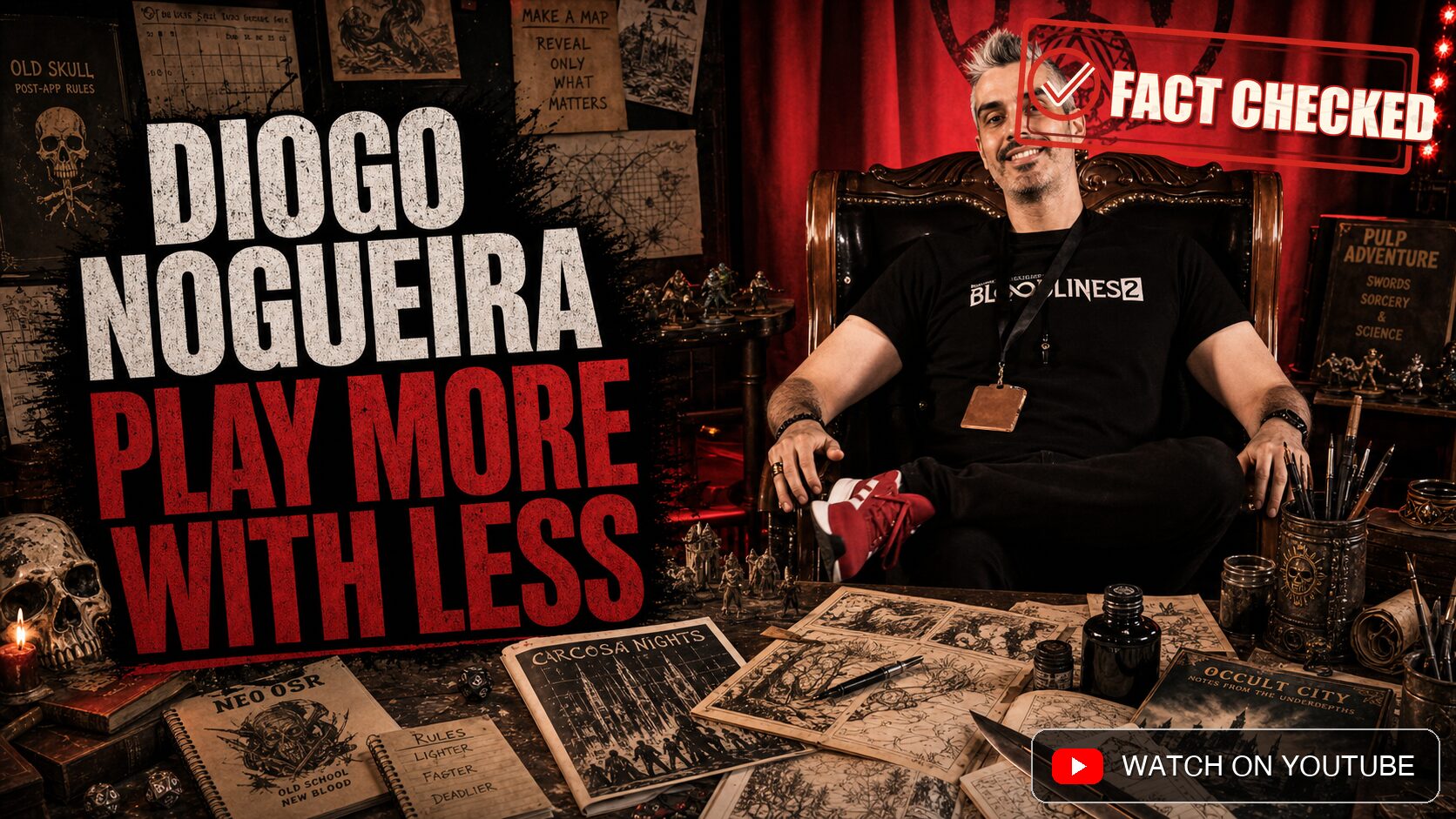
Diogo Nogueira makes role-playing games that feel like they have already packed for the trip.
The rules are lean. The pages move fast. The art tells you what kind of trouble you are about to get into before the first die hits the table.
That is not an accident.
Nogueira is not only a game designer. He is also an illustrator, graphic designer, layout artist, publisher, and visual storyteller. Working from Rio de Janeiro, Brazil, he built Old Skull Publishing around a promise that sounds simple until you try to do it well:
Play more with less.
That phrase is the key to his work.
It does not mean thinner games for people who do not care. It means games that know what they are about. Games that cut the fat so the table can get to the haunted street, the sword fight, the starship, the jungle ruin, the weird idol, the bad bargain, the thing in the dark.
Nogueira belongs to the Neo OSR because he understands both halves of that label.
Old-school play matters to him: danger, rulings, strange worlds, player choice, fast consequences, and the feeling that the dice can turn an ordinary door into a bad idea.
But the neo part matters too.
His books are not pretending to be photocopies from 1981. They are modern objects. They use graphic design as a play aid. They treat genre as structure. They respect the reader’s time.
He does not ask the table to admire the rulebook.
He asks the rulebook to help the table start playing.
From Rio With A Skull On The Cover
Old Skull Publishing launched in the mid-2010s with a clear identity from the beginning.
The name was blunt. The art was bold. The books looked like something pulled from a pulp shelf, a metal album, a horror paperback, and a game table all at once.
That visual confidence matters because Nogueira’s design is inseparable from his presentation. A lot of RPG books divide labor cleanly. One person writes. Another handles art. Someone else lays out the pages. A publisher packages the thing and gives it a line identity.
Nogueira often compresses those jobs into one creative voice.
That gives his games a rare coherence. The typography, illustration, chapter rhythm, tone, rules text, and table procedures all seem to understand the same promise. The book is not only explaining a genre. It is already performing it.
That is why the "triple-threat" label fits him.
Designer.
Artist.
Graphic designer.
In practice, the list is even longer. He is also the publisher who has to decide what deserves to exist, how it should be sold, and what shape the next project should take.
For small-press RPGs, that combination can be the whole difference between a clever PDF and a recognizable creative world.
Sharp Swords And Sinister Spells
Sharp Swords & Sinister Spells was the statement of intent.
The title tells you almost everything you need to know. This is not polite high fantasy. It is pulp fantasy: blades, curses, desperate wanderers, bad magic, strange ruins, and people making dangerous choices because safer lives are not available.
Mechanically, the game takes old-school fantasy instincts and pares them down.
Characters are not buried under a stack of subsystems. The rules move quickly. The referee gets room to make calls. The players get enough structure to understand risk without losing the raw edge of discovery.
That is the Neo OSR at its most direct.
Nogueira does not treat simplicity as emptiness. He treats it as pressure.
When a game has fewer moving parts, each part has to work harder. Character options need to suggest a life. Magic needs to feel dangerous without becoming a spreadsheet. Combat needs to resolve quickly while still hurting enough to make players think. Advancement needs to reward play without turning the campaign into homework.
Sharp Swords & Sinister Spells found that register.
It honored old-school fantasy without dragging every old-school habit along with it. The game felt familiar, but lighter on its feet.
That became the Old Skull pattern.
Different genre.
Same discipline.
Less weight. More motion.
The Genre Engine
The easiest mistake is to call Nogueira’s later games reskins.
They are not.
They share a family resemblance because they come from the same designer with the same table values, but each one changes emphasis for the genre it serves.
Solar Blades & Cosmic Spells takes the Old Skull attitude into science fantasy and space opera. The center of gravity shifts. You still get fast play and pulp urgency, but the fiction now wants starships, cosmic ruins, impossible technology, alien threats, tyrants, smugglers, mystics, and vast dangerous frontiers.
Dark Streets & Darker Secrets moves toward urban horror and occult investigation. That genre asks different questions. What hides behind the city? What do ordinary streets look like when the supernatural is not a distant dungeon but a door you pass on the way home? How much can a character learn before the thing learning back notices them?
Primal Quest turns toward prehistoric fantasy and survival adventure. The pressure changes again. Gear is different. Civilization is different. Mystery lives closer to hunger, weather, territory, tribe, and beast.
That is the real design work.
Genre is not paint.
Genre is pacing, risk, expectation, reward, fear, and possibility. Nogueira’s best games understand that. They do not try to make one universal chassis pretend everything is the same. They keep the shared Old Skull philosophy, then bend the procedures toward the kind of story the table came to play.
That is why the catalog feels connected without feeling locked into one trick.
The Page As A Play Surface
Nogueira’s graphic design background is not decoration around the game.
It is part of the game.
You can see it in the way his books communicate quickly. Dense enough to feel complete. Loose enough to breathe. Strong enough visually that a reader can feel the tone before reading every rule.
That matters at the table.
RPG layout is not only about looking professional. It is about lowering friction. It is about where the eye lands. It is about whether a referee can find a rule while five people wait. It is about whether a new player understands the kind of character they are making before the text turns into fog.
Nogueira’s pages have a poster-maker’s instinct.
Important things should announce themselves.
Mood should arrive early.
Rules should get to the point.
Art should not merely fill white space. It should teach the reader what the game wants to feel like.
That is where his work overlaps with other information-first designers while still sounding like him. He is not just organizing a classic system more cleanly. He is creating compact genre engines where words, images, and layout all push in the same direction.
The Honest Shape Of The Legacy
Diogo Nogueira’s scale is indie scale.
That should be said plainly.
Old Skull Publishing is not Wizards of the Coast, Games Workshop, or a mass-market board game line. His work lives primarily in the RPG underground, the OSR and Neo OSR communities, Kickstarter circles, itch.io libraries, DriveThruRPG collections, convention conversations, and the recommendations people pass around when they want something fast, strange, and ready.
That limits mainstream recognition.
It does not limit the importance of the work inside its lane.
Nogueira has shown what a one-person creative studio can do when the design vision, art direction, and page craft all come from the same hand. He has built a catalog that moves across sword and sorcery, science fantasy, urban horror, prehistoric adventure, and other pulp modes while keeping a recognizable philosophy.
Play more with less is not only a slogan.
It is a production method.
It is a rules method.
It is a visual method.
It is the thing that lets Old Skull books feel complete without feeling heavy.
That is his contribution: not a giant engine, not a corporate line, not a single rule that everyone copied, but a body of games that make compactness feel alive.
Where To Find Him
Diogo Nogueira remains active through Old Skull Publishing. His official Old Skull site identifies him as a game creator, artist, and graphic designer from Rio de Janeiro and directs readers to his published games, art, newsletter, and social links. His itch.io catalog remains live with Old Skull titles including Sharp Swords & Sinister Spells, Solar Blades & Cosmic Spells, Dark Streets & Darker Secrets, Primal Quest, and newer releases.
That current footprint fits the work.
Small press.
Direct to players.
Personal voice.
A skull on the label and a fast road to the table.
Nogueira did not make the OSR global by himself. No one person did.
But he is one of the designers who proved that old-school play could speak from somewhere other than the usual centers of English-language hobby publishing.
From Rio, he made lean games with big genre hearts.
He made the pages carry their own weight.
He kept daring players to bring less and play more.
Fact Check Notes
Publication notes
This site is AI-assisted and human-reviewed. We use artificial intelligence to help gather research, organize source material, and draft profile content. Human editors then read, revise, and check each profile before it goes live. Most profiles are built through deep AI research and two separate rounds of fact-checking.