Fact-Checked Icon
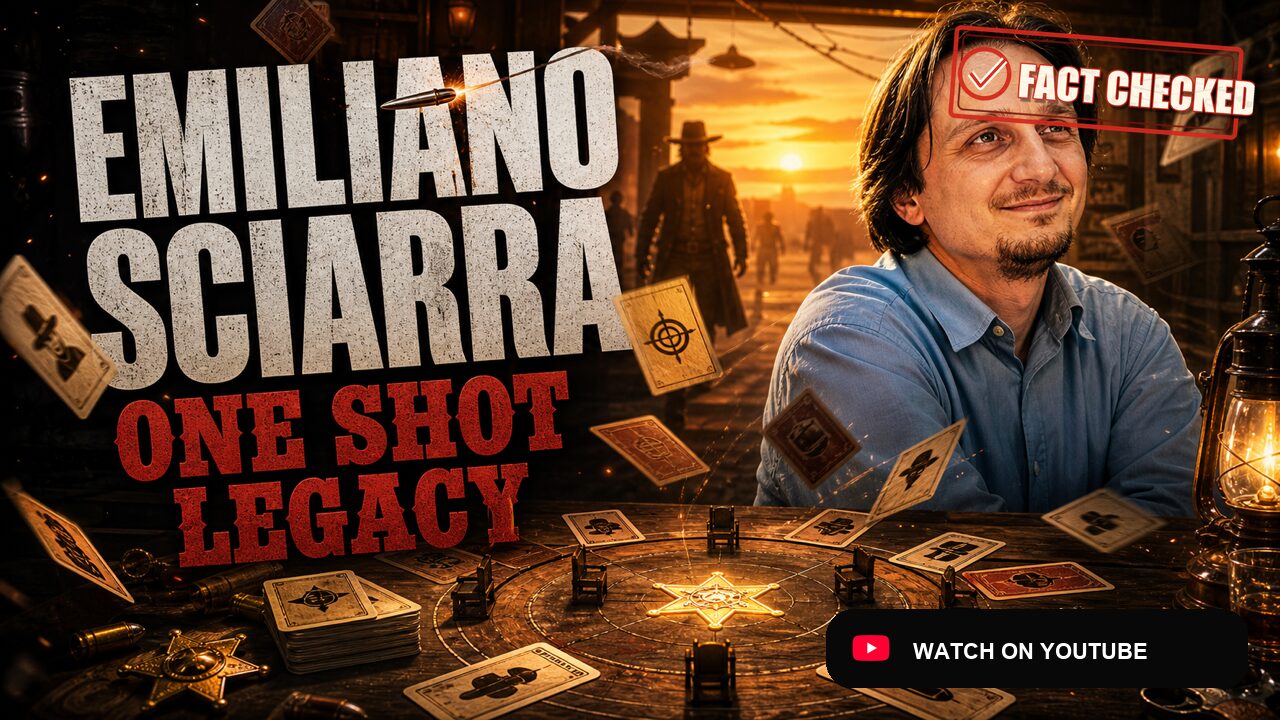
Emiliano Sciarra
Designer Who Turned One Western Shootout Into A Long Game
One player is the Sheriff. Everyone can see him. Everyone knows he is important, and everyone knows the game will eventually turn around whether he lives or dies.
The other players are harder to read. A Deputy wants the Sheriff alive. An Outlaw wants him dead. The Renegade wants almost everyone dead, but not too quickly, because the Renegade needs the Sheriff to survive long enough for the endgame to tilt into a duel.
That is the social engine. Then Emiliano Sciarra added cards, character powers, bullets, horses, weapons, missed shots, beer, and one small spatial idea that made the whole thing feel like a western instead of an argument with props.
You cannot shoot everyone.
You can only shoot the people within range.
The Spaghetti Western At The Card Table
Sciarra was a computer scientist from Civitavecchia when BANG! appeared in 2002 through daVinci Editrice, the company now known as dV Games. The pitch was almost absurdly clean: a spaghetti western card game where the Sheriff is public, everyone else has a hidden role, and the table slowly discovers who is lying, who is protecting, and who is waiting for the right moment.
Hidden-role play already existed. Mafia had been around since the 1980s, and Werewolf had carried that same social suspicion into party-game culture. Card combat was older still. Players had been drawing, attacking, blocking, bluffing, and managing hands for decades.
What Sciarra did was fuse those pieces into something that felt immediate.
BANG! does not ask players to spend an hour learning a simulation of gunfighting. It gives them a hand of cards and a simple emotional instruction: survive long enough to figure out who is dangerous. The Sheriff starts under the light. The Outlaws have every reason to fire. Deputies have to help without exposing themselves too soon. The Renegade is the knife in the boot, playing balance-of-power politics until the table is weak enough to finish.
It is simple enough to teach at a noisy table. It is mean enough to produce stories. It is structured enough that the accusations have game weight behind them.
That combination made BANG! travel.
The Range Between Chairs
The smartest thing in BANG! may be the thing players explain in one sentence and then forget to praise.
Distance is seating.
In many social deduction games, suspicion has no geography. Anyone can accuse anyone. Anyone can become the center of the table’s attention. That openness creates drama, but it can also turn play into pure volume: who talks loudest, who seems nervous, who can steer the room.
BANG! gives suspicion a table map. The player to your left is close. The player across from you is farther away. A weapon extends your reach. A Mustang makes you harder to hit. Suddenly the physical arrangement of chairs becomes part of the design.
That is a wonderful party-game move because it uses something already present. No board is required. No measuring stick. No tactical grid. The human circle around the table becomes the battlefield.
The range system also gives social deduction a mechanical governor. You might be certain the quiet player across from you is an Outlaw, but certainty does not mean reach. You need the right weapon, the right card, or the right ally. A western standoff is not just about knowing who to shoot. It is about whether your gun can reach the target before their friends reach you.
That one constraint gives BANG! much of its texture. The hidden roles create suspicion. The cards create tactical opportunity. Range decides whether suspicion can become action.
The Bullet That Kept Rolling
BANG! became one of the best-known Italian tabletop exports of its era. It won early recognition, including the 2003 Origins Award for Best Traditional Card Game, and it spread through international editions with the ease of a game whose core joke works in almost any language.
The theme helped. Westerns are legible. A Sheriff, an Outlaw, a duel, a beer, a missed shot. Players do not need a lore lecture to understand why a card called BANG! makes somebody duck.
The packaging helped too. BANG! The Bullet!, the bullet-shaped tin that collected the base game and expansions, became one of those objects that starts a conversation before the game is even opened. It looked like a prop from the world the game was pretending to be.
The expansions kept the system alive without trying to make it into something else. High Noon added events that changed the table’s weather. Dodge City brought new characters and cards. Later expansions pushed at equipment, risks, special effects, and new wrinkles in the same basic standoff.
That is harder than it sounds. A light social card game can break easily. Add too much and the table slows down. Add too little and the expansion feels like spare parts. BANG! survived because the core loop remained clear: hidden loyalties, card pressure, range, and timing.
Sciarra did not abandon the shootout. He kept finding ways to reload it.
Samurai, Duels, And Legends
The BANG! engine also proved it could change clothes.
Samurai Sword moved the hidden-role combat structure into a Japanese setting. The Sheriff and Outlaws became a different social arrangement, but the appeal remained recognizable: players had public actions, private loyalties, and a combat system that let alliances reveal themselves through behavior before anyone formally confessed.
BANG! The Duel reduced the idea to two players, a difficult move for a design built around hidden teams and table suspicion. BANG! Legends, released more than two decades after the original game, showed that the franchise was still active and still connected to Sciarra’s name.
These later designs matter because they show both the strength and the boundary of his career. Sciarra did not spend twenty years chasing a new hit every season. He kept returning to the same town, the same dust, the same draw.
For some designers, that would look like a limitation. Here it also looks like patience.
There is a particular discipline in maintaining one system for decades. The temptation is always to over-explain, over-expand, or sand away the rough edges that gave the original its personality. BANG! remained BANG! because the central social promise stayed intact. Somebody is the Sheriff. Somebody is lying. Somebody is waiting for the right shot.
The room takes care of the rest.
The One-Game Question
Sciarra’s legacy is unusually concentrated.
Many major designers build their reputation through range: abstract games, negotiation games, heavy strategy games, children’s games, party games, card games, dice games. Their catalogs become arguments for adaptability.
Sciarra’s argument is different. His career is not a tour through every corner of tabletop design. It is the long stewardship of one game family that found a mass audience and kept that audience for more than twenty years.
That can be easy to underestimate because tabletop culture often rewards novelty. New mechanisms. New boxes. New systems. New problems solved in new genres. But players do not experience a designer’s career as a spreadsheet of variety. They experience the game that arrives at the table and works.
BANG! worked.
It worked for families, hobby gamers, convention groups, casual players, and people who wanted a little treachery without a rulebook sermon. It created a social situation people understood immediately and then gave that situation just enough tactical shape to keep it from becoming pure yelling.
The one-game question is real. It is also not the whole story.
What He Actually Built
Emiliano Sciarra did not invent hidden-role games. Mafia and Werewolf were already there.
He did not invent card combat. He did not create the western genre. He did not build a vast catalog of unrelated systems.
What he built was one of the cleanest bridges between social deduction and accessible card combat.
BANG! takes the emotional charge of hidden roles and gives it a hand-management body. It takes the chaos of table suspicion and gives it range, weapons, and timing. It makes seating matter. It lets players reveal themselves through shots, saves, hesitations, and strangely convenient acts of loyalty.
That is why the game lasted. The theme is funny. The cards are easy. The accusations are loud. But underneath that noise is a small structural insight: social deduction becomes richer when players cannot act on every suspicion at once.
Sciarra’s contribution is not breadth. It is focus. He made one shot count, then spent decades proving it could keep echoing.
Where To Find Him
Emiliano Sciarra appears to be living and publicly active. He maintains an official website, and the BANG! line remains active through dV Games. BANG! Legends is a recent expansion carrying his name forward more than twenty years after the original release.
That is the cleanest ending to his story. The bullet-shaped tin is still on shelves. The Sheriff is still exposed. The Outlaws are still pretending to be helpful. Somebody is still too far away to shoot.
One card. One shot. One long legacy.
Fact Check Notes
Publication notes
This site is AI-assisted and human-reviewed. We use artificial intelligence to help gather research, organize source material, and draft profile content. Human editors then read, revise, and check each profile before it goes live. Most profiles are built through deep AI research and two separate rounds of fact-checking.
Leave a Reply
You must be logged in to post a comment.