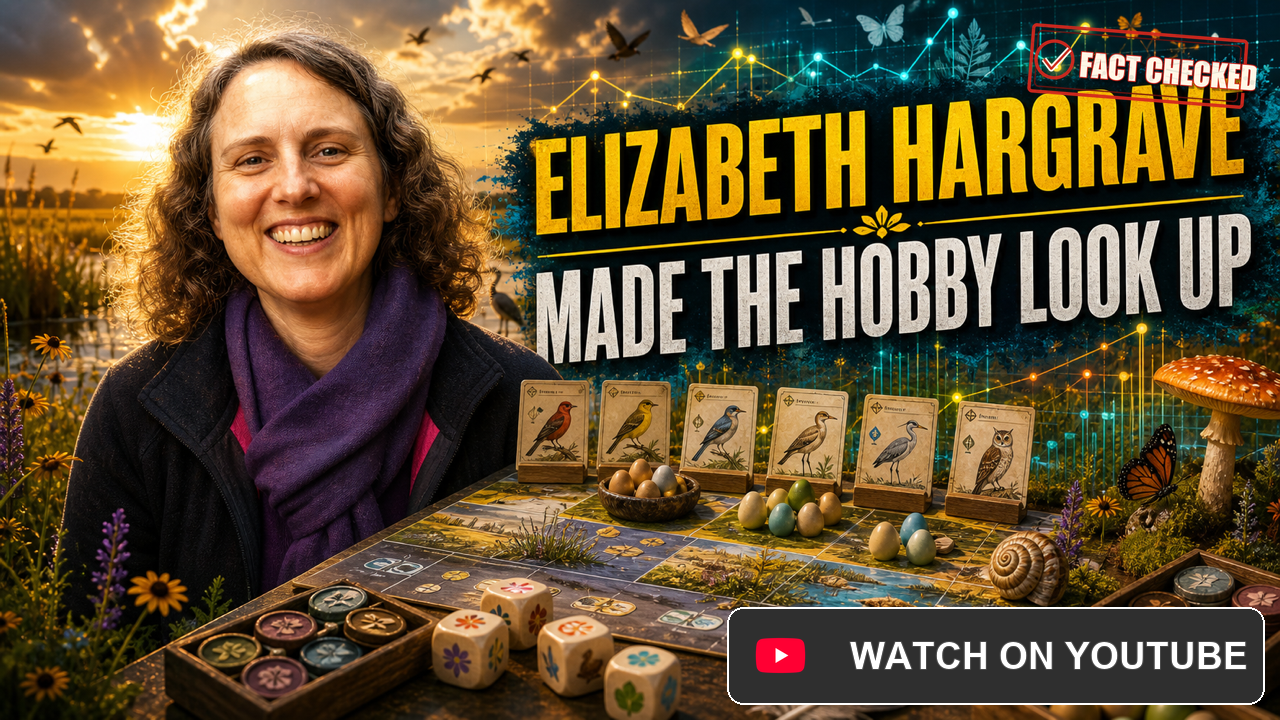
It is a spreadsheet.
Rows and columns. Names. Habitats. Food. Wingspans. Nesting habits. Behaviors. Conservation notes. A quiet grid of living things, each one waiting to become more than a fact.
Elizabeth Hargrave began there, with a complaint about what board games kept asking players to imagine. Castles. Empires. Trade routes. Wars. Space. Monsters. The familiar shelves of hobby theme, rearranged with new icons and old assumptions.
She wanted something else.
Birds.
Not birds as decoration. Not birds pasted onto a mechanism that could have been merchants or spaceships. Birds as data. Birds as behavior. Birds as habitat, food, eggs, migration, predation, flocking, and ecology.
That was the move.
Wingspan did not succeed because it was gentle. It succeeded because it treated gentleness as compatible with serious structure. It proved that a game could be beautiful, scientific, accessible, commercially huge, and mechanically interesting without leaning on the hobby’s default fantasies of conquest.
It asked players to look up.
The Spreadsheet
Hargrave came to game design from health policy, not from a publisher’s development desk.
That background matters, but only so far. Policy analysis does not automatically produce a good game. A spreadsheet does not become a design just because it contains information. Plenty of strong games come from people with no formal analytical background at all.
Still, once you know the policy piece, Wingspan becomes easier to understand.
Policy work trains a person to see systems. Inputs. Outputs. Incentives. Behaviors that look personal until the structure underneath them becomes visible. It also trains a person to live inside spreadsheets without treating them as dead.
For Wingspan, the spreadsheet was not bookkeeping after the creative work.
It was part of the creative work.
The old story describes a huge bird database built from real sources, with hundreds of rows and columns tracking facts that could become mechanisms. How birds eat. How they reproduce. Where they live. What they do.
That is a very particular kind of imagination.
Some designers begin with a feeling and search for rules that evoke it. Hargrave began with nature’s facts and searched for the system already hiding there.
Predatory birds could hunt. Flocking birds could tuck cards. Cuckoos could interact with other nests. The game did not need to pretend theme and mechanism were separate layers. The biology could become the mechanism.
That is why Wingspan felt different when it arrived.
The birds were not flavor text.
They were the math.
Three Rows And A Tightening Sky
Wingspan’s core board is calm at first glance.
Three habitats. Forest. Grassland. Wetland.
Each habitat is tied to a basic action: gain food, lay eggs, draw cards. When a player plays a bird into a habitat, that bird becomes part of the action row. Later, when the player activates that habitat, the cube moves across the row and the birds trigger in sequence.
That is the machine.
It teaches itself because the player mat makes visual sense. Birds live in habitats. Habitats produce actions. More birds make the action richer. The tableau grows, and the growing tableau changes what the player can do.
The quiet trick is that the game does not simply give players more and more time as their engines improve.
It takes time away.
Each round has fewer actions than the last. The engine gets stronger while the remaining opportunities shrink. That inversion gives Wingspan pressure. You are not just building a bird sanctuary. You are building under a tightening sky.
That pressure keeps the game from becoming only pleasant accumulation.
The eggs are pretty. The cards are beautiful. The birds are inviting.
Underneath them, the clock is running.
The Bird Game That Moved The Room
Wingspan became a phenomenon.
Hargrave’s own site describes her as a designer inspired by nature and by a desire to break away from tried-and-true themes. It also notes that Wingspan won the 2019 Kennerspiel des Jahres. That prize alone would have made it a major debut.
The sales made it something else.
By 2026 reporting, the larger Wingspan family had become one of the biggest success stories in modern hobby board gaming. BoardGameWire reported that Stonemaier’s span trilogy had passed 3.3 million lifetime copies across Wingspan, Wyrmspan, and Finspan, with Wingspan and Wingspan Asia making up about 2.6 million of that total.
Those numbers changed what publishers could believe.
A first-time designer with a bird game did not merely win awards. She sold at a scale usually reserved for safer bets, better-known brands, and themes that already looked proven.
That success did not prove every nature game would sell.
It proved the old assumptions were weaker than they looked.
Softness With Teeth
Wingspan is often described with soft words.
Beautiful. Relaxing. Gentle. Cozy.
Those words are not wrong. They are just incomplete.
The game is also a controlled engine with probabilistic card flow, food conversion, tempo pressure, activation sequencing, and end-of-round incentives. It invites players through art, components, and subject matter, then keeps them through decisions.
That combination is the achievement.
Hargrave did not make a nature poster with points. She made a medium-weight strategy game that could sit comfortably in a family living room and still give hobby players something to optimize.
The softness was the doorway.
The system was the room.
The Cracks In The Shell
Wingspan is not flawless.
Some players experience it as too solitary. Interaction is indirect and limited: face-up cards, food dice, shared goals, and the occasional bird power that touches another player. That low-conflict structure is part of the appeal for many people, but it also means the game can feel like parallel engine-building.
Card luck can matter. Certain early strategies became dominant enough that later expansions adjusted the ecosystem. Oceania’s new player mats and nectar resource are often read as a substantial rebalancing of the base game’s incentives.
None of that cancels the design.
It locates it.
Wingspan is not a knife fight. It is not a deep adversarial contest built around direct denial. It is an accessible engine-builder optimized for wonder, tempo, and discoverability. It lets many kinds of players enter the same table without demanding that they enjoy aggression.
That is not a flaw by itself.
It is a choice with consequences.
Flowers, Butterflies, Foxes, Fungi, Shells
Hargrave did not simply remake Wingspan.
That matters.
Tussie-Mussie, published the same year, is tiny by comparison: an 18-card microgame about Victorian flower language built around "I cut, you choose" tension.
Mariposas turns monarch butterfly migration into movement, collection, and generational return.
The Fox Experiment, co-designed with Jeff Fraser, uses dice and written traits to model selective breeding.
Undergrove, co-designed with Mark Wootton, moves underground into the trade between trees and fungi.
Sanibel, now listed on Hargrave’s site as available at local game stores, is a cozy shell-collecting game about walking the beach and arranging finds in a bag.
The subjects change.
The method remains recognizable.
Start with a natural phenomenon. Respect the facts. Find the behavior that can become procedure. Let players learn something without turning the game into homework.
That is a rare design signature.
The games keep returning to small things that carry larger systems: a bird’s food, a butterfly’s path, a fox’s trait, a fungal exchange, a shell in a bag.
The object is never just an object.
It is a doorway into behavior.
The Table She Questioned
Hargrave’s career also widened into advocacy.
The Tabletop Game Designers Association lists Elizabeth Hargrave as treasurer and describes her as an award-winning designer whose games include Wingspan, Mariposas, The Fox Experiment, and Undergrove. BoardGameWire reported on the association’s launch as an effort by Hargrave, Geoff Engelstein, and Sen-Foong Lim to support designers in North America with advocacy, contracts, and professional development.
That work fits her public career.
Hargrave has talked for years about who gets to design, whose interests are treated as marketable, and whose names appear on boxes. Wingspan’s success gave her a platform, but the concern predates the platform. She noticed the shape of the hobby before she changed it.
She did not only bring birds to the table.
She brought a question about who the table had been built for.
The Shadow Of A Franchise
Wingspan’s mechanical afterlife is complicated.
Inside Stonemaier’s world, its structure clearly became a platform. Wyrmspan and Finspan are not Hargrave designs, but they exist because Wingspan created a chassis and a commercial language that could be adapted beyond birds. Hargrave’s original system became the ancestor of a small family of games.
Outside that family, the evidence is more subtle.
Nature games became more visible. Publishers became more willing to believe in subjects that once sounded too quiet. But that is not the same as saying every later nature game copied Wingspan’s mechanisms. Cascadia, Meadow, Earth, Ark Nova, and other nature-heavy titles each have their own lineage and structure.
The honest claim is stronger anyway.
Hargrave proved that a scientifically grounded nature game could be a serious commercial force.
That changed the conversation even where it did not copy the mechanism.
What She Actually Built
The deepest pattern in Hargrave’s work is not birds.
It is translation.
She translates living systems into playable systems. Bird behavior becomes card power. Butterfly migration becomes generational movement. Fox domestication becomes dice and traits. Fungal networks become resource exchange. Shell collecting becomes spatial arrangement and memory of place.
The spreadsheet is the instrument because the spreadsheet lets the living system be seen clearly enough to convert.
That is why her best work feels different from pasted-on nature. The research is not a costume. It is a source of constraints. It tells the game what it is allowed to become.
Wingspan remains one of the defining hobby board games of the last decade. Not because it made birds cute. Not because it made science decorative. Because it understood that living systems already contain tension, rhythm, hunger, scarcity, timing, and choice.
A bird eats.
A bird nests.
A bird migrates.
A bird changes the row.
What Remains
What remains is Wingspan.
What remains is the image of a designer entering a theme-saturated industry with a spreadsheet full of birds and proving that the audience was larger than the old shelves implied.
What remains is a body of work still in motion: flowers, butterflies, foxes, fungi, shells, and whatever natural system catches her attention next.
And what remains is the invitation.
Look closer.
Look outside.
Look up.
Fact Check Notes
Publication notes
This site is AI-assisted and human-reviewed. We use artificial intelligence to help gather research, organize source material, and draft profile content. Human editors then read, revise, and check each profile before it goes live. Most profiles are built through deep AI research and two separate rounds of fact-checking.
Leave a Reply
You must be logged in to post a comment.