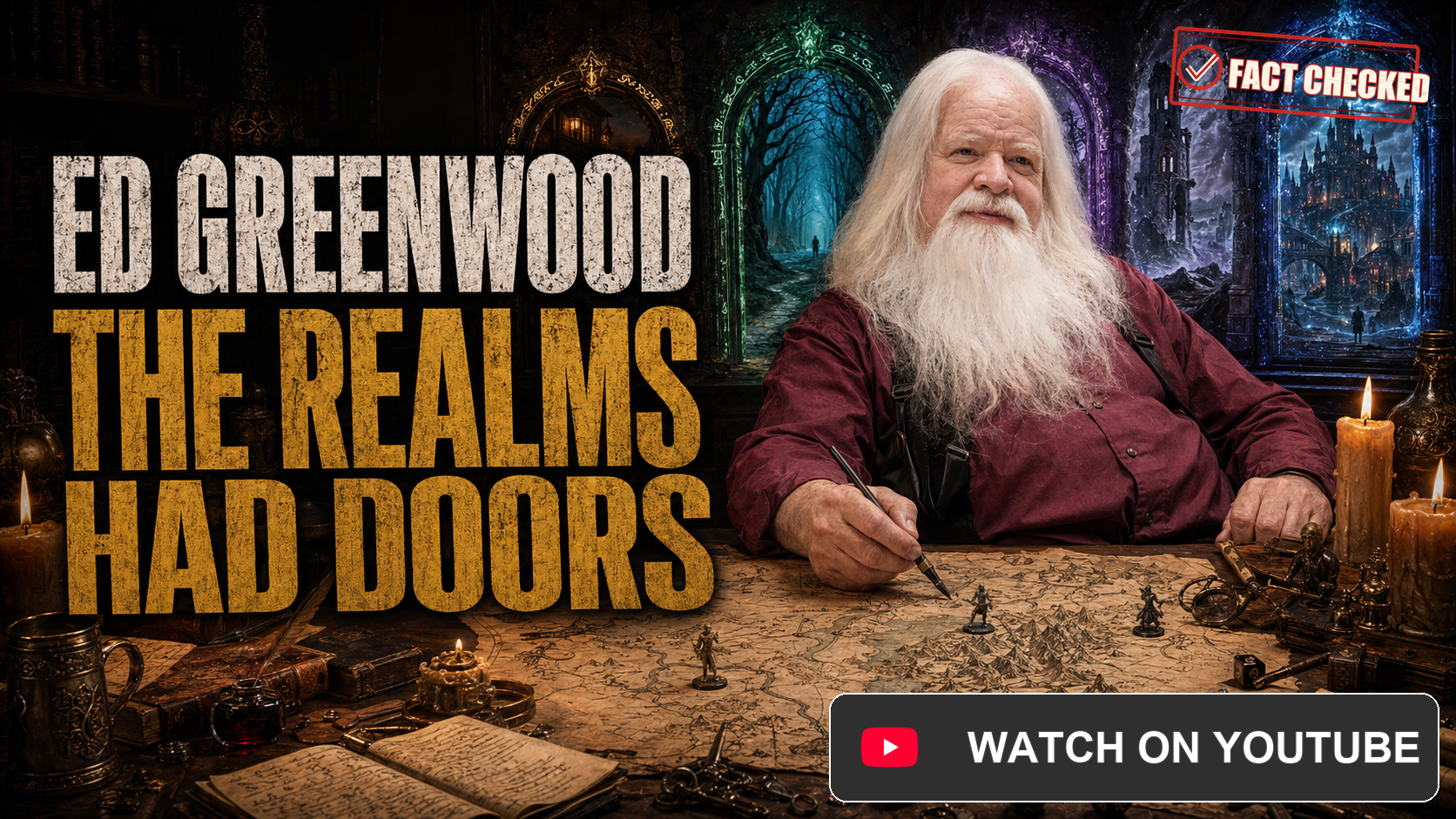
Ed Greenwood did not start the Forgotten Realms as a product line.
He started it as a place.
That difference matters.
Before the gray box, before Drizzt, before Baldur’s Gate, before the maps and sourcebooks and endless arguments about canon, there was a boy in Canada writing stories about another world. Greenwood’s own site dates that beginning to 1967, when he was eight years old. By 1975, he was using the Realms for his own Dungeons & Dragons games.
The public did not meet it all at once.
They met it in pieces.
A monster here. A bit of magic there. A wizard with too much history in his voice. A tavern, a kingdom, an old ruin, a spell, a name that sounded like it belonged to a place bigger than the paragraph it appeared in.
That was the trick.
The Realms always felt larger than the window you were looking through.
The World Before The Box
The most important thing to understand about Greenwood is that he built outward from use.
The Realms was not only fiction. It was not only a private notebook. It was not only an exercise in mapmaking. It was a place where people played.
That gave it a particular texture.
Some fantasy worlds feel like they were built to prove a thesis. Some feel like they were made to support one story. Some feel complete in a way that becomes sterile.
The Realms felt inhabited.
It had famous people, but it also had shopkeepers, sages, old grudges, unreliable rumors, secret doors, tavern gossip, local power, petty danger, and roads that implied other roads. Greenwood’s talent was not merely invention. It was density.
He made the world feel as if the player had arrived late.
That is a powerful game design move.
When a setting feels like it began when the player sat down, the player can enjoy it. When a setting feels as if it was already alive before the player arrived, the player begins to wonder what else is moving just out of sight.
The Realms became famous because it kept inviting that question.
The Dragon Magazine Doorway
Greenwood’s Dragon magazine articles gave readers glimpses of the Realms before TSR bought the setting.
Those pieces did something subtle. They made the Realms feel useful before it was official.
A Dungeon Master could take a spell, a monster, a bit of lore, or a strange little place and drop it into play. The article did not need to explain the whole world. It only needed to open a door.
That habit stayed with the Realms.
The best Forgotten Realms material is full of doorways.
Here is a merchant who knows more than he should.
Here is a road that disappears into old trouble.
Here is a city with politics deep enough to drown in.
Here is a wizard who seems absurd until you understand how much history he carries.
Here is a forest, a ruin, a god, a cult, a spellbook, a family line, a name on a map.
Use it now, or leave it alone.
It will still be there.
That is why the Realms worked so well for D&D. It did not only give players a place to visit. It gave Dungeon Masters an enormous menu of playable openings.
Designing For The Person Behind The Screen
Greenwood’s work also respected the Dungeon Master.
That may be the hidden craft in a lot of Realms material.
A campaign setting can drown a referee if it only delivers facts. Names, dates, rulers, gods, wars, and maps are useful only if they create decisions at the table. The Realms often gives a Dungeon Master something more valuable than certainty.
It gives playable tension.
This noble is helpful, but compromised.
This temple is holy, but political.
This road is safe, except when it is not.
This old wizard knows the answer, but the answer comes with trouble.
That kind of lore is not static. It is loaded.
A Dungeon Master can take it and immediately ask, "Who wants this? Who fears this? Who lied about this? What happens if the characters step into it tonight?"
That is where worldbuilding becomes game design.
Greenwood’s Realmslore has always had a strong sense of rumor, motive, appetite, and local consequence. Even when the material is dense, it usually wants to move. It wants to become a scene, a patron, a secret, a bargain, a clue, a journey, or a bad decision with a memorable bill.
That is why the setting keeps feeding campaigns.
The Gray Box
TSR purchased the Forgotten Realms in 1986, and the Forgotten Realms Campaign Set appeared in 1987.
That box changed the scale of Greenwood’s work.
The campaign set was not only a published setting. It was a transfer of a long-running, private, lived-in world into the shared bloodstream of Dungeons & Dragons.
Jeff Grubb’s role matters here. Greenwood was the creator of the Realms, but the published Realms was also shaped by TSR development, editing, art, cartography, and later by many other writers and designers. Grubb helped turn Greenwood’s deep private material into a form the public could use.
That credit boundary is important because the Realms became too large for any one person almost immediately.
Greenwood made the place.
TSR opened the gates.
Other creators moved in.
That is not a diminishment of Greenwood’s legacy. It is part of it.
A small setting can be controlled. A great shared setting has to survive other hands.
The Realms did.
Elminster And The Voice Of Lore
Elminster is easy to parody.
Old wizard. Pipe smoke. Secrets. Power. A fondness for appearing exactly when the story needs a voice from deep history.
But Elminster also shows something central about Greenwood’s design voice. Lore in the Realms often arrives as character.
It is not just a timeline. It is someone telling you what happened, and maybe leaving out what would hurt them. It is a sage who knows the official answer and the scandalous version. It is a powerful figure with opinions, habits, mistakes, affections, appetites, and enemies.
That is why Realmslore can feel different from setting exposition.
It has personality.
Greenwood’s worldbuilding often behaves like conversation. It invites interruption. It leaves room for contradiction. It carries the sense that history is not a museum display but a stack of arguments still happening in the next room.
For a tabletop setting, that is gold.
Players do not need a perfect encyclopedia. They need something to push against. They need information that can become action.
The Realms gives them both.
The Open-World Instinct
The Forgotten Realms became one of the central fantasy settings of D&D because it could hold almost anything.
That has been praised. It has also been criticized.
The setting is huge. It is crowded. It can feel over-detailed. It has been revised, exploded, restored, rebooted, adapted, novelized, digitized, and argued over for decades.
But the reason it can absorb so much is the same reason it became powerful in the first place.
The Realms was built with doors.
It can hold a city campaign, a dungeon crawl, a divine war, a murder mystery, a pirate story, a wizard duel, political intrigue, a road adventure, a heroic quest, a local problem, or a world-shaking event. It can be the place where a new player meets D&D for the first time or the place where an old fan spends years chasing deep lore.
That flexibility did not happen by accident.
It comes from Greenwood’s early habit of making small pieces feel connected to an unseen whole.
Every door suggests a room.
Every room suggests another corridor.
Every local answer suggests older trouble.
That is the Realms engine.
The Shared Legacy
Greenwood’s legacy is not that he personally wrote every famous Realms story.
He did not.
R.A. Salvatore’s Drizzt became a phenomenon in his own right. Video games brought whole generations to the Sword Coast. Designers, editors, artists, novelists, and players all added weight to the setting. Wizards of the Coast now stewards the official version. Many fans know the Realms first through Baldur’s Gate, Neverwinter, Icewind Dale, or fifth edition D&D rather than through Greenwood’s Dragon magazine work.
That is the honest shape of a living world.
But the foundation matters.
The reason all those later stories had somewhere to go is that Greenwood had already given the world depth, names, politics, magic, food, roads, taverns, danger, and old shadows.
The Realms became shared because it was roomy enough to share.
That is not easy.
Many invented worlds collapse when too many people enter them. The Realms became more famous because people kept entering.
Where To Find Him
Ed Greenwood is still publicly active through EdGreenwood.net, TheEdVerse, Patreon, video appearances, and ongoing Realmslore work. His official site describes him as the creator of the Forgotten Realms and continues to publish news and related material.
The essential tabletop stop is the 1987 Forgotten Realms Campaign Set, the gray box that brought Greenwood’s world to AD&D with Jeff Grubb and TSR’s team.
The essential design lesson is older than the box.
Do not build only what the players can see.
Build enough behind the door that they want to open it.
That is why the Realms lasted.
Not because every detail was nailed down forever.
Because the world kept feeling as if another door was waiting.
Fact Check Notes
Publication notes
This site is AI-assisted and human-reviewed. We use artificial intelligence to help gather research, organize source material, and draft profile content. Human editors then read, revise, and check each profile before it goes live. Most profiles are built through deep AI research and two separate rounds of fact-checking.