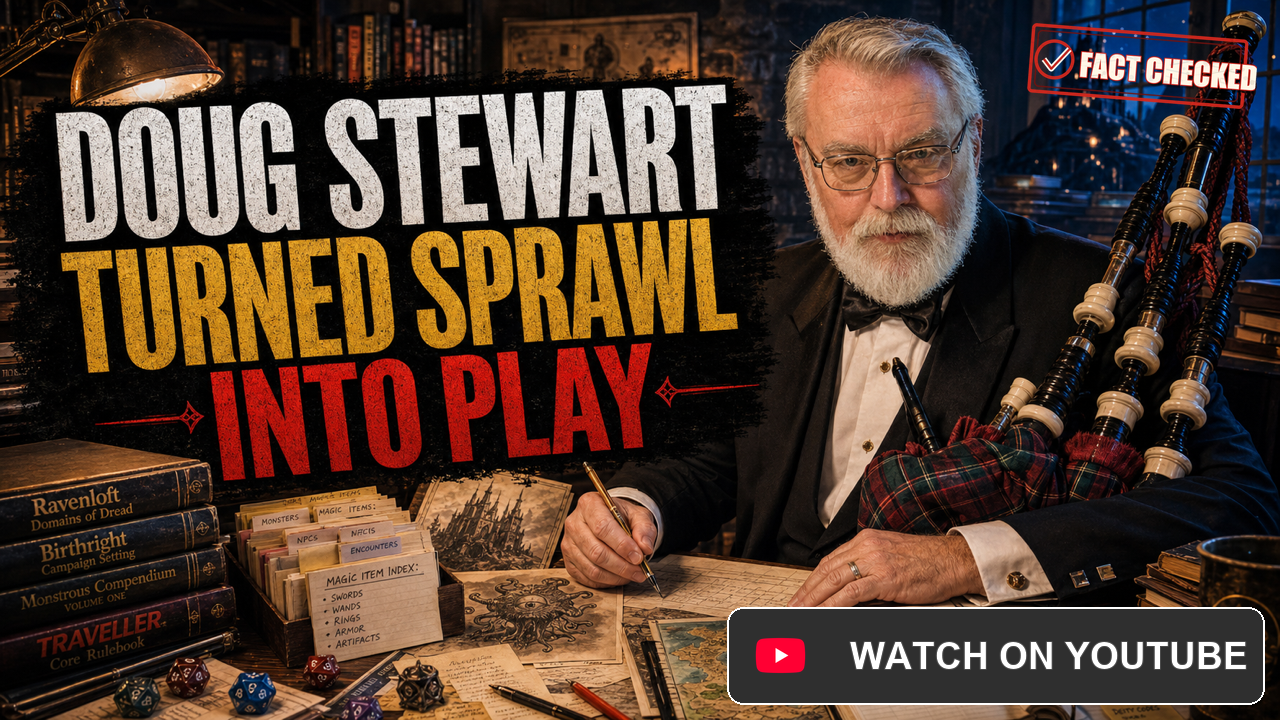
Doug Stewart is not an easy subject if you are looking for the usual game-designer biography.
The public record does not hand over a childhood story, a college story, a famous interview, or a neat origin myth. There is no clean, widely verified birth date in the sources I found. No public hometown arc. No long memoir explaining how he came to TSR.
What exists is work.
Credits pages. Editors’ lines. Development notes. Product histories. Books that came out near the end of TSR, when Dungeons & Dragons was carrying decades of accumulated material and the company was trying to make that material usable before the whole structure changed hands.
That is where Stewart becomes visible.
Not as the loudest auteur in the room.
As the person doing the hard structural labor: editing, developing, consolidating, organizing, and occasionally designing products that helped players and Dungeon Masters handle large, messy game lines.
His story is not "one famous invention."
His story is interface.
The Late Tsr Problem
By the early 1990s, D&D had a scale problem.
That is not an insult. It is what happens when a game survives. Monsters pile up. Magic items pile up. Settings multiply. Boxed sets multiply. Campaign worlds create sub-lines. Sub-lines create supplements. Supplements create exceptions. Exceptions create indexes. Players keep asking where something is. DMs keep trying to carry six books to the table.
Late TSR was full of imagination, but imagination had become heavy.
Stewart’s credits keep appearing in places where that heaviness needed shape.
He edited Spelljammer material. He edited Monstrous Manual. He developed and edited The Classic Dungeons & Dragons Game. He developed and edited Encyclopedia Magica. He edited Dark Sun, Birthright, Ravenloft, and other line material. He designed Player’s Secrets of Stjordvik. He wrote Castle Spulzeer. He contributed to Children of the Night: Ghosts. He also worked in Traveller with books like Naval Architect’s Manual and Missions of State.
That range says something.
He was not only dealing with one setting or one genre. He kept appearing where a line needed to become easier to enter, easier to reference, or easier to use.
The Monster Book You Could Carry
Monstrous Manual is a good place to start because its purpose was so practical.
AD&D’s monsters had been spread through Monstrous Compendium binders and appendices. That loose-leaf approach had a certain logic. It was modular. It could grow. It could be sorted. It also became cumbersome for ordinary play. Players and DMs wanted a single durable book.
Monstrous Manual answered that need.
Stewart’s credit there was editorial, not sole authorship. That distinction matters. The monsters came from a long lineage of designers, artists, editors, and prior books. But editing a monster book is not passive clerical work. A bestiary is an interface between imagination and table use. It has to make hundreds of creatures findable, readable, consistent enough, corrected enough, and durable enough that a DM can open the book in the middle of a session and keep moving.
That is the kind of work Stewart’s career keeps pointing toward.
Not making the dragon exist.
Making the dragon usable.
The Beginner Box And The Archive
The Classic Dungeons & Dragons Game shows the same instinct from the opposite direction.
Instead of helping experienced DMs carry an overloaded monster library, it had to teach new players how to enter the hobby. Its development and editing work put rules and play instruction into a guided structure. The point was not to impress people who already knew D&D. The point was to reduce the fear of the first session.
That is design too.
Teaching is design. Layout is design. What gets introduced first is design. What gets hidden until later is design. A beginner box succeeds when the reader stops thinking about the rulebook and starts imagining the next room.
Then there is Encyclopedia Magica, the extreme version of Stewart’s consolidation pattern.
The premise was almost absurd in scale: gather magic items from years of D&D publications, organize them, index them, and make them usable again. It was archive work, but not dead archive work. A magic item book is only useful if the DM can actually find something, understand it, and decide whether it belongs in the campaign.
The first volume won the Origins Award for Best Roleplaying Supplement of 1994. Reviewers recognized the diligence. They also saw the risk. An archive can become exhausting if completeness outruns usefulness.
That tension is exactly why the project matters.
Stewart’s strongest work lived inside that tension: how do you respect the accumulated game without burying the table under it?
Birthright, Ravenloft, And The Modular Adventure
Player’s Secrets of Stjordvik gave Stewart a more authored design lane.
Birthright was a setting about rulership, bloodlines, politics, territory, and domain play. A domain sourcebook had to do more than describe scenery. It had to make a realm playable. Who holds power? Who threatens it? What does the player rule? What is unstable? Where are the hooks?
Stjordvik fit Stewart’s structural habits. It was about making a place operable.
Castle Spulzeer moved in a different direction. It tied Forgotten Realms material into Ravenloft horror, using investigation, haunted-castle structure, and crossover logic. That kind of adventure can easily collapse into confusion: too much backstory, too much setting baggage, too many handoffs between tones. Stewart’s assignment was to make the crossing playable.
Children of the Night: Ghosts shows the modular version of the same thing. Ravenloft ghost entries were not just monster listings. They were scenario seeds, character problems, curses, histories, and miniature dramas that a DM could insert into play.
Again, the pattern repeats.
Not just content.
Usable content.
The Traveller Toolkit
Stewart’s Traveller work helps prove the pattern was not limited to D&D.
Naval Architect’s Manual was a toolkit. It helped players and referees build ship interiors, stations, bases, and related spaces. Missions of State dealt with noble and political play. Different system. Different genre. Same kind of design problem.
How do you give a table enough structure to create something larger than a single scene?
How do you make a big imaginary machine operable?
That is why Stewart’s credits are more coherent than they first look. D&D monsters, beginner rules, magic items, domain politics, haunted castles, ghost mini-adventures, starship interiors, noble intrigue. On the surface, that is a scattered resume.
Underneath, it is one job asked in different accents.
Make the large thing playable.
What He Actually Built
Doug Stewart did not create D&D. He did not create AD&D 2nd Edition. He did not invent the Monstrous Manual’s creatures, the entire Encyclopedia Magica archive, Birthright, Ravenloft, Spelljammer, Dark Sun, or Traveller.
What Stewart built was usability inside sprawl.
He helped turn monster overload into a durable book.
He helped turn beginner friction into a guided entry point.
He helped turn years of magic-item accumulation into a reference architecture.
He helped turn setting politics into playable domain pressure.
He helped turn haunted lore and crossover setting material into adventures a DM could actually run.
That may not sound glamorous. It is also one of the most important kinds of work in a long-running roleplaying game.
Because games do not only need ideas.
They need handles.
They need tables, indexes, clear instructions, edited prose, useful structures, and enough judgment to know when the reader is about to drown.
Stewart’s visible legacy is not a monument. It is a set of handles on enormous old doors.
The Company Falling Around The Work
Stewart’s late-TSR credit cluster sits close to the company’s collapse and sale to Wizards of the Coast.
That context matters. These books were not produced in a calm golden age with infinite runway. They came from a company under pressure, with product lines sprawling, finances tightening, and the old TSR model nearing its end. In that environment, consolidation was not just convenience. It was survival behavior.
Make the monster book easier to use.
Make the beginner product easier to enter.
Make the magic-item archive easier to search.
Make the setting sourcebook easier to run.
That is not flashy design. It is triage with craft.
Where To Find Him
This is where the public record becomes thin.
I did not find a reliable current public profile, recent interview, or obituary for Doug Stewart. The safest statement is that his well-documented public game-design trail belongs mainly to the 1990s, especially the late TSR period and nearby Traveller work. Later reissue pages, fan databases, archives, and old product credits keep his name alive through the books rather than through a visible public platform.
That fits the rest of the story in a strange way.
Some designers remain visible because they built a persona.
Stewart remains visible because DMs still open the tools.
The Monstrous Manual. Encyclopedia Magica. Classic D&D teaching material. Birthright domain play. Castle Spulzeer. Ravenloft ghosts. Traveller toolkits.
The name is quiet.
The work is still on the shelf.
And when a Dungeon Master opens one of those books looking for a way to make too much material manageable, Stewart’s real contribution is still there.
He turned sprawl into play.
Fact Check Notes
Publication notes
This site is AI-assisted and human-reviewed. We use artificial intelligence to help gather research, organize source material, and draft profile content. Human editors then read, revise, and check each profile before it goes live. Most profiles are built through deep AI research and two separate rounds of fact-checking.