That is the cleanest way to read the record.
He was a Canadian Army officer with a mathematics degree from the Royal Military College. He served in the Corps of Electrical and Mechanical Engineers. That background matters because Perrin’s game work keeps returning to the same instinct: where are the pieces, how does the load move, and what happens when a system is pushed past normal tolerance?
Then, in the mid-1990s, he entered the collectible card game boom.
Most people chasing that boom were chasing Magic.
Perrin brought a wargamer’s eye to the table.
Lanes On The Table
Mag Force 7 began inside the orbit of Margaret Weis’s Star of the Guardians novels. Perrin and Weis founded the company, and the name itself came from that fictional universe. The timing was dangerous. Magic: The Gathering had exploded, and the market was suddenly full of publishers trying to turn every property into a collectible card game.
Perrin’s Star of the Guardians CCG arrived in 1995.
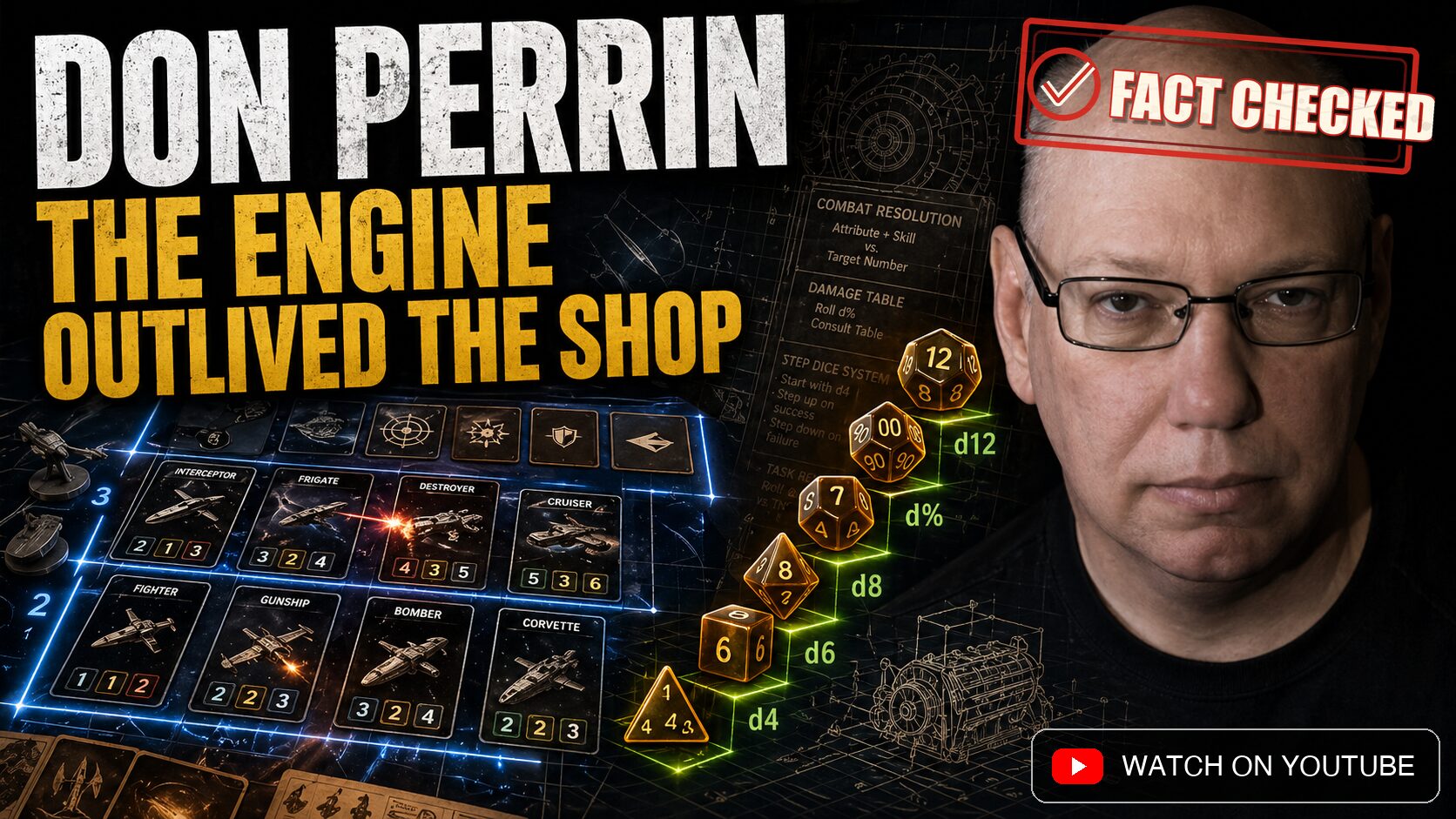
Its most interesting idea was spatial. Ships were not simply played into an abstract combat zone. They occupied lanes. Position mattered. A player had to think not only about card strength, but about placement, blocking, and how a line of battle developed across the table.
That was not the dominant CCG language of the moment.
Magic had taught the market to think in creatures, attacks, blockers, and abstract zones. Perrin’s instinct was different. He wanted card combat to care about where things were.
That same broad idea traveled into other licensed card-game work, including Wing Commander and Star Trek: The Card Game. The details changed, and other designers were involved, but the shared impulse is clear: make the card table more like a tactical space.
It was a smart synthesis.
It was also badly timed.
The CCG market was already filling with more product than players could absorb. Distribution, print runs, and license expectations could crush a good mechanical idea before it had time to find a community. The lane idea did not become a design lineage. It did not reshape collectible card games. It became a road not taken.
Still, it shows what Perrin was trying to do.
He was turning cards into positions.
The Step-Die Engine
After the card-game crash, Perrin moved deeper into role-playing design.
The important system was Sovereign Stone, first published in 1999 and co-designed with Lester Smith. It grew out of Larry Elmore’s fantasy world of Loerem, with Margaret Weis and Tracy Hickman tied to the fiction. The rule engine was not a d20 clone. It used step dice.
Attributes and skills were rated by die type. A character might roll an attribute die plus a skill die, add the results, and compare the total to a target number. Bigger competence meant bigger dice. That is easy to understand at the table. You feel improvement in the hand before you calculate it on the page.
Step-die thinking was not invented by Perrin and Smith. Earthdawn had important prior art. The point is not that Sovereign Stone created the idea from nothing.
The point is how the pieces were assembled.
Sovereign Stone paired the step-die core with exertion, stun, wounds, and magic that demanded time and risk. Characters could push beyond normal limits, but that push cost them. Damage was not just a number ticking downward. Stun and wounds pressed from different directions. Magic was not a simple slot economy. Casting took effort, rolls, time, and bodily consequence.
That is the military-mechanic mind again.
A system should have load.
The Bad First Machine
The problem was not only the rules.
Sovereign Stone’s first edition had a reputation problem almost immediately. Reviews praised parts of the underlying system while criticizing the book’s presentation, layout, organization, and production choices. The mechanical engine had strengths. The first package made those strengths harder to see.
That can kill a tabletop system.
Role-playing games live or die by first contact. A group has to read the book, understand the loop, trust the examples, build characters, and believe the game will reward the effort. If the rules arrive in the wrong order or the design is buried under confusing presentation, the system may never get the second chance its mechanics deserve.
Sovereign Stone did get a revised edition.
By then, the window was narrow. Dungeons & Dragons Third Edition and the d20 boom were reshaping the RPG market. A smaller original fantasy system had to fight not only for attention, but for table time against a new industry standard.
The engine worked.
The shop around it struggled.
Dragonlance And The Professional Turn
Perrin’s most visible RPG credit came through Dragonlance.
The Dragonlance Campaign Setting for Dungeons & Dragons 3.5 appeared in 2003, with Jamie Chambers as lead designer and Margaret Weis, Don Perrin, and Christopher Coyle among the authors. That book mattered because it returned one of D&D’s most famous worlds to active official tabletop support under the new edition.
This was not the same kind of work as Sovereign Stone.
It was not an original engine. It was adaptation, stewardship, and franchise support. The job was to make Krynn function inside the d20 rules environment, not to invent a new resolution system from scratch.
But that kind of work counts.
Licensed and legacy worlds need people who can translate love into procedure. They need someone to decide what belongs in a prestige class, how old story material becomes player-facing rules, and how a setting with decades of emotional weight can survive contact with a new edition’s math.
Perrin was part of that work.
The Cortex Ancestry
The Sovereign Stone engine did not vanish when Sovereign Press changed shape.
Its most important afterlife runs through the Cortex family. Jamie Chambers later built Cortex for the Serenity Role Playing Game, published by Margaret Weis Productions in 2005. Cortex used step-die logic in a new licensed-game context, then grew through Battlestar Galactica, Supernatural, and other lines. Cam Banks later pushed the family further into Cortex Plus and Cortex Prime.
Perrin should not be given sole credit for Cortex.
That would be wrong.
Sovereign Stone was co-designed with Lester Smith. Cortex was Chambers’s adaptation and expansion. Cortex Plus and Cortex Prime belong heavily to Banks and later development. The lineage is not a straight line from one designer’s hand to one later system.
But the ancestry is real.
Sovereign Stone helped put a step-die vocabulary into the Margaret Weis Productions bloodstream. Later designers used that vocabulary differently, tuned it for different licensed worlds, and carried it further than the original game ever traveled.
That is why Perrin’s contribution is strange.
His mechanics outlived the storefront.
After Design
Perrin did not remain a visible system designer forever.
His public record after the early 2000s shifts toward operations, publishing, and professional life outside game design. He served as president of GAMA, the Game Manufacturers Association. He worked with miniatures and wargaming publishing, including Historical Miniature Gamer Magazine, which won an Origins Award. Later public biographies place him in IT and product-management work while continuing to write and play games.
That track fits the larger shape of the career.
Perrin was always closer to systems, engines, and organizations than to celebrity design. He built inside companies. He worked on licensed products. He co-designed. He edited, managed, published, and moved on.
The name did not become a brand.
The work left traces anyway.
What He Actually Built
Don Perrin did not create Cortex by himself.
He did not invent step dice. He did not build a long solo catalog of famous games. The lane-based card-combat idea did not become a major adopted school of CCG design.
What he built was a set of useful mechanical bridges.
He brought spatial thinking into collectible card combat when most CCGs were still learning how to exist. He co-built an RPG engine that treated ability as dice, effort as cost, damage as pressure from more than one direction, and magic as accumulated strain. He helped bring Dragonlance into the d20 era. He served the field through GAMA and wargaming publishing.
That is a modest legacy compared to the giants.
It is not empty.
Perrin’s career sits in the uncomfortable space between invention and visibility. Some of the ideas were strong. Some of the products were badly timed. Some of the later influence traveled through other people’s hands.
That happens in game design more often than the credit lines admit.
Where To Find Him
Perrin maintains a public website at donperrin.com. His biography there describes his Canadian military background, writing, game work, and later professional life in Las Vegas. His bibliography lists his game and fiction credits, including Sovereign Stone, Dragonlance, Wing Commander, Star of the Guardians, and related work.
He is not currently visible as a designer releasing major new tabletop systems.
That is fine. Not every designer stays in the same shop forever.
The interesting part is what kept moving after the shop changed. The lane-to-lane idea remains a glimpse of a card-game path the market did not take. Sovereign Stone remains one of the ancestors behind the wider step-die conversation that later found a larger audience through Cortex. Dragonlance remains the visible licensed-world credit most players are likely to recognize.
Perrin built what he knew.
Machines. Systems. Load-bearing parts.
Some of them broke in the market. Some were rebuilt by others. Some kept running under a different name.
That is still a designer’s mark.
Fact Check Notes
Publication notes
This site is AI-assisted and human-reviewed. We use artificial intelligence to help gather research, organize source material, and draft profile content. Human editors then read, revise, and check each profile before it goes live. Most profiles are built through deep AI research and two separate rounds of fact-checking.
Leave a Reply
You must be logged in to post a comment.