For more than twenty years, social deduction had a problem it treated like a law of nature.
People got eliminated.
Someone had to moderate.
That was just how the form worked. Mafia and Werewolf created extraordinary table energy, but they also carried two obvious wounds. A player who died early might spend the rest of the game watching. A moderator gave up playing so the group could have structure. The genre was thrilling, but it was also logistically awkward and socially wasteful.
Don Eskridge looked at those inherited problems and cut them out.
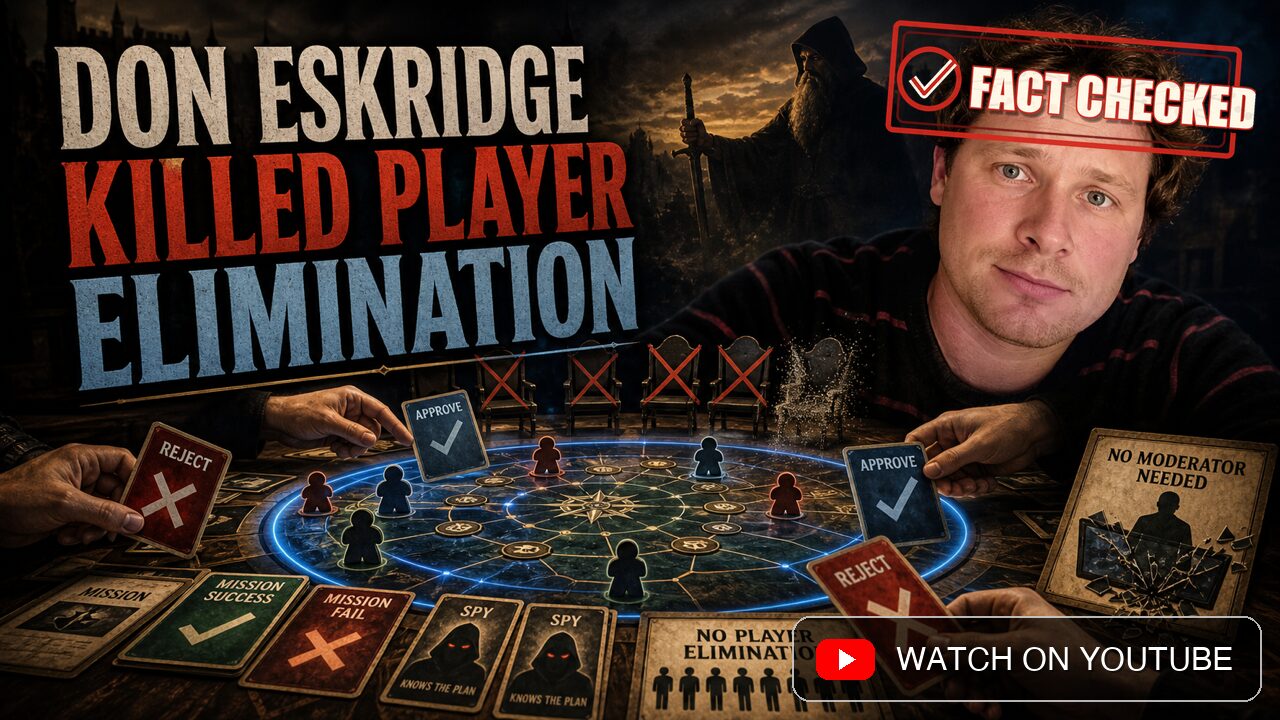
The Resistance replaced the elimination loop with a mission-vote structure. A leader proposes a team. The table votes to approve or reject it. If the team goes, the chosen players secretly submit success or failure cards. The mission result generates new information. No one leaves. No one moderates. The game produces deduction from public choices and private outcomes.
That sounds simple now.
It was not simple before The Resistance made it obvious.
The Structural Fix
The genius of The Resistance is not that it contains hidden roles.
Hidden roles already existed.
The genius is where the information comes from.
In Mafia, the central public act is accusation and execution. The table talks, votes, removes someone, then tries to interpret what the removal meant. That structure creates drama, but it also creates downtime and early exit.
The Resistance changes the unit of drama.
You are not voting to kill a person.
You are voting to trust a team.
That one shift does a lot of work. Every proposed team becomes evidence. Every yes vote and no vote becomes evidence. Every failed mission becomes evidence. The spy team must decide when to sabotage, when to hide, and when to let suspicion fall elsewhere. The good team must read not only outcomes but the shape of every proposal.
The game is deduction through process.
The machine runs because players keep making visible decisions under hidden incentives.
The Free Print-And-Play
The Resistance began humbly.
Eskridge first encountered hidden-role play through Werewolf while abroad in France. Later, he developed his own answer to the form and posted The Resistance as a free print-and-play on BoardGameGeek. Indie Boards & Cards picked it up and published it in 2009.
That origin matters because the game feels like a design solved at the table, not a product line engineered from the top down.
The published version became a staple of game nights because it removed friction. It played with a crowd. It required no moderator. It kept everyone involved. It created suspicion quickly. It gave the quiet player something visible to analyze even if they did not dominate the argument.
In social deduction, logistics are design.
The Resistance understood that better than almost anything before it.
The Missing Moderator
Removing the moderator was as important as removing elimination.
A moderator can be wonderful. In the right game, that person becomes pace, atmosphere, rules memory, and dramatic timing. But a moderator is also a cost. One person must know the procedure, stay outside the struggle, and donate their evening to everyone else’s suspicion.
The Resistance made the table self-operating.
That changed who could bring it out. You did not need a specialist. You did not need someone willing to sit apart from the game. The rules produced phases, votes, missions, and reveals without a human referee managing night actions.
That logistical elegance is part of why the design traveled.
The game was not only clever.
It was easy to host.
Avalon And The Knowledge Problem
The Resistance: Avalon looks like a medieval reskin until you see what Merlin does.
Merlin knows too much.
That is the role’s entire brilliance.
Merlin knows who the evil players are, but if Merlin is too obvious, the evil team can identify Merlin at the end and steal the win. The good team has a source of truth, but that source must speak through implication, nudges, hesitation, and plausible uncertainty.
This created one of modern social deduction’s most durable tensions:
The danger of being visibly correct.
Many hidden-role games make ignorance the central problem. Avalon makes knowledge dangerous. The informed player must guide without revealing the fact of guidance. The uninformed players must decide whether a helpful voice is genuinely wise, lucky, manipulative, or bait.
That is a different texture from base Resistance.
It deepens the game without adding a moderator or restoring elimination. The core structure remains intact. The new role changes the social temperature.
The Information Paradox
Eskridge’s best designs circle around the social cost of knowledge.
What do you reveal?
When do you reveal it?
How do you make someone believe you without making the wrong person notice?
The Resistance turns voting records into evidence. Avalon turns accurate knowledge into a liability. Dune: Betrayal takes the hidden-agenda structure into a licensed world built around prophecy, factions, and knife-edge suspicion. Spies & Lies compresses deduction into a two-player head-to-head format. Abandon Planet and Black Hole Council move toward negotiation, hidden goals, and the problem of collective survival when everyone has private incentives.
The forms change.
The pressure remains.
People need each other.
People cannot fully trust each other.
That is Eskridge’s weather.
The Broader Portfolio
Eskridge founded Orange Machine Games and worked beyond The Resistance family.
Abandon Planet is a negotiation game about escaping Earth as disaster arrives. Black Hole Council is a hidden-goals negotiation game. Spies & Lies: A Stratego Story adapts deduction to a two-player licensed format. Dune: Betrayal brings social deduction into Gale Force Nine’s Dune line. Quest revisits the Resistance and Avalon space with a streamlined structure. Umami, listed through Czech Games Edition for 2025, shows him still publishing outside the original Resistance shadow.
That range matters.
It shows a designer trying to move outward from one breakthrough into adjacent problems: negotiation, two-player deduction, licensed IP, lighter card play, and new social structures.
But the boundary is visible too.
Nothing else has matched The Resistance.
That is not an insult. Most designers never make one game that rewires a genre’s assumptions. But Eskridge’s career is shaped by the fact that the first major design remains the clearest and most influential statement.
The Post-Resistance World
After The Resistance, social deduction changed.
Not every later game copied its exact mission structure. Many did not. But the genre could no longer pretend that early elimination and moderator dependency were inevitable. Designers had to make a choice.
Keep elimination and justify it.
Remove elimination and find another pressure system.
Use an app, a script, a night phase, a storyteller, a rotating procedure, or a self-running structure.
That is influence at the level of assumption.
Secret Hitler uses a nomination-and-vote political structure that clearly lives in the post-Resistance design world. Deception: Murder in Hong Kong uses an informed clue-giver who must communicate indirectly, echoing the Merlin problem in a different form. One Night Ultimate Werewolf, Blood on the Clocktower, and many later games all exist in a field where “what happens to eliminated players?” has become a design question rather than a given.
The Resistance did not end every old model.
It made the old model answer for itself.
The Clean Machine
The core system is elegant because it is small.
Roles are binary at first. Resistance members and spies. The public procedure is clear. Team proposal, vote, mission, result. The private action is simple. Success or fail. The consequences are social, not mathematical.
That smallness is why the game works with intense argument.
The rules do not compete with the table. They create a structure, then get out of the way. Players can focus on timing, tells, voting patterns, confidence, hesitation, framing, memory, and persuasion.
A heavier system would have smothered it.
The Resistance is not trying to simulate espionage in detail.
It is trying to create the feeling of being in a room where the vote itself is evidence and every person wants control of the next team.
The Honest Boundary
Eskridge transformed an existing genre.
He did not invent hidden roles. He did not invent social deduction from nothing. Mafia and Werewolf were already there, and their table energy made The Resistance possible. His achievement was surgical: find the inherited damage, remove it, and replace it with a structure that generated equal or greater tension.
That is a different kind of invention.
The other boundary is concentration.
Eskridge has a broader catalog than people sometimes remember, but the gravitational center remains The Resistance and Avalon. His later work is competent, varied, and often interesting. It has not displaced the original breakthrough.
So the clean claim is this:
Don Eskridge did not create social deduction.
He made modern social deduction prove it did not need to send people out of the room.
What Remains
What remains is the no-elimination default.
Not as an absolute rule, but as an expectation. If a modern social deduction game removes a player early, players notice. If it needs a moderator, groups ask whether that cost is worth paying. If the game runs itself and keeps everyone involved, it is living in territory The Resistance helped normalize.
What remains is Merlin.
The player who knows too much and must act less certain than they are.
What remains is the team vote.
The proposal that becomes evidence. The approval that becomes evidence. The failure that becomes evidence. The table that teaches itself who to suspect by watching who everyone is willing to trust.
Eskridge’s best idea was not a new monster or map or scoring trick.
It was a room full of people who all stayed in the game.
That changed the genre.
Fact Check Notes
Publication notes
This site is AI-assisted and human-reviewed. We use artificial intelligence to help gather research, organize source material, and draft profile content. Human editors then read, revise, and check each profile before it goes live. Most profiles are built through deep AI research and two separate rounds of fact-checking.
Leave a Reply
You must be logged in to post a comment.